
Using hospitals
Community clinic, general hospital or specialist hospital?
Compare community clinics, general hospitals and specialist hospitals in China by service, campus, passport access, language, insurance and follow-up.
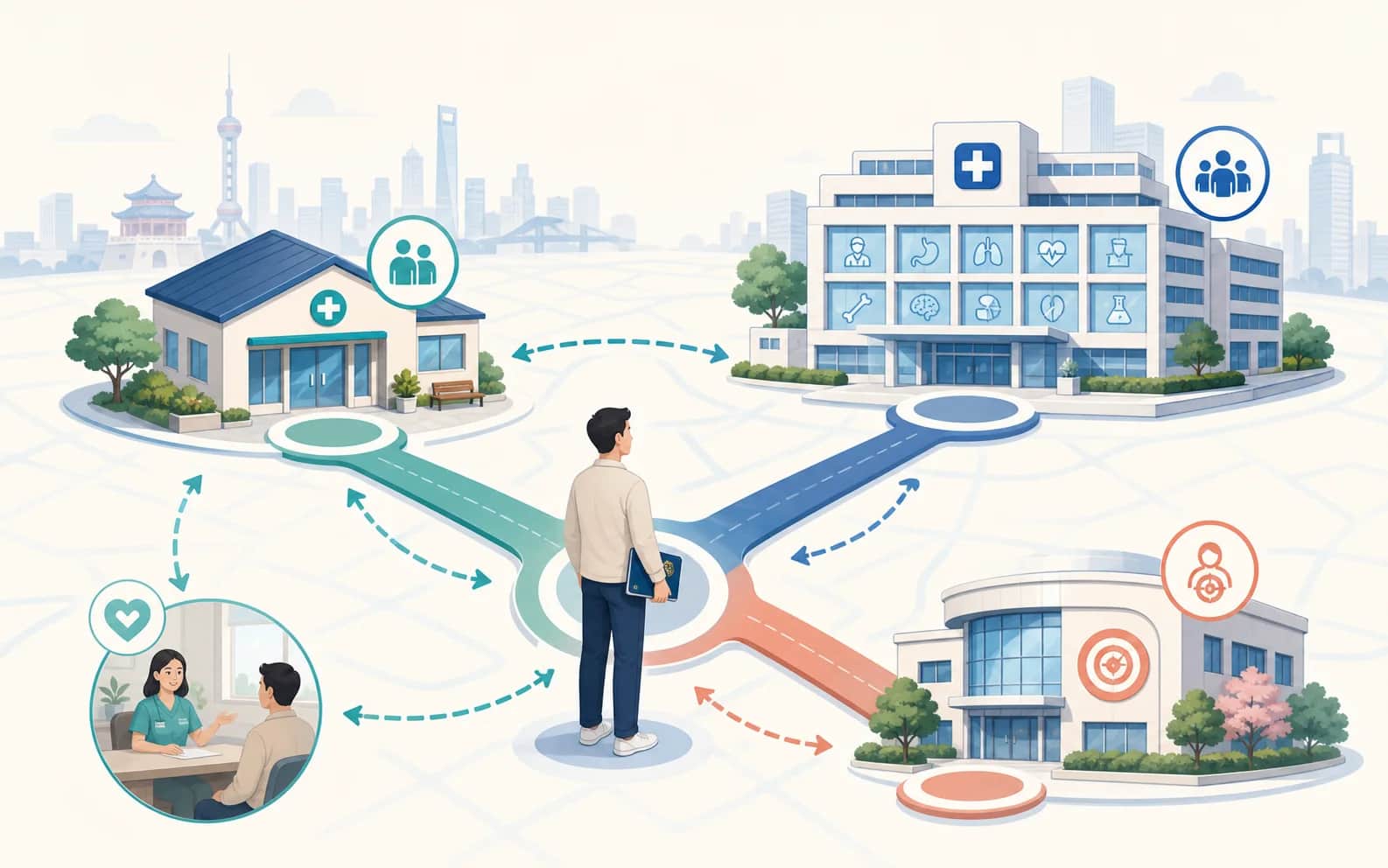
The useful question is not simply whether a community clinic, general hospital or specialist hospital is ‘better.’ These labels describe different institutional roles, while an actual visit depends on urgency, the exact service and campus, appointment or referral rules, registration documents, language support, payment, insurance and the route for results and follow-up. A community health service centre may be a practical first contact for ordinary local care or stable continuing needs; a general or family-medicine service can also provide first-contact assessment inside a clinic or hospital network; a general hospital brings many departments and support services together; and a specialist hospital concentrates on a defined population or field. None of those descriptions selects care for an individual. Use this guide to ask the right administrative questions, then let a qualified professional and the receiving provider decide the clinical route.
Use this as a practical starting point
Provider procedures can change, so confirm time-sensitive details with the hospital, insurer or service. A licensed professional must make clinical decisions for an individual patient.
At a glance
Key points
- Start with the provider's emergency instructions when care may be urgent; an institution-comparison page is not a triage tool.
- Community health centres and stations are primary-care access points, but their departments, tests, medicines, hours and foreign-document workflows differ locally.
- Family medicine or general practice describes a first-contact clinical route and can exist in a community facility, clinic network or comprehensive hospital.
- A general hospital normally offers several departments and shared diagnostic or inpatient services; the exact campus may still lack the service you need.
- A specialist hospital focuses on a field or population, but can contain many sub-specialties and may require a specific clinic, age group, referral or appointment.
- Secondary, tertiary and Grade A labels describe institution-level roles or accreditation; they do not rank every department, clinician or outcome for an individual.
- For a foreign passport holder, verify registration, language, payment and insurance separately from the clinical service itself.
- A successful visit ends with a result-review and follow-up route, not merely with registration, payment or completion of a test.
1. Separate urgency from the choice of institution
Provider comparison is appropriate only after the emergency boundary is clear. If a situation may require immediate help, use the provider's current emergency instructions or call 120 rather than spending time comparing hospital grades, online ratings or routine appointment pages. A community facility may publish urgent support, and a hospital may publish an emergency department, but a directory label does not prove that the exact location is equipped or open for the situation in front of you.
For a planned or non-emergency visit, define the administrative task without diagnosing yourself. Useful descriptions include a first assessment for a new concern, continuing care already managed by a clinician, a named specialist follow-up, a test ordered elsewhere, a prescription review, vaccination, rehabilitation or review of an existing report. That description lets a registration desk or clinician identify a route without forcing the patient to guess a disease or department from search results.
- Emergency or possibly time-critical: use emergency instructions or 120
- New non-emergency concern: ask for an appropriate first-contact or triage route
- Known follow-up: name the clinician, department, diagnosis record or prior order
- Administrative task: identify the exact test, report, prescription, certificate or referral involved
This page cannot determine urgency or choose a clinical service for an individual. When in doubt, seek qualified clinical guidance instead of relying on the facility label.
2. Understand what a community health facility can be
China's primary-care network includes community health service centres and stations, township health centres, village clinics and other locally organized access points. National planning places these facilities around basic outpatient care, prevention, health management, family-doctor services and links with higher-level providers. That is an institutional direction, not a promise that every neighbourhood location has the same clinicians, laboratory, imaging, pharmacy, vaccination service, rehabilitation service or appointment system.
A community facility can be especially useful when location, continuity and local follow-up matter. It may hold a resident health record, support stable chronic-care follow-up, administer locally available public-health services or coordinate a referral. Yet one centre may offer a service that the next does not; a station can have a narrower scope than its supervising centre; and evening, weekend or holiday coverage can change. Confirm the legal name and address of the exact facility rather than relying on a map label that says only ‘community clinic.’
- Ask whether the location is a centre, station, clinic or another type of primary facility
- Confirm the department or service, clinician schedule and whether an appointment is required
- Ask whether the required test, medicine or procedure is performed or dispensed there
- Confirm whether follow-up and referral records can be shared with the receiving provider
3. Keep family medicine separate from the building label
‘Family medicine,’ ‘general practice’ and ‘community health centre’ are related ideas but not interchangeable labels. Family medicine or general practice describes a clinical approach and first-contact route. It can be offered in a public community facility, a private clinic network or a department inside a large comprehensive hospital. The University of Hong Kong-Shenzhen Hospital, for example, publishes a Department of Family Medicine alongside emergency, medicine, surgery and specialist services; Jiahui publishes family-medicine clinicians and locations inside its wider health network. These are provider examples, not national access rules.
A generalist route can help organize an undifferentiated non-emergency concern, medication or record review, continuing care and referral when another service is needed. It is not automatically the same as signing a local family-doctor service agreement, creating a resident electronic health record or obtaining basic-insurance benefits. Those administrative layers can have separate eligibility, address, identity and local-platform requirements. Ask whether you are booking an ordinary consultation, a contracted family-doctor service or both.
Do not reject a useful first-contact route merely because it is inside a hospital, and do not assume every neighbourhood clinic provides the same family-doctor contract or record services.
4. Use a general hospital for breadth, not as a universal default
A general or comprehensive hospital normally brings several clinical departments together with shared laboratory, imaging, pharmacy, emergency, inpatient and support services. The published clinical-services directory for the University of Hong Kong-Shenzhen Hospital lists medicine, surgery, obstetrics and gynecology, pediatrics, emergency, family medicine, imaging, pathology, pharmacy and rehabilitation among other services. Jiahui International Hospital similarly publishes family medicine, multiple specialties, focused centres and emergency care. These examples show breadth; they do not prove that every general hospital offers the same route.
Breadth can reduce the number of external handoffs when several services may be needed, but a large hospital still has separate campuses, buildings, departments, appointment types and payment points. A hospital name in an insurer directory or search result does not tell you which campus has the clinic, whether the department accepts a first visit, whether a test can be completed the same day, or whether an international service shares the same entrance as the general outpatient route. Verify each layer before travel.
- Exact hospital and campus, not only the hospital group
- Exact department, clinic type and age or patient-group limits
- Routine outpatient, international service, special medical service or emergency route
- Availability of the named test, treatment, pharmacy or inpatient handoff
5. Read ‘specialist hospital’ as a focus, not a shortcut
A specialist hospital concentrates on a defined population, organ system or field. That focus can make its departments, equipment and referral relationships especially relevant when the required service is already known. It does not mean the hospital has only one department. Shanghai Children's Hospital, for example, publishes a special medical-service route covering many pediatric medical, surgical and support specialties across named campuses. The unifying focus is the patient population, while the operational route still depends on the exact pediatric department and location.
Specialist status also does not prove that the hospital accepts every stage of care. Some focused services may expect a confirmed diagnosis, prior imaging, pathology, a referral or an initial assessment elsewhere; other services may accept first visits. Age, pregnancy status, disease area or required procedure can define the scope. Ask the hospital whether the clinic receives a new undiagnosed patient, a confirmed referral, a second opinion, a procedure booking or follow-up after treatment, and what records must arrive first.
A specialist hospital can be the right receiving provider without being the right first contact. The provider and a qualified clinician must confirm the route.
6. Do not turn secondary, tertiary or Grade A into a personal ranking
Secondary and tertiary labels describe broad institutional roles in a tiered system. Current national measures position primary facilities around common-condition and stable chronic-care access, secondary hospitals as a bridge, and tertiary hospitals around critical, complex, referral and inpatient work. Accreditation labels such as Grade A describe institution-level frameworks. None of these labels chooses a clinician, measures one department against another or guarantees that a particular patient will receive faster access or a better outcome.
Going directly to the largest tertiary hospital can add travel, registration and queue complexity without solving a department mismatch. Starting locally can also be inappropriate when the required service is unavailable or a receiving specialist route is already established. Treat level as one piece of context. Compare the exact clinical service, current appointment, campus, emergency capability, referral rule and follow-up plan instead of assuming that ‘higher’ always means ‘better for me.’
- Institution level is not a department ranking
- Accreditation is not an appointment or outcome promise
- A famous main campus does not prove the same service exists at every branch
- Online popularity does not replace provider confirmation or clinical judgment
7. Verify the foreign-patient access layer separately
Clinical capability and foreign-patient access are different questions. A facility may offer the needed department yet have a registration channel that requires an original identity document, a staffed desk for passports, a local mobile number or a different route from Chinese-ID self-service. Peking Union Medical College Hospital publishes both general outpatient registration notices and a distinct International Medical Services route with its own booking and service information. That is one provider's structure; it must not be copied to another hospital.
Before leaving, ask whether the exact campus and clinic can create or retrieve a patient record using the passport or other document you will carry. Confirm whether the spelling and document number must match a previous record, appointment, insurer file and payment receipt. If an app, mini-program or kiosk cannot process the document, ask for a staffed or telephone alternative rather than creating duplicate identities or borrowing another person's account.
- Accepted original identity document and whether a copy is also needed
- First-visit patient-record creation and the route for returning patients
- Mobile-number, app, mini-program, kiosk or staffed-desk requirements
- Whether a child's or dependant's registration needs a guardian and relationship documents
8. Compare language, cost and insurance as independent layers
An English page, international office or multilingual coordinator can make navigation easier, but it does not prove that every clinician, test area, pharmacy, billing desk or overnight service has the same language support. United Family and Jiahui publish provider-specific coordination and international-patient services; other facilities may require a booked interpreter, a companion or written translation. Ask who provides language support, at which stages, during which hours and whether a fee applies.
Insurance must be checked at the patient-policy-service level. A provider logo in an insurer network, a hospital's partner list or the presence of an international department does not guarantee direct billing. Confirm the exact legal provider, campus, department, date, planned service, authorization or guarantee-of-payment requirement, deductible, copayment and exclusions. Ask for a self-pay estimate and claim-document route even when direct billing is expected, because an unapproved or excluded part can remain payable by the patient.
Service comfort, clinical capability and insurance settlement are three separate comparisons. A strong result in one does not prove the other two.
9. Use one verification call to build the actual route
Contact the provider through an official channel and describe the task in one sentence: who the patient is, whether this is a first visit or follow-up, the known service or prior order, and the identity document and language or insurance support involved. Ask the provider to name the campus, department, appointment type, arrival point and documents. Record the date, channel and answer because hours, clinicians, campuses and booking rules can change after a guide or search result is published.
Build a backup before travel. If the department cannot accept the visit, ask whether the provider recommends a generalist assessment, another campus, another department or an external referral. If the appointment platform fails, identify a staffed route. If direct billing remains pending, confirm self-pay methods and the documents needed for reimbursement. A backup is not pessimism; it prevents one broken administrative step from ending the entire care attempt.
- What exact service can this location provide?
- Is a first visit, referral or prior record required?
- Which campus, building, floor and arrival desk should be used?
- What passport, guardian, appointment and insurance documents are needed?
- Who owns language support, payment questions and the fallback route?
10. Plan the return route before the visit ends
The first facility and the long-term follow-up facility do not have to be the same. A community or family-medicine route may continue stable care after a hospital assessment; a general hospital may coordinate several specialties; and a specialist hospital may return part of the follow-up to a local provider. What matters is a documented handoff: the receiving service, purpose, records, medicines, pending results and timing must be clear to both sides.
Before leaving, separate completed from pending items. Confirm how results will be released, who will interpret them, whether the patient must book another department, how prescriptions are renewed and what should trigger an earlier contact through the provider's instructions. Keep the appointment record, orders, reports, images, prescriptions, medication list, itemized charges and receipts. A visit is administratively complete only when the next responsible person or service can actually receive the case.
- Named result-review route and expected release channel
- Referral or return-referral document and receiving confirmation
- Medication supply, monitoring and renewal owner
- Records and images the next provider can open or import
- Follow-up date, booking method and provider contact route
Avoidable problems
Common mistakes
- Using a map label such as community clinic without verifying the legal facility and service
- Treating family medicine, a family-doctor contract and a community health centre as the same thing
- Trying to diagnose the condition in order to choose a department from a search result
- Delaying emergency help while comparing hospital grades or routine appointment pages
- Assuming every community centre offers the same tests, medicines, vaccines or hours
- Assuming one general-hospital campus contains every department and support service
- Assuming a specialist hospital accepts every first visit within its broad field
- Treating secondary, tertiary or Grade A status as a personal quality ranking
- Assuming an English website guarantees language support at every stage and hour
- Creating a duplicate patient identity when an app cannot process a passport
- Treating an insurer network logo or hospital partner list as individual direct-billing approval
- Arriving without a self-pay and alternative-registration plan
- Leaving after tests without a named result-review, referral or follow-up route
Common questions
Frequently asked questions
Must I always start at a community health centre?
No single national answer covers every city, service, patient, provider and insurance arrangement. Primary first contact and referral coordination are policy directions, while local systems and providers define operational routes. Use emergency instructions when relevant; otherwise ask the receiving provider whether it accepts a first visit or expects an assessment or referral elsewhere.
Are community health centres real medical facilities?
They are recognized parts of China's primary-care network, but a map label alone is not verification. Confirm the exact legal institution, address, service scope, clinician schedule and current registration route through the provider or responsible local channel.
Can a community facility order tests or prescribe medicine?
It may provide locally authorized tests, treatment and medicines, but the available equipment, formulary, clinicians and hours differ by facility. Ask about the exact test or medicine rather than assuming that a primary-care label proves availability.
Is family medicine the same as a general hospital?
No. Family medicine or general practice is a clinical first-contact route. A general hospital is an institution with multiple departments and shared services. A family-medicine department can operate inside a community facility, private clinic network or comprehensive hospital.
What is the difference between a general and specialist hospital?
A general hospital covers several fields and usually shares diagnostic, pharmacy, inpatient and support services. A specialist hospital concentrates on a defined population or field but may still contain many sub-specialties. The receiving provider must confirm the exact clinic and whether it accepts a first visit.
Does tertiary or Grade A mean the hospital is best for me?
No. These are institution-level role or accreditation labels, not a personal recommendation, department comparison, appointment promise or outcome guarantee. Compare the exact service, campus, clinician route, access requirements and follow-up plan.
Can a foreign passport holder use a community clinic or public hospital?
Some facilities publish routes that accept passports, but support can differ by city, provider, campus, app, kiosk and service. Confirm the exact document and staffed alternative before the visit. Do not infer universal access from another provider's English page.
Do I need a referral for a specialist hospital?
Requirements can depend on the city, provider, clinic, stage of care and insurance arrangement. Ask whether the service accepts a new first visit, requires prior records or a referral, or is limited to confirmed cases, procedures or follow-up.
Is an international department a separate hospital?
Not necessarily. It can be a distinct route inside a public or private hospital with its own booking, entrance, prices, language support and insurance process. Verify the clinical department and the international-service route separately.
What if I do not know which department to book?
Do not invent a diagnosis. Give the provider a concise description of the non-emergency task and ask for a generalist, triage or registration route that can direct the visit. If the situation may be urgent, use emergency guidance instead.
Does direct billing determine which hospital I should use?
It is one administrative factor, not a clinical decision. Confirm clinical suitability first, then verify the exact provider, campus, service, date, policy, authorization, deductible and exclusions. Keep a self-pay and reimbursement-document backup.
When is the provider-choice task complete?
When the campus and department have accepted the route, identity and appointment requirements are clear, language and payment plans are assigned, and the result-review, referral or follow-up owner is known. A booking confirmation alone does not complete the care pathway.
Evidence
Sources consulted for this guide
National rules are separated from city and provider examples. Access dates show when a source was collected; source pages and procedures can change afterward.