
Using hospitals
Public, private and international hospitals in China
Compare public, special-service, private, international and specialist hospital routes in China by capability, access, language, cost and insurance.
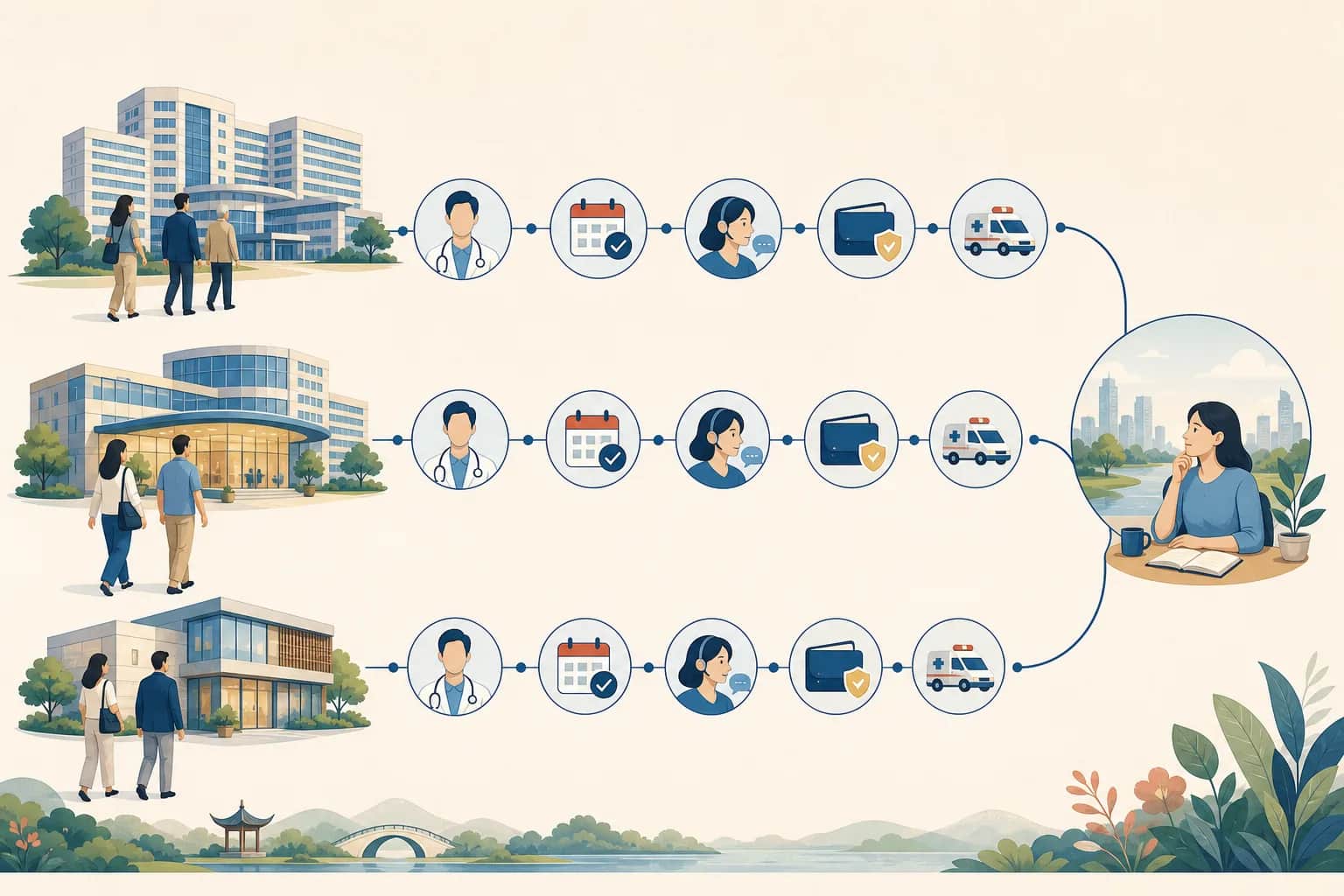
A foreign patient choosing a hospital in China will often see four overlapping descriptions: public hospital, private hospital, international hospital, and an international, VIP, special or premium service inside a larger hospital. Those labels are useful search clues, but they are not a dependable quality ranking and they do not reveal what one campus can do today. The practical choice is between exact care routes. Compare the named hospital, campus, department and service by clinical scope, appointment route, passport handling, language arrangement, tests, pharmacy, admission, emergency capability, price, insurance and follow-up. This guide provides a reusable comparison method. Its hospital pages are provider-specific examples checked on the date shown, not endorsements or nationwide promises.
Use this as a practical starting point
Provider procedures can change, so confirm time-sensitive details with the hospital, insurer or service. A licensed professional must make clinical decisions for an individual patient.
At a glance
Key points
- Use ownership and service labels to find candidates, never as a clinical-quality score or final recommendation.
- Match the clinical task and urgency to an exact hospital, campus, department and care route before comparing convenience.
- A public hospital may offer a general outpatient route and a separately operated international or special service with different access and payment steps.
- A private healthcare group may include a full hospital, medical centres and smaller clinics; the brand does not make their capabilities interchangeable.
- An English page, international name or patient-services desk does not confirm an English-speaking clinician or interpreter for every handoff.
- Compare emergency, diagnostics, pharmacy, admission, intensive care, records and referral capability as separate fields.
- A written estimate is not a final bill, and a direct-billing relationship is not proof of coverage, authorization or a zero patient balance.
- Save the evidence behind the choice, reconfirm time-sensitive facts and keep a clinically appropriate fallback route.
Use hospital labels as an index, not a verdict
Public, private and international describe different things. Public or private commonly describes ownership or operation. International may describe a whole provider's positioning, a named medical centre, an office for overseas patients, or one service inside a larger hospital. VIP, special, premium and international are not interchangeable national categories. The same English label may represent a different operational route at another institution, and translations used by booking platforms may simplify the provider's own wording.
Begin with a neutral candidate list. For every candidate, write the exact legal or provider name, city, campus, department, general or special service, and the page that supports each claimed feature. If the provider operates a hospital and several clinics, record which location the feature belongs to. A network page, group logo or clinician profile can help discovery, but it does not prove that a named test, pharmacy, emergency department, inpatient bed or specialist is available at the location you plan to visit.
The comparison is therefore not public versus private in the abstract. It is route A at one campus versus route B at another campus for one defined task and date. A route can be easier in English yet lack a required on-site service; another can publish broad specialist capability but require more preparation for booking and language. Neither observation establishes overall quality. The useful output is a documented match, a list of unresolved questions and a fallback—not a universal winner.
China Care Desk does not rank hospitals, certify clinicians or recommend a provider for an individual. It compares published access routes and shows what still needs direct confirmation.
Separate emergencies from planned comparisons
Do not spend an emergency comparing comfort, ownership or insurer lists. If there may be an immediate threat to life or serious harm, call 120 or follow the local emergency route and use the facility the emergency team identifies as appropriate. A normal appointment page, international office, clinic reception number or insurer assistance line is not a substitute for emergency assessment. Do not delay urgent care while waiting for a routine booking, a preferred-language clinician, a price estimate or a guarantee of payment.
For advance planning, verify emergency capability as a precise field. Ask whether the exact location has an emergency department, which patient groups and conditions it receives, its operating hours, how it handles ambulance arrivals, and how it escalates to imaging, surgery, intensive care or another hospital. A provider may publish a 24-hour main hospital and separate clinics with different functions. Save the main-campus emergency route; do not infer it from a group brand or from the word hospital in an advertisement.
PUMCH currently publishes a 24-hour emergency route within its International Medical Department. Jiahui's location page identifies 24-hour emergency service at Jiahui International Hospital. Beijing United Family publishes a distinct ER hotline and location information. These examples show why a claim must be attached to the named service and campus. They do not establish that another branch is open, that a particular condition will be accepted or that the provider is the clinically appropriate destination.
Define the task before opening a hospital list
Write one sentence describing the administrative task without diagnosing yourself: for example, arrange a first general consultation, continue care with a named specialty, obtain a provider-requested test, discuss a planned admission, attend pediatric specialty care, or collect a second opinion with records. Add the city, realistic date range and whether the patient can travel. If a clinician or emergency team has already specified a specialty or level of care, preserve that instruction instead of replacing it with an online popularity list.
Next list the constraints that could change the route: original passport use, mobility access, age or pregnancy-related service, a confirmed language arrangement, a companion, same-day diagnostics, a pharmacy, possible admission, an English or bilingual record, a written estimate, direct billing, insurer preauthorization, or a referral back to another provider. Mark each as required, preferred or unknown. Convenience features should not silently displace a required clinical capability.
Keep adjacent decisions separate. Choosing a hospital is not the same as selecting a department, confirming an individual clinician, making an appointment, creating a patient record, registering on arrival or obtaining insurer authorization. Use the dedicated China Care Desk guides for those workflows after the route is shortlisted. This separation prevents an English booking form or a successful call from being mistaken for confirmed care at the right department.
- Clinical task and urgency
- Exact city, hospital and campus
- Department or service named by a clinician
- Patient age and access needs
- Date and travel limits
- Language tasks
- Tests, pharmacy or admission needs
- Payment and insurance route
- Records and follow-up output
- Emergency or transfer fallback
Route A: a general public-hospital outpatient service
A general public-hospital route may provide access to a broad department structure, tests and higher-level services at one institution, but the label alone proves none of those features. Inspect the exact provider's department directory and campus notice. Confirm whether the intended service is ordinary outpatient, a special clinic, an expert clinic or another named route, because those can have different booking releases, entrances, fees and identity categories even inside the same hospital.
Expect the workflow to contain separate states. PUMCH's current general outpatient notice distinguishes first-visit record creation, identity and reimbursement category, registration, check-in, consultation, payment, test scheduling, pharmacy, reports and record copies. A foreign passport is included in that provider's published record-creation route, but this does not make every app, machine or hospital accept the same document. Ask for the provider's staffed fallback when a digital field cannot process the identity accurately.
Compare operational demands rather than stereotypes. Record whether advance booking is required, how the patient selects a campus and department, where a first visit is registered, whether payment occurs after each order, how tests are scheduled, where prescriptions are dispensed, and how reports are retrieved. Do not describe all public hospitals as crowded, inexpensive, clinically superior, difficult or Chinese-only. Those conclusions require evidence about the actual route and date, and some characteristics can change by department or service.
A public-hospital label is neither a warning nor an endorsement. Verify the exact service, access process and capability just as rigorously as any private route.
Route B: an international, VIP or special service inside a hospital
A hospital can operate an international, VIP, special or premium route alongside its general service. Treat it as a separate operational product until the provider confirms what is shared. Check the service's departments, named clinicians, booking channel, entrance, reception, testing, pharmacy, inpatient rooms, emergency route, language support, price structure, insurance handling, records and after-hours contact. Do not assume the general route's instructions or charges transfer in either direction.
PUMCH describes its International Medical Department as independently operated with appointment-based outpatient care, its own emergency centre and inpatient wards, more than 30 specialties, nearby ultrasound, blood-draw and pharmacy functions, and commercial-insurance services. The same hospital's general outpatient notice separately describes ordinary, special and international identity or payment handling in its own workflow. This is strong evidence of two distinct routes at PUMCH, not a template for every public hospital.
The University of Hong Kong-Shenzhen Hospital likewise publishes a distinct International Medical Center location with outpatient and inpatient areas, departments, contacts and insurance services within a wider hospital whose clinical directory includes emergency, intensive care, imaging, pathology and pharmacy. Confirm which hospital resources the special service can actually access for your case and how internal referrals work. A shared campus can be helpful, but the website's co-location does not by itself guarantee access, priority or one bill.
Route C: a private or internationally oriented hospital
A private or internationally oriented hospital may publish English navigation, patient coordination, interpreter arrangements, appointment channels, price information or commercial-insurance relationships. These can reduce administrative uncertainty when the features are confirmed for the actual visit. They do not establish that the provider is clinically better, that every clinician works in English, that all services are on site, or that a hospital with fewer convenience features is clinically worse.
Jiahui International Hospital's location page identifies a hospital campus with more than 35 specialties, focused centres, family medicine, general surgery and 24-hour emergency service. Its International Office separately describes multilingual coordination, estimate requests, interpreter support, physician coordination, records and insurer or third-party payment facilitation. Those are two evidence layers: campus capability and a coordination service. Verify availability with both the relevant department and the office rather than allowing one layer to stand in for the other.
Beijing United Family's patient-services page publishes language and telephone interpretation arrangements, a medical-record request process, hospital and clinic locations, a department directory and appointment and emergency contacts. This can be compared as a concrete service package. Still identify which location has the department, testing, pharmacy, admission and emergency functions you need. The provider's larger network and patient-services team do not make every clinic equivalent to the main hospital.
Route D: a specialist hospital or specialist service
Some searches should begin with a specialist population or service rather than ownership. A children's hospital, maternity hospital, oncology centre, rehabilitation hospital, eye hospital, dental hospital or infectious-disease service may have a different scope and referral pattern from a comprehensive general hospital. Confirm patient age, department, campus, appointment route, diagnostic and inpatient support, and what happens if the patient needs care outside that institution's focus.
Shanghai Children's Hospital publishes a Special Medical Services Department spanning multiple pediatric medical, surgical and support specialties, with provider-specific campus, language, hours and appointment information. The useful lesson is not that special medical service is always preferable. It is that a specialist hospital can contain its own general, specialist and special-service layers, so the patient must identify both the population focus and the operational route.
Ask how the specialist provider handles emergencies, comorbid conditions, adult companions who also need care, outside test review, anesthesia, intensive care, pathology, medicines and transfer. A narrow clinic may be ideal for a defined follow-up but not for an unstable presentation. A comprehensive hospital may still refer a highly specialized problem. These are service-matching questions for the providers and clinicians involved, not conclusions that can be drawn from the word specialist.
Distinguish a hospital campus from clinics in the same network
A healthcare group can operate a full hospital, medical centres, rehabilitation facilities and neighborhood clinics under one recognizable name. Search results, map listings and appointment pages may show them together. Before booking, copy the complete location name and address and compare its own service directory. Confirm whether the clinician is physically seeing patients there and whether the required tests, pharmacy, procedure room, emergency department or inpatient beds are on site.
Jiahui's provider pages separate Jiahui International Hospital from its Shanghai and other-city clinic locations. Beijing United Family lists a main hospital, rehabilitation hospital, medical centre and several clinics. Those published lists demonstrate the location problem clearly: a brand-level statement about language, specialties or insurance cannot automatically be assigned to every site. Even where a central service centre books multiple locations, the final confirmation must preserve the exact campus and service.
Ask what happens if the initial location cannot complete the next step. Is the patient referred within the network, sent to the main hospital, or directed to an unrelated provider? Who transfers the clinical summary, images, laboratory data, prescription and payment records? Is another appointment required, and does the insurer treat the second location separately? A convenient clinic can remain a sensible entry route when the escalation plan is explicit; it becomes risky when the patient assumes the brand makes transfer automatic.
Brand → city → facility → campus → department → service → clinician is a chain. Verify every link that matters to the visit.
Compare clinical capability and escalation without ranking quality
Build a capability row for the defined task. Look for the named department, relevant clinician roster, diagnostic services, pharmacy, procedure or operating support, inpatient care, intensive care, emergency service, rehabilitation and record access only where those functions matter. Use provider directories to form questions, not to diagnose or choose treatment. A long department list does not show availability, expertise for one condition or whether the patient will be accepted.
The HKU-Shenzhen hospital directory illustrates a comprehensive capability map: medicine, surgery, obstetrics and gynecology, pediatrics, adult intensive care, accident and emergency, family medicine, medical imaging, pathology, pharmacy and rehabilitation are separately published. Jiahui's hospital page shows a different provider-specific mix. PUMCH's international service describes more than 30 specialties and nearby testing and pharmacy. Compare these stated routes, then ask the department to confirm the exact service and date.
Add an escalation row. If the consultation produces a need for imaging, laboratory testing, a procedure, admission or emergency review, can it occur in the same service or campus? If not, where does the patient go, who makes the referral, and which records travel? This is not an argument that one-stop care is always better. A deliberate external referral can be appropriate. The goal is to avoid discovering the handoff only after registration, payment or deterioration.
Compare appointment, passport and arrival friction
Access begins before the consultation. Record the official booking channel, whether the route is a request or a confirmed appointment, how far ahead slots appear, which campus and department the confirmation names, and how a first-time foreign patient creates a record. Preserve one passport spelling and document number across the appointment, hospital record and insurer. If a form rejects the passport, use the provider's staffed route; do not substitute another person's identity or an invented document number.
PUMCH publishes English-web and bilingual-app booking for foreign patients in its international service, while its general outpatient notice describes its own identity, registration and check-in sequence. HKU-Shenzhen publishes different contact routes for general outpatient care and its International Medical Center, and warns that not every department can be booked online or obtained the same day on site. These differences are operational evidence, not a measure of clinical quality.
Ask for the arrival handoff: date, time window, building, entrance, floor, counter, patient-record step, check-in rule and late-arrival consequence. Confirm whether the booking includes the consultation only or also a test, procedure or admission assessment. A submitted request, patient profile, successful payment screen or conversation with an international office is not automatically a confirmed appointment. The dedicated booking and registration guides cover those states in detail.
Compare language and coordination task by task
Do not reduce language access to a yes or no field. List the communication tasks: initial enquiry, booking, first-visit registration, wayfinding, clinical history, consultation, informed consent, tests, pharmacy, payment, discharge, insurer calls and record requests. Ask who supports each task, in which language, at what time and whether advance arrangement is required. A bilingual receptionist, English website or international office does not confirm the treating clinician's language.
Beijing United Family publishes multilingual staff and telephone interpretation arrangements through patient services. Jiahui's International Office describes multilingual coordination and professional interpreter support. Those are useful provider commitments, but they still need confirmation for the requested campus, department, language and date. PUMCH's English foreign-patient route confirms an English booking path, not English at every clinical and administrative handoff.
For consent, diagnosis discussion, allergies, medicine instructions and important follow-up, ask how the provider will establish accurate patient-clinician communication. Distinguish a bilingual clinician, trained hospital staff member, professional spoken-language interpreter, informal companion, written translator and machine translation. A friend can help with navigation but does not establish professional interpretation. Also ask whether an English or bilingual medical record can be issued; spoken support and translated records are separate services.
Confirm the exact language arrangement in writing where possible. Do not claim guaranteed English merely because a provider uses an international name.
Compare price information, estimates, deposits and final bills
Never transfer a price between hospital categories. The charge can depend on the exact general, special or international service, department, clinician level, tests, medicines, supplies, room, procedure and complication. Ask the exact provider for a written estimate tied to the planned route. Record the currency, validity date, included and excluded items, assumptions, deposit, cancellation terms and who updates the estimate if the plan changes.
An estimate is not a final bill. Jiahui's International Office publishes an estimate-request service, but the amount remains specific to the individualized plan. PUMCH's own notices show that general and international pathways can use different service and insurance handling. Do not infer that public is always cheaper, that private is always expensive, or that an international department sits at a predictable premium. Only comparable written figures for the actual service can support a useful cost comparison.
Map payment operations as well as amount. Ask which methods the campus accepts, when a deposit is collected, whether tests and medicines are paid separately, when inpatient accounts are settled, and which itemized statement and official receipt are available. Keep a backup payment method even when direct billing is expected. The cost guide covers fee lists and estimates; the payment guide covers orders, receipts and final settlement.
Compare insurance with the provider and insurer separately
Hospital acceptance and policy coverage are separate decisions. First ask the hospital whether the exact facility, service and date can use direct billing for the named insurer and plan, what documents or guarantee of payment are required, and what the patient may need to pay. Then ask the insurer whether that provider, campus, department, clinician, service and patient are eligible and whether preauthorization, a referral, deductible, copayment, limit or exclusion applies.
Beijing United Family explains that its direct-billing route can leave a copayment or deductible based on the specific plan and that it accepts only primary coverage for direct billing. Jiahui publishes provider-specific social-medical-insurance and commercial direct-billing information. PUMCH publishes commercial-insurance services inside its international department. None of these relationships proves that a displayed insurer will authorize one consultation, test, medicine, room or procedure.
Save two confirmations: the provider's operational acceptance and the insurer's benefit or authorization decision. Name the person or system, date, reference number and remaining patient balance where available. If direct billing is not confirmed, ask about pay-and-claim documents and prepare funds without assuming reimbursement. A provider logo on an insurer list, an insurer logo on a hospital page or a card shown at reception is evidence to investigate, not a guarantee of coverage or payment.
Audit diagnostics, pharmacy, admission, emergency and records separately
A consultation route can look complete while the next step occurs elsewhere. Create separate yes, no and unknown fields for laboratory, imaging, pathology, pharmacy, procedures, inpatient admission, intensive care, emergency care, rehabilitation and medical-record copies. Mark whether each function is in the same building, elsewhere on the campus, another network location or an outside provider. Confirm hours and access; a department directory does not prove same-day availability.
PUMCH's international-service page describes outpatient, emergency and inpatient functions plus nearby ultrasound, blood drawing and pharmacy. HKU-Shenzhen's broader directory separately identifies imaging, pathology, pharmacy, adult intensive care, emergency and rehabilitation, while its International Medical Center page lists its own areas and services. Jiahui's hospital page identifies a full hospital and 24-hour emergency service. These examples show how to assemble questions, but each answer remains provider-, campus-, service- and date-specific.
Also plan the information trail. Ask how the patient obtains consultation notes, orders, prescriptions, itemized charges, receipts, reports, images and discharge or referral records, and in what language. If a transfer is possible, ask who sends the record and whether the patient should carry a copy. A convenient clinical handoff is not automatically an insurance handoff; a record visible in an app is not necessarily a portable official copy or proof that a clinician has reviewed it.
Score evidence strength instead of scoring hospital prestige
For each comparison cell, record one of four evidence states. Confirmed means the exact provider has confirmed the exact campus, service, patient and date. Published means a current provider page supports the feature but the appointment-specific detail remains unchecked. Reported means a directory, insurer, map or third party mentions it but the provider has not confirmed it. Unknown means no usable evidence has been found. Do not turn these states into a clinical-quality score.
Give more weight to the provider's current department, location, patient-service and booking pages than to old blogs, social posts, screenshots or unnamed lists. Check the page date where available, but also record your own access date because an undated live service page can change. Save the URL and the wording that matters. When two official pages conflict, ask the provider which route controls and keep the conflict visible until resolved.
A hospital can have many confirmed convenience fields and still be unverified for the required clinical service. Another can have a sparse English website but confirm the exact capability through a staffed channel. The decision gate is therefore: all required fields confirmed, acceptable unknowns explicitly acknowledged, and a fallback recorded. Popularity, star ratings, building appearance and the number of English pages should not bypass that gate.
Build a one-page route comparison worksheet
Give each candidate one column. Use rows for exact facility name, address, general or special route, department, clinician confirmation, appointment state, passport route, arrival instructions, language arrangement, diagnostics, pharmacy, admission, emergency, estimate, deposit, insurance, records, referral and last verification. Add the evidence URL, access date and provider contact used for every important answer. Leave unknown cells visible rather than filling them with assumptions.
Then apply gates in order. Gate one is urgency and clinically required capability. Gate two is confirmed access for the patient and date. Gate three is safe communication. Gate four is a workable payment and insurance fallback. Gate five is continuity: results, records and escalation. A route that fails a required gate stays a candidate only if the provider resolves the gap. Preferred amenities can break a tie after required gates, but they should not substitute for capability or emergency planning.
For a planned visit, contact the leading candidate with the same concise question set and compare like with like. Avoid sending private medical records to an unverified email or messaging account; begin on a contact route published by the provider. When the visit is complex, ask which department or international office should receive records and how consent, privacy and file transfer work. The worksheet is a planning record, not a medical referral or authorization.
- Exact provider and campus
- General, international, VIP, special or clinic route
- Required department and service
- Appointment and registration state
- Passport and arrival route
- Language for each important task
- On-site tests, pharmacy and admission
- Emergency and transfer capability
- Written estimate and deposit
- Provider and insurer confirmations
- Records and follow-up owner
- Evidence URL and verification date
Reconfirm the final route and preserve a fallback
Before a long journey, planned procedure or first visit, reconfirm the exact hospital, campus, department, service, clinician or team, date, arrival window, building, passport route and language arrangement. Recheck time-sensitive pages such as schedules, opening hours, insurer relationships and location notices. Save the confirmation offline with the address and provider-controlled contact route. Tell a companion which campus was selected and what remains unconfirmed.
Keep a fallback proportional to the situation. For a routine visit, it may be a staffed booking channel or another confirmed provider. For a specialized planned route, it may be the referring clinician's alternative or a transfer plan. For urgent deterioration, use the emergency plan and call 120 rather than waiting for the preferred appointment. An international office, insurer helpline or clinic reception may assist coordination, but none replaces emergency services.
After the visit, update the worksheet with what was actually available, retain records and receipts, and note any material mismatch for a page-specific correction to China Care Desk. Do not generalize one experience to an entire ownership category. A useful correction identifies the exact provider, campus, service, date, published claim and observed change so that it can be rechecked responsibly.
Choose the exact route that passes the required gates. Keep assumptions visible, reconfirm before travel and switch routes when a required capability cannot be verified.
Avoidable problems
Common mistakes
- Using public, private or international as a clinical-quality ranking
- Searching for the best hospital before defining the task
- Comparing hospital brands instead of exact campuses and services
- Assuming every location in a healthcare network has the same capability
- Treating an international office as proof of clinical capability
- Assuming an English website proves an English-speaking clinician
- Treating one bilingual staff member as end-to-end language support
- Using a friend as if that established professional interpreting
- Assuming an international department uses the general route's entrance or process
- Transferring a price between general, special and international services
- Calling a written estimate the final bill
- Assuming public hospitals are always cheaper
- Assuming private hospitals are always more expensive
- Treating direct billing as proof of coverage or a zero balance
- Checking insurance only with the hospital
- Checking insurance only with the insurer
- Choosing a convenient clinic without checking tests, pharmacy or admission
- Confusing a central service number with a confirmed appointment
- Confusing booking, patient-record creation, registration and check-in
- Confusing a clinic contact with a confirmed emergency department
- Waiting for a preferred route during a possible emergency
- Assuming a long department list proves current availability
- Ignoring how records and results move after a referral
- Hiding unknown fields instead of asking the provider
- Relying on an old blog or map listing without provider confirmation
- Generalizing one patient experience to an entire hospital category
Common questions
Frequently asked questions
Are public hospitals always cheaper than private hospitals in China?
No reliable price conclusion follows from ownership. Charges can differ by general, special or international service, department, clinician, tests, medicines, room and procedure. Request comparable written estimates from the exact routes and keep a final-bill and payment fallback.
Are private hospitals always easier for foreigners?
Some private providers publish English booking, patient coordination or insurance routes, but the exact campus still needs the required clinical capability, passport process, language arrangement, price and emergency fallback. Convenience is a field to verify, not a category guarantee.
Is an international hospital automatically better for foreigners?
No. International can describe a provider, a service or an office and does not certify quality or suitability. Verify the exact hospital, campus, department, clinician or team, communication plan, cost, insurance and escalation route.
Can a public hospital have an international or VIP department?
Yes. PUMCH and the University of Hong Kong-Shenzhen Hospital are current provider examples of distinct internationally oriented services inside wider hospitals. Names, scope, booking, prices and insurance differ, so confirm the exact institution and route.
What is the difference between a hospital and a clinic in the same network?
Capability can differ substantially. Confirm the exact location's departments, diagnostics, pharmacy, emergency and inpatient functions. A shared brand, appointment centre or insurer relationship does not make every location interchangeable.
Will an international hospital always have an English-speaking doctor?
No. An English page or patient-services team does not confirm the requested clinician's language. Ask about the specific appointment and every important communication task, including consent, tests, pharmacy and discharge, and arrange interpreting where needed.
Can I use a friend or relative as my interpreter?
A companion may help with navigation and personal support, but that does not establish professional interpretation for clinical history, consent, medicine or important instructions. Ask the provider how accurate patient-clinician communication will be arranged.
Does an international or private hospital always offer direct billing?
No. A provider may have relationships with some insurers, but the policy, patient, facility, service and date may still require confirmation, authorization, a deductible, copayment or full payment. Obtain separate confirmations from the provider and insurer.
Does direct billing mean I will pay nothing?
No. Beijing United Family's own explanation, for example, states that a copayment or deductible can remain and depends on the plan. Coverage, authorization and the final patient balance must be confirmed for the actual service.
Can I compare prices from hospital websites?
Use published prices to form questions, not as a complete quote. Ask what route, date and items the price covers and request a written estimate for the planned service. An estimate can change and is not the final bill.
Which hospital type is best for a specialist consultation?
No type wins automatically. Start with the specialty or clinician instruction, then compare the exact provider's department, availability, diagnostics, admission or referral support, language, cost and insurance. Leave clinical appropriateness to qualified professionals.
Should a child always go to a children's hospital?
This guide cannot make that clinical decision. A children's specialist hospital may offer relevant pediatric services, while other hospitals also publish pediatrics and emergency care. Use clinician or emergency guidance and verify age, department, campus and capability.
Which type should I choose in an emergency?
Use urgency and confirmed emergency capability, not ownership or international branding. Call 120 or follow the local emergency route when serious harm may result from delay; do not wait for a routine appointment, interpreter request, estimate or insurance guarantee.
Can an international office book everything for me?
It may coordinate enquiries and appointments within its published scope, but a conversation or request is not necessarily a confirmed clinician, test, admission, interpreter or insurer approval. Save each confirmation and its responsible team separately.
How often should I recheck a hospital choice?
Recheck time-sensitive details before the visit, especially campus, department schedule, appointment, entrance, language arrangement, emergency hours and insurance. For planned procedures or long travel, reconfirm close to departure and keep the access date for each source.
Evidence
Sources consulted for this guide
National rules are separated from city and provider examples. Access dates show when a source was collected; source pages and procedures can change afterward.