
Tests, medicines & records
How to get medical records from a hospital in China
Request China hospital records, collect formal copies and images, authorize a representative, translate files and confirm secure receipt.
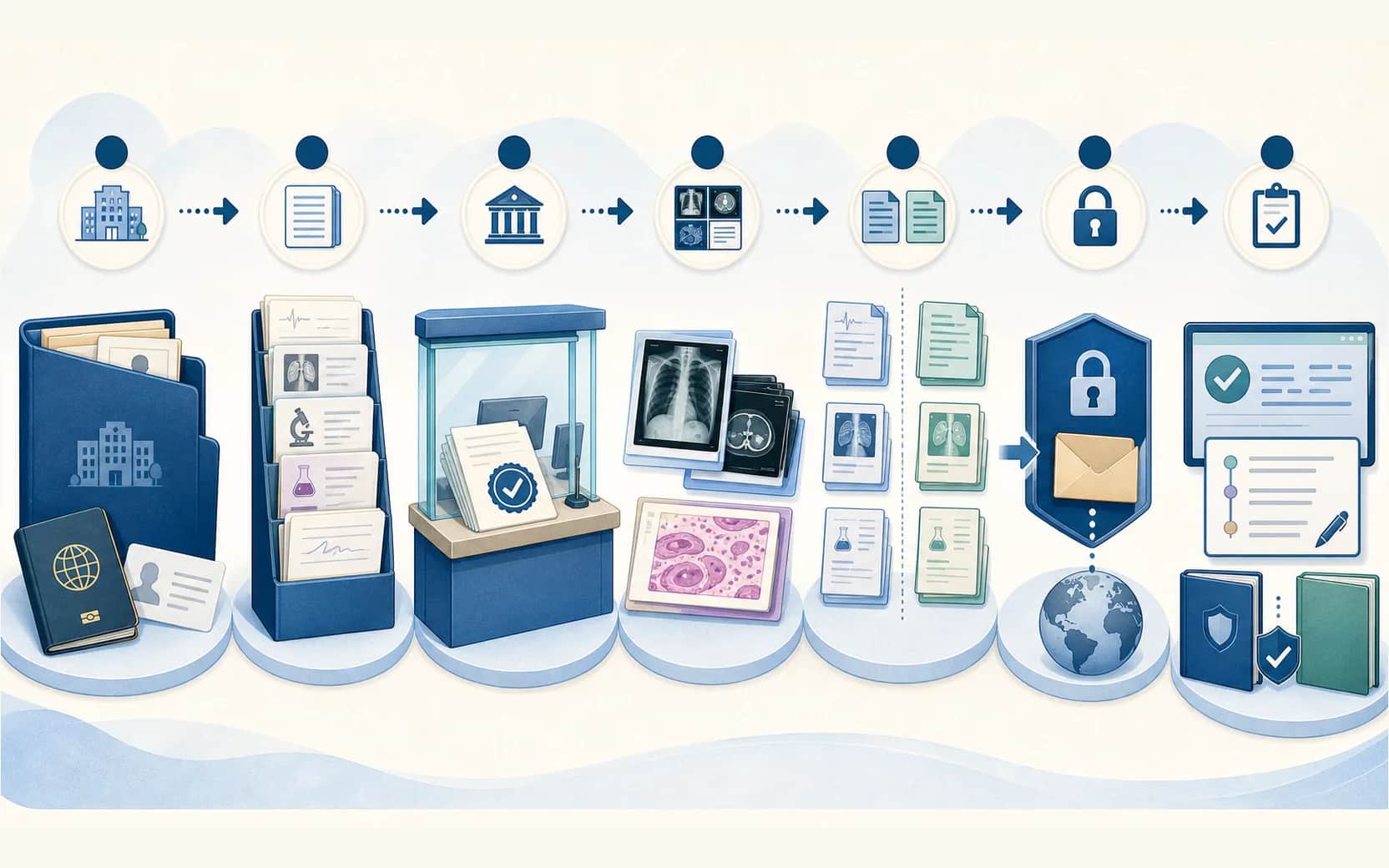
Getting a record after care in China is not one request for one universal file. A portal result, consultation note, formal outpatient or inpatient copy, imaging report, original image study, pathology report, prescription, discharge summary and translated package are different objects. Start with the task the record must complete, identify the holder of every object, preserve the hospital-issued source and close the loop only when the intended recipient can open, match and use what arrived.
Use this as a practical starting point
Provider procedures can change, so confirm time-sensitive details with the hospital, insurer or service. A licensed professional must make clinical decisions for an individual patient.
At a glance
Key points
- Define the recipient and purpose before ordering records; a clinician, insurer, school, employer and visa authority can require different objects.
- Build an object-by-object manifest because outpatient notes, inpatient files, reports, images, pathology material, prescriptions and financial documents can use different routes.
- Use the patient identity and hospital number attached to the original visit; resolve mismatches through the provider instead of editing a file or opening duplicate profiles.
- Arrange written representative authority before the patient leaves when another person may need to apply, pay, collect or receive the record.
- Treat an app view, notification, screenshot, formal copy, stamped copy, translation and clinician-authored summary as separate artifacts.
- Keep the issuing provider's original unchanged and store translations, indexes and patient-created timelines as clearly labelled companion documents.
- Use a recipient-approved, minimum-necessary transfer route and protect passport images, hospital numbers, QR codes, access links and record files.
- Sent does not mean received, opened, matched, reviewed or accepted; obtain a traceable acknowledgment and next action.
- Follow provider-issued urgent or immediate-care instructions without waiting for a perfect archive, translation, claim decision or overseas handoff.
Start with the task the record must complete
Write one sentence naming the recipient, purpose and deadline: for example, continue care at another hospital, obtain an overseas second opinion, support an insurance claim, document a hospital admission, provide a school or employer certificate, or preserve a complete personal archive. Do not begin with an undefined request for “everything.” The receiving party controls what it will accept, while the issuing hospital controls what it can release and through which route.
Ask the recipient for a written checklist before paying for copies, courier service or translation. Record whether it needs a consultation note, discharge summary, final report, source images, complete inpatient file, itemized bill, receipt, prescription, provider seal, certified translation or another exact object. Keep the recipient's administrative requirement separate from any clinical decision: China Care Desk cannot decide which record is medically sufficient or whether care can safely wait.
Recipient identified → purpose documented → exact record set agreed → issuing route confirmed.
Build an object-by-object episode manifest
Create one private manifest for the episode. Include hospital legal name, campus, date range, patient name as registered, passport or identity route, hospital number, department, clinician where known and every record object expected. Useful rows can include the registration or encounter note, outpatient record, admission record, discharge summary, laboratory report, imaging report, original image study, pathology report, procedure note, prescription, medicine list, consent document, itemized statement and receipt.
For every row, add the holder, release state, access channel, request reference, fee status, expected collection date, file or physical format and intended recipient. Mark unknown rather than guessing. PUMCH's Xidan instructions show why this matters: recent and older outpatient records, inpatient copies, laboratory reports, radiology reports or films and pathology reports can follow different routes inside one provider. That example is a model for asking questions, not a process to copy elsewhere.
- Visit, campus and department
- Patient profile and hospital number
- Exact record object
- Issuing or holding office
- Portal, kiosk, department, window or courier route
- Requested, processing, ready, collected or received status
Ask before leaving the hospital or China
Before discharge or departure, ask where every pending document will appear and how long that access route remains usable. Save the official app, WeChat account, service centre, records office, department desk or international-patient contact published by the provider. Confirm which items are available immediately, which become final later, which require a separate application and which cannot be delivered through the same channel.
If another person may need to finish the request, ask what authorization, identity evidence, relationship evidence, form, payment method and collection authority the holder requires. Do this while the patient can still sign or verify information. Do not hand a companion the patient's account password, one-time code or unrestricted cloud folder as a substitute for accepted authority. For time-sensitive follow-up, obtain the provider's clinical contact or appointment route separately from the records office.
Separate portal visibility from a formal hospital copy
An app or WeChat view can help a patient see that information exists, but it does not automatically establish that the record is final, complete, portable, formally issued or accepted by a recipient. A notification is not the report; a report preview is not necessarily the complete medical record; a screenshot is not automatically a stamped or verified copy. Ask the recipient what evidence it needs and ask the holder how to obtain that exact artifact.
PUMCH publishes an authenticated app route for a stated report category and access period. HKU-Shenzhen publishes several result routes, including its official WeChat service, machines, a service centre and department nurse stations, with some reports handled differently. These provider examples show that online access is one layer of a record system. Preserve useful access evidence, but do not label it “official,” “complete” or “certified” unless the issuer and recipient support that description.
Visible ≠ final ≠ complete ≠ formally copied ≠ accepted by the recipient.
Find the holder and official application route
Ask which office owns the exact object. The outpatient clinic, inpatient records office, laboratory, radiology department, pathology department, pharmacy, billing desk and insurer can each control different records from the same episode. Begin on a page, phone number, service desk or app route published by the named provider. Verify the campus because two locations under one hospital brand can use different staff, archives or collection arrangements.
Record the application date, reference number, requested scope, number of copies, quoted fee, stated processing period, collection method and help route. If a staff member redirects the request, update the manifest instead of starting unrelated duplicate requests. When an online route fails, capture the error without exposing personal data and ask for the provider's staffed fallback. Do not use an address found in a forum, personal messaging account or unofficial document reseller.
Keep passport identity and hospital identity aligned
Use the identity document and patient profile attached to the original care. Bring or prepare the exact evidence the holder requests, plus the hospital number, encounter number, old patient card, appointment reference or report identifier when available. If a renewed passport, different name order, missing space or previous document number prevents access, ask registration or records staff to locate and link the existing episode rather than creating a new profile merely to continue an online form.
Create a private crosswalk showing the passport spelling, hospital display name, patient number, visit dates and insurer member name. The crosswalk is an index, not an edited medical record and not proof of identity. Keep old and new identity evidence available when the provider asks for it. Never type a guessed Chinese identity number, change a date of birth or edit the patient name inside a downloaded report to make systems appear consistent.
Authorize a representative without sharing the account
A spouse, parent of an adult, friend, interpreter, employer, insurer or travel companion is not automatically authorized to apply for, read or collect a patient's full record. Ask the holder which patient authorization, patient identity evidence, representative identity, relationship or legal-authority document and collection instruction it requires. Ask whether the authority covers application, payment, copying, physical collection, courier delivery and digital receipt; those can be different actions.
HKU-Shenzhen's published inpatient-copy notice includes representative-document requirements and, at publication, directed foreign patients away from a WeChat document-recognition route that did not support foreign identity documents and toward its window. Treat that as a provider-specific limitation, not a rule for all foreigners. Jiahui's rights statement similarly supports written consent or authorized-representative handling within its process. Confirm the current route instead of reusing a form from another hospital.
Distinguish outpatient, emergency and inpatient records
Do not assume one request covers all care settings. An outpatient consultation note, emergency encounter, observation record, admission file, operative record and discharge summary can be stored or released differently. Ask which date range and episode identifier the application uses, whether a complete inpatient file must wait until the record is closed, and whether later reports or addenda require a second request.
For a transfer, claim or overseas review, ask whether the recipient wants the complete file or selected documents. A full inpatient file can be large and may still omit separately held image data, pathology material, pharmacy dispensing evidence or final financial settlement. Keep the clinical episode and financial episode linked through dates and identifiers without combining them into one misleading PDF. The holder can describe what it issues; the recipient decides what it needs.
Track laboratory reports from release to review
Record the laboratory report as its own object: test date, issuing laboratory, patient profile, order or accession reference, preliminary or final state, release route and responsible follow-up team. Download or collect the provider-issued report when available and preserve its original filename, page order, units, reference information and issue date. Do not retype values into a clean table and present that table as the hospital result.
A visible result does not prove that a clinician reviewed it or that no further action is required. Ask the responsible provider how review occurs and how the patient will receive the next instruction. If the provider gives an urgent, immediate-care or return instruction, follow that provider route without waiting for a translation, copy seal, insurance decision or overseas upload. China Care Desk does not interpret values, flags, reference ranges or urgency.
Request imaging reports and source images separately
An imaging report is the written record; the underlying study can be a DICOM export, disc, download, viewer link or physical film. Ask the receiving clinician which study, date, body part, sequences or series and prior comparison it needs, and whether it wants the report, source images or both. Ask the imaging holder what it actually supplies, whether a viewer is included and how long a link remains active.
Before leaving the collection point, check the patient and study identity and preserve the supplied folder structure and files. Do not convert, compress, rename or screenshot the source study as the only copy unless the recipient explicitly accepts that format. A link that opens on the patient's phone does not prove the receiving system can import it. Close the handoff only after the recipient confirms that the study opens and matches the correct patient and examination.
Keep pathology reports and retained material distinct
A pathology report, digital image, glass slide, paraffin block, specimen list and molecular-test output are not interchangeable. If another provider requests review, obtain its written material and packaging requirements first, then contact the issuing pathology service. Ask about identity evidence, authorization, deposit or fee, collection, courier, return obligations, tracking and the person permitted to receive the material.
Do not assume that receiving a PDF report includes access to slides or blocks, or that ordinary parcel shipping is acceptable. Preserve accession numbers, material counts, labels, chain-of-custody notes and dispatch or return confirmation. If the requested material cannot be released or the recipient asks for a different preparation, route that question between the two responsible pathology services; China Care Desk cannot choose specimens or determine whether another examination is required.
Keep clinical records separate from bills and insurance evidence
A consultation note or test report proves clinical documentation, not payment. An itemized statement describes charges, a receipt or invoice records a financial transaction, a direct-billing statement shows a payer workflow, and an insurer explanation records a coverage decision. Keep them as separate objects linked by provider, patient, encounter date and charge reference. Do not edit a clinical PDF to attach financial pages or use a payment screenshot as proof of diagnosis.
Ask the insurer for its current checklist and submission route before copying the whole record. It may require a claim form, policy or member details, authorization, medical report, prescription, discharge summary, itemized charges and official payment evidence in a specific combination. Share only the relevant pages and keep the hospital-issued clinical source unchanged. A provider can issue documents; it cannot guarantee that an individual insurer will accept or reimburse them.
Preserve originals, translations and personal indexes
Store the provider-issued file as read-only source material. Give every companion translation, filename index, timeline or one-page summary a separate filename and label showing who created it, the date and the exact source documents covered. Keep the original and translation together so a recipient can verify names, dates, units, medicine names, signatures, seals and context. Do not overwrite the original with translated text or silently correct a perceived spelling or value.
Before ordering translation, ask the recipient which pages, language, format and translator qualification it accepts and whether certification, notarization or another formal step is required. Those terms are not interchangeable. A bilingual hospital report may reduce navigation work but does not automatically satisfy an overseas authority. Machine translation can help locate a section, but it must not become an unlabelled diagnosis, medicine instruction or clinician-authored record.
Prepare a handoff to another provider in China
Ask the receiving hospital or clinic which department, campus and staff-controlled route should receive records before uploading anything. Confirm accepted formats, file-size limits, whether source images are needed, whether an interpreter or translated index helps and whether the patient must bring physical originals. A record visible inside the issuing hospital's app is not automatically visible to another provider, even in the same city or under a related brand.
Build the smallest usable package: a manifest, the exact final reports requested, source images or material where requested, current medicine and allergy records from the responsible provider, and the referral or visit information supplied for the handoff. Preserve the issuing source and date. The receiving clinician may decide that more information or another assessment is required; delivery supports continuity but does not obligate a provider to accept a prior conclusion or avoid a repeat test.
Prepare an overseas or second-opinion package
Obtain a written intake checklist from the actual overseas clinician or second-opinion service. Confirm patient consent, record categories, date range, image and pathology requirements, translation responsibility, secure upload, file limits, payment state, review timeline and the form of the eventual output. Do not send the complete medical history to a generic contact address merely because the organization name looks familiar.
Jiahui's published international second-opinion workflow describes collection, completeness checks, translation coordination, secure transfer, missing-record follow-up and a consultation output inside its own service. Use that as evidence that a controlled handoff has several states, not as a promise about a different destination. Track requested → collected → checked → translated if required → transferred → acknowledged → reviewed → further information requested or case closed.
Uploaded ≠ received ≠ complete ≠ technically usable ≠ clinically reviewed.
Share the minimum necessary through a verified route
Verify the receiving organization, named team, case or appointment reference and its approved portal, records-transfer service, secure email or physical delivery route. Share the smallest record set that completes the stated task. Treat passport copies, hospital numbers, barcodes, QR codes, access tokens, viewer links and cloud folders as sensitive. Use expiry and access controls where the approved route offers them, and keep a dated delivery log.
Avoid public messaging groups, personal translation accounts, shared hotel or workplace printers and open cloud links. Do not give a recipient permanent access to the patient's hospital account. If redaction is requested for an administrative purpose, preserve the untouched provider original and create a labelled working copy; never remove clinical context from the only copy. Ask the holder and recipient how consent, retention and later deletion are handled in their own workflows.
Confirm receipt, identity match and usability
A sent message, courier delivery or successful upload is an administrative event, not proof that the right team opened the file. Ask the recipient to confirm the patient identity, visit or study, page count, requested date range, image or material usability and whether anything is missing. Record the name or team, date, case reference and next action without claiming clinical review unless the responsible provider states that review occurred.
For digital imaging, confirm that the study opens and includes the requested examination. For translated packages, confirm that the original and translation remain paired. For a claim, confirm that the submission is linked to the correct member and encounter. For a second opinion, confirm that intake is complete enough to enter review. Sent ≠ received ≠ matched ≠ opened ≠ reviewed ≠ accepted; each transition needs its own evidence.
Resolve missing, incomplete or mismatched records
Route the problem to the owner. A missing online result belongs first with the issuing department or provider access route; an absent inpatient section belongs with the records office; an image-export problem belongs with imaging; a name or passport mismatch belongs with registration or records staff; a recipient rejection belongs with the recipient's intake team. Keep the request reference, screenshots of non-sensitive error states and the provider's written response.
Do not edit the source, create a replacement report, merge pages from different patients or open duplicate profiles to make the archive look complete. Ask whether the provider issues a corrected copy, addendum, linked identity record or new export and preserve both the original evidence and traceable correction. If the normal service route stalls, use the provider's published patient-services or advocacy channel and state the object, holder, request date, reference and unresolved next step.
Close the record loop without delaying care
The record task is complete only when the required objects are identified, the issuing route is documented, the originals are preserved, any representative authority and translation are traceable, and the intended recipient confirms receipt and usability. Keep open items visible with an owner and date. A personal archive can remain incomplete while an urgent clinical handoff proceeds; administrative perfection must not become a reason to postpone provider-directed care.
If a provider gives an urgent-result, immediate-return or emergency instruction, follow that provider instruction or its verified clinical route now. For a perceived medical emergency in mainland China, call 120. Do not wait for an insurer, translator, copy office, website answer or overseas clinician. China Care Desk explains record logistics only; it does not interpret records, determine urgency, recommend treatment or decide whether waiting is medically safe.
Avoidable problems
Common mistakes
- Asking for “all records” without naming the recipient or purpose
- Treating every document from one visit as one file held by one office
- Leaving without asking where pending reports or copies will appear
- Assuming an app notification is the final report
- Calling a screenshot an official or stamped record without confirmation
- Using another hospital's copy instructions or form
- Requesting the right hospital brand but the wrong campus or service
- Opening a duplicate patient profile when an old record cannot be found
- Editing a passport spelling or date inside the downloaded source
- Typing a guessed Chinese identity number into a digital form
- Giving a companion account credentials instead of arranging authority
- Assuming a spouse, employer, insurer or interpreter automatically has access
- Waiting until after the patient leaves to discover that a signature is needed
- Requesting only an imaging report when the recipient needs source images
- Assuming a viewer link is a permanent or importable image archive
- Converting or renaming DICOM files as the only retained copy
- Assuming a pathology PDF includes slides, blocks or retained material
- Shipping pathology material without the issuing and receiving services' instructions
- Mixing clinical reports, itemized bills and receipts as if they prove the same fact
- Sending an insurer the complete medical history without a checklist
- Overwriting the original with an English translation
- Presenting a machine translation as a clinician-issued record
- Paying for certified translation before confirming the recipient's requirement
- Uploading records to a generic or unverified contact address
- Sharing open cloud folders, QR codes or app passwords
- Sending the entire archive when a minimum record set would complete the task
- Treating a successful upload or courier delivery as proof of review
- Failing to confirm that source images open and match the correct study
- Failing to keep the original and translation paired
- Editing an incomplete record instead of requesting a traceable correction
- Waiting for a perfect archive while the provider has issued an urgent instruction
- Assuming another provider must accept prior records or avoid a repeat assessment
Common questions
Frequently asked questions
How do I get a copy of my medical records from a hospital in China?
Identify the exact outpatient, inpatient, report, image or pathology object and ask the named hospital which office or official digital route holds it. Confirm the identity documents, patient number, authorization, copy scope, fee, processing time and collection method for that provider and campus.
Can foreigners request hospital records with a passport?
Provider routes differ. Use the identity under which care was registered and ask the holder what original or copy it accepts. One HKU-Shenzhen notice published a staffed-window fallback because its WeChat document-recognition route did not support foreign documents at that time; that is not a nationwide rule.
Can someone else collect my hospital records?
Possibly, but do not assume automatic authority. The holder may require patient and representative identity evidence, written authorization and relationship or legal-authority documents. Confirm whether the person may apply, pay, collect, receive a courier and access digital files.
Is a hospital app screenshot an official medical record?
Not necessarily. It can show that information is visible, but it may be partial, temporary or unsuitable for the recipient. Ask what formal, complete, stamped, signed or verified object the recipient accepts and how the issuing hospital provides it.
What is the difference between an outpatient record and an inpatient record?
They document different care settings and may use different holders, closure times and copy routes. An inpatient file can include admission, progress, procedure and discharge records, while outpatient or emergency material may be released separately. Ask for the exact episode and date range.
How do I get a stamped copy of a China hospital record?
Ask the issuing hospital whether it provides the verification the recipient is requesting and through which records office or application route. Do not add a seal yourself or assume every printout can be stamped. Use the dedicated formal-copy guide for a deeper checklist.
What is the difference between an imaging report and DICOM images?
The report is the written result; DICOM commonly describes source medical-image data. A recipient may need the report, source study or both. Confirm the examination, date, series, delivery medium, viewer and import requirements with the imaging holder and receiving team.
How do I request pathology slides or blocks?
Start with the receiving pathology service's written requirements and then contact the issuing pathology department. Reports, slides, blocks and other retained material are different objects and can require identity, authorization, deposits, courier controls, tracking and return arrangements.
Should I translate every page of a Chinese medical record?
Ask the actual recipient which pages, language, format and translator qualification it accepts. Preserve the hospital-issued original unchanged and keep every translation or summary as a labelled companion file. Do not translate values or medicine instructions from memory.
Will another hospital in China automatically see my records?
Do not assume that. Access differs by provider, campus, system and record type. Ask the receiving team what it can retrieve, what the patient must supply and which upload or physical route it accepts.
Can I send China hospital records to a doctor overseas?
Yes when the issuing and receiving workflows allow it, but confirm consent, the exact record set, source images, translation, secure transfer, file limits and acknowledgment first. Delivery does not prove that the overseas clinician can use or has reviewed the material.
What records does an insurer usually need?
Use the insurer's current checklist. It may distinguish a claim form, authorization, medical report, prescription, discharge summary, itemized charges and official payment evidence. A clinical report and a receipt prove different things.
What if my name or passport number is wrong on the record?
Contact the issuing provider's registration or records team with the original identity evidence and visit references. Ask for its correction, addendum or record-linking process. Do not edit the PDF or create a second patient profile to hide the mismatch.
How long does a hospital medical-record request take?
There is no single turnaround for every provider and record object. Ask the holder for its current processing period, whether the episode must close first, whether business days are used and how readiness is communicated. Keep the request reference and escalation route.
How should I send records securely?
Use a provider- or recipient-approved portal, transfer service, secure email or controlled physical route. Verify the team and case reference, send only the necessary records, protect access links and keep a delivery log. Do not share hospital-account credentials.
When is the medical-record handoff complete?
When the required objects are collected from their holders, originals are preserved, authority and translations are traceable, and the intended recipient confirms the patient match, completeness and technical usability. Uploading or sending alone does not close the loop.
Evidence
Sources consulted for this guide
National rules are separated from city and provider examples. Access dates show when a source was collected; source pages and procedures can change afterward.