
Insurance & costs
Paying hospital bills and keeping receipts
Map every charge from hospital order to payment, final settlement, itemized statement and the receipt your insurer or employer actually requires.
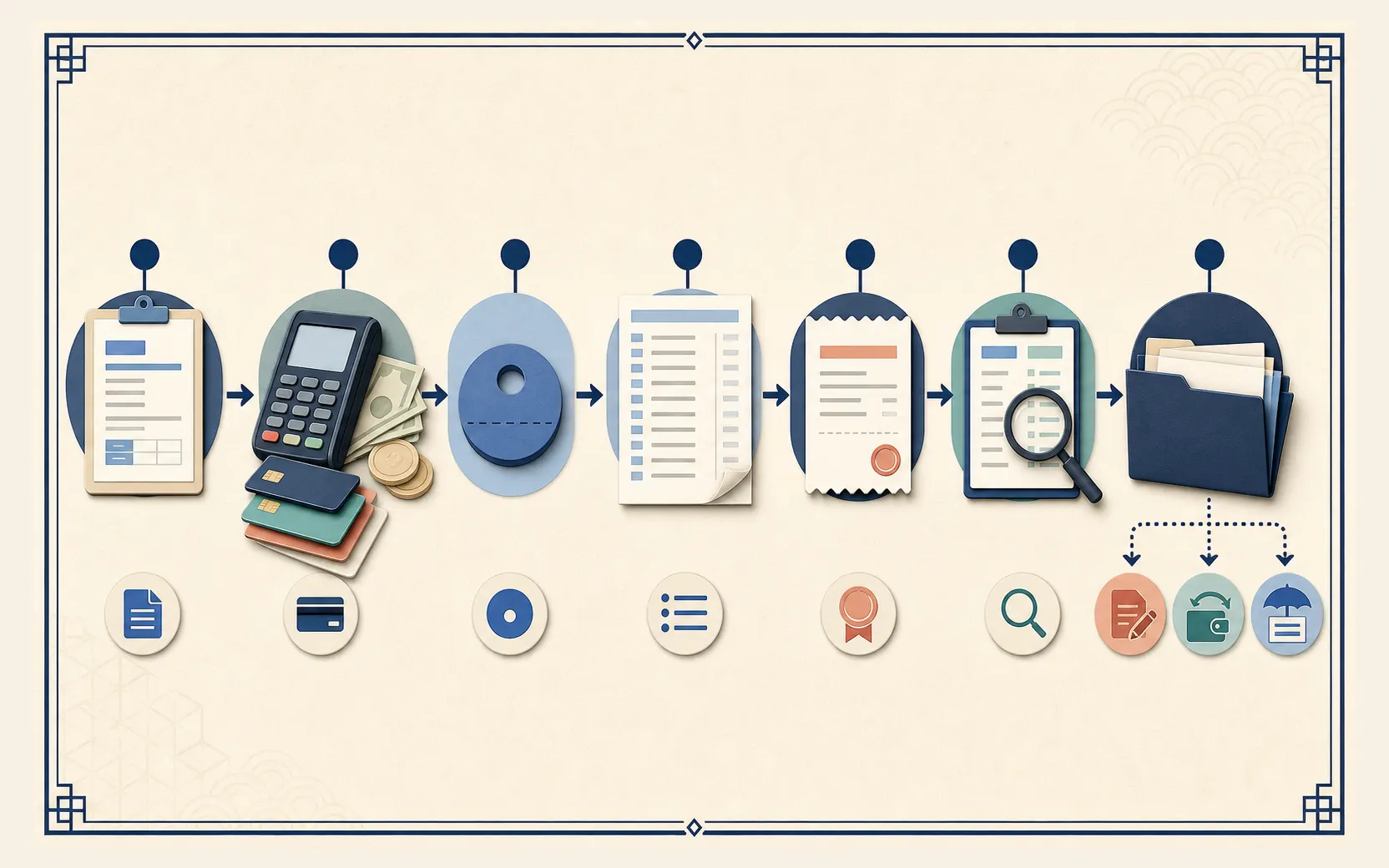
A hospital visit can create an estimate, deposit, service order, payment transaction, final settlement, itemized statement, provider receipt or invoice and insurer decision. These are different records, even when an app displays them on one screen. Payment methods, cashier locations, direct-billing arrangements and document formats vary by provider, campus, service and payer. Build one payment ledger from the first order to the final document instead of relying on a single card slip or grand total.
Use this as a practical starting point
Provider procedures can change, so confirm time-sensitive details with the hospital, insurer or service. A licensed professional must make clinical decisions for an individual patient.
At a glance
Key points
- Confirm the exact campus, payment point and accepted methods; keep a backup that the provider has not promised to accept.
- Match each consultation, test, medicine or admission charge to its order, payment and completion state.
- Keep an estimate, deposit, patient payment and final settlement as separate records.
- Direct billing can still leave a deposit, deductible, co-payment or excluded charge with the patient.
- Collect both the provider-issued payment document and the charge detail required by the actual insurer or employer.
- Check names, dates, issuer, amounts and payment allocation before leaving; never edit a hospital-issued document yourself.
Map the payment route before the visit
Write down the exact hospital, campus, department or service, outpatient or inpatient setting and planned date. Ask the provider whether the visit is self-paid, handled through an applicable local medical-insurance route, eligible for commercial direct billing or paid first and claimed later. Then ask the insurer separately. A hospital answer and an insurer answer are two records; neither replaces the other.
Provider pages show why a group name or insurance logo is not enough. Jiahui's international service publishes price-estimate and third-party-payment assistance for its own route. Beijing United Family and the University of Hong Kong-Shenzhen Hospital describe their own direct-billing services while also tying the patient amount to the individual plan or coverage. Confirm the transaction rather than copying another patient's result.
- Patient identity and hospital patient number
- Exact provider, campus, service and date
- Who is expected to pay first
- Authorization, guarantee or direct-billing reference
- Patient share and fallback if approval is unavailable
A provider relationship with an insurer does not prove that one policy, service, clinician, room, medicine or date is covered.
Confirm where and how each charge is paid
Ask which payment methods work at the exact cashier, self-service machine, online channel, pharmacy or discharge desk you will use. A method accepted at one counter or campus may not work at another. Beijing United Family, for example, currently names checks, debit cards and credit cards for its own patient payments; that provider statement is not a nationwide promise about card networks, foreign-issued cards, cash, mobile wallets or every terminal.
Carry more than one practical method where possible and keep the payer available until any refund route is known. If another person pays, record the payer name, payment account or last digits shown by the provider, transaction reference and whether a later refund must return to the original channel. Do not describe a backup method as guaranteed until the hospital confirms it.
Confirm the payment point, not only the hospital: registration, consultation, tests, pharmacy, admission and final settlement can use different systems.
Keep an order-to-payment ledger
Create one row for every consultation, test, medicine, procedure, package or inpatient account. Match the hospital order or item name to the department, date, amount, payment reference and current service state. A payment proves that money moved; it does not prove that a test was performed, a medicine was collected, an appointment was kept or an insurer accepted the charge.
Jiahui's patient-rights statement says its patients may question bill and physician-charge accuracy and request a summary and explanation of charges. That is a useful provider example of asking for charge-level clarification. At another hospital, identify the billing, cashier, finance, price-enquiry or patient-service route that owns the question instead of expecting clinical staff to reconstruct the payment record.
- Hospital order, item or account reference
- Department, campus and service date
- Ordered, scheduled, performed, dispensed or cancelled state
- Amount, payment time, channel and transaction reference
- Receipt, invoice or itemization retrieval route
- Open question, responsible office and case reference
Separate the estimate, deposit, payment and final settlement
Treat a price display or estimate as planning information, a deposit as money held toward a later account, a service payment as a transaction for a named item and final settlement as the closing reconciliation. Do not submit all four as separate expenses or assume that an early estimate is the final patient balance. Keep the documents linked but label their status clearly.
The same separation applies to insurance. Jiahui publishes detailed estimates and third-party-payment assistance for its international route; Beijing United Family says its direct-billing patients can still owe a co-payment or deductible; HKU-Shenzhen says full or partial on-the-spot payment depends on personal coverage. Allianz's claims guidance is one insurer example that treats an advance deposit differently from a completed treatment expense. These are scoped examples, not universal payment rules.
- Estimate or price breakdown
- Deposit and deposit-balance record
- Payments for named services or medicines
- Insurer or other-payer allocation
- Final patient balance
- Refund or additional-payment reference
Collect the provider-issued billing set
Before leaving the final cashier or discharge desk, show the insurer's, employer's or other recipient's current written requirement. Ask the hospital which provider-issued document matches it and how to retrieve the native electronic file or paper original. A summarized or itemized charge statement explains the bill; a receipt or invoice records the provider's financial transaction; a card slip, bank entry or wallet screenshot records the payment channel. Keep them separate unless the recipient confirms that one is sufficient.
Requirements differ by payer. Allianz's current international-plan claims FAQ, for example, tells members to retain supporting receipts or invoices and proof of payment and identifies a China tax invoice or fapiao for claims when its process requests one. That does not make the same document necessary or sufficient for every insurer. Use the applicable policy and claim instructions, and ask the provider for the exact document it can lawfully issue for this visit.
- Current provider-issued receipt or invoice for the visit
- Summarized or itemized charge statement
- Final settlement or patient-balance record
- Deposit and refund record where applicable
- Other-payer or direct-billing settlement record
- Proof of payment when the recipient requests it
Receipt, invoice, fapiao, itemized bill, settlement statement and payment screenshot are not safe synonyms. Show the recipient's wording to the issuing desk.
Check every record before leaving
Compare the patient name and identity used for the visit, provider and campus, outpatient or inpatient setting, service and payment dates, issuer, total amount and currency, payer allocation and final patient share. Reconcile the itemized total with the final settlement and record which earlier estimate or deposit has been superseded. Ask how to retrieve the active electronic document after any later refund or correction.
If a field, amount or charge is unclear, ask for a neutral explanation and keep the staff reply or case reference. If a document is wrong, use the issuer's formal correction route. Do not hand-edit a paper record, alter a PDF, crop away status information or submit both an old and corrected document as separate expenses. Scan or photograph the complete set, but keep originals when the recipient may request them.
Close correction, refund and claim loops separately
A billing explanation, charge correction, receipt replacement, refund and insurance claim are separate cases. Record the responsible organization, submission date, case number, document status, approved amount, payment destination and final outcome for each one. A hospital refund does not automatically update an insurer, and a claim denial does not by itself prove that the hospital bill is wrong.
Use the dedicated workflow for the problem you actually have: reconcile an unexpected charge line, retrieve or correct a receipt, cancel an unperformed paid test, track a deposit refund or assemble the insurer's claim file. Keep the original and revised hospital records together and disclose other payer decisions accurately. Do not promise a refund or reimbursement until the responsible provider or payer has issued its decision.
- Charge explanation or billing dispute
- Receipt retrieval or issuer correction
- Deposit or service refund
- Insurer claim or direct-billing reconciliation
- Final payment-arrival and document-status confirmation
Avoidable problems
Common mistakes
- Assuming one payment method works at every hospital desk or campus
- Treating a payment screenshot as the provider's complete billing record
- Losing the link between a payment and its consultation, test or medicine
- Calling an estimate, deposit and final settlement the same bill
- Assuming direct billing means the patient pays nothing
- Requesting a generic fapiao without showing the recipient's exact requirement
- Leaving before checking identity, issuer, dates, totals and payment allocation
- Editing a provider-issued document instead of using the issuer's correction route
- Treating a hospital refund and an insurer reimbursement as one transaction
Common questions
Frequently asked questions
Can I pay a hospital in China with a foreign bank card?
There is no safe site-wide promise. Ask the exact hospital and payment point which card network, issuing country, currency and terminal are supported, and keep another method where possible. A provider page naming credit or debit cards applies only to that provider's stated route.
Does direct billing mean I pay nothing?
No. A provider or insurer may still require a deposit, deductible, co-payment, excluded charge or payment while eligibility is checked. Record what the written authorization covers and the fallback if it cannot be used at checkout.
What receipt or fapiao should I ask for?
Ask the insurer, employer or other recipient for the exact current document name, fields, format and original-retention rule, then show that wording to the hospital. Do not assume receipt, invoice, fapiao, itemized statement and payment slip are interchangeable.
Is an itemized bill the same as proof of payment?
Not necessarily. The itemization explains charge lines, while the provider receipt or invoice and payment transaction record serve different purposes. Keep all relevant records until the recipient confirms what it accepts.
Is a card slip or payment-app screenshot enough for an insurance claim?
Only if the insurer expressly accepts it for that claim. It can help trace the transaction, but many claim processes also require a provider invoice or receipt, diagnosis or treatment information and other supporting records.
What if a companion or employer paid the hospital bill?
Keep the patient record, payer identity, provider transaction reference and any authorization connecting the payer to the visit. Ask the hospital how a correction or refund would be returned and ask the insurer whose proof of payment it requires.
Evidence
Sources consulted for this guide
National rules are separated from city and provider examples. Access dates show when a source was collected; source pages and procedures can change afterward.