
Insurance & costs
Hospital deposits, final settlement and refunds in China
Track a hospital deposit from the first payment through top-ups, final settlement, refund confirmation and the records needed for insurance or follow-up.
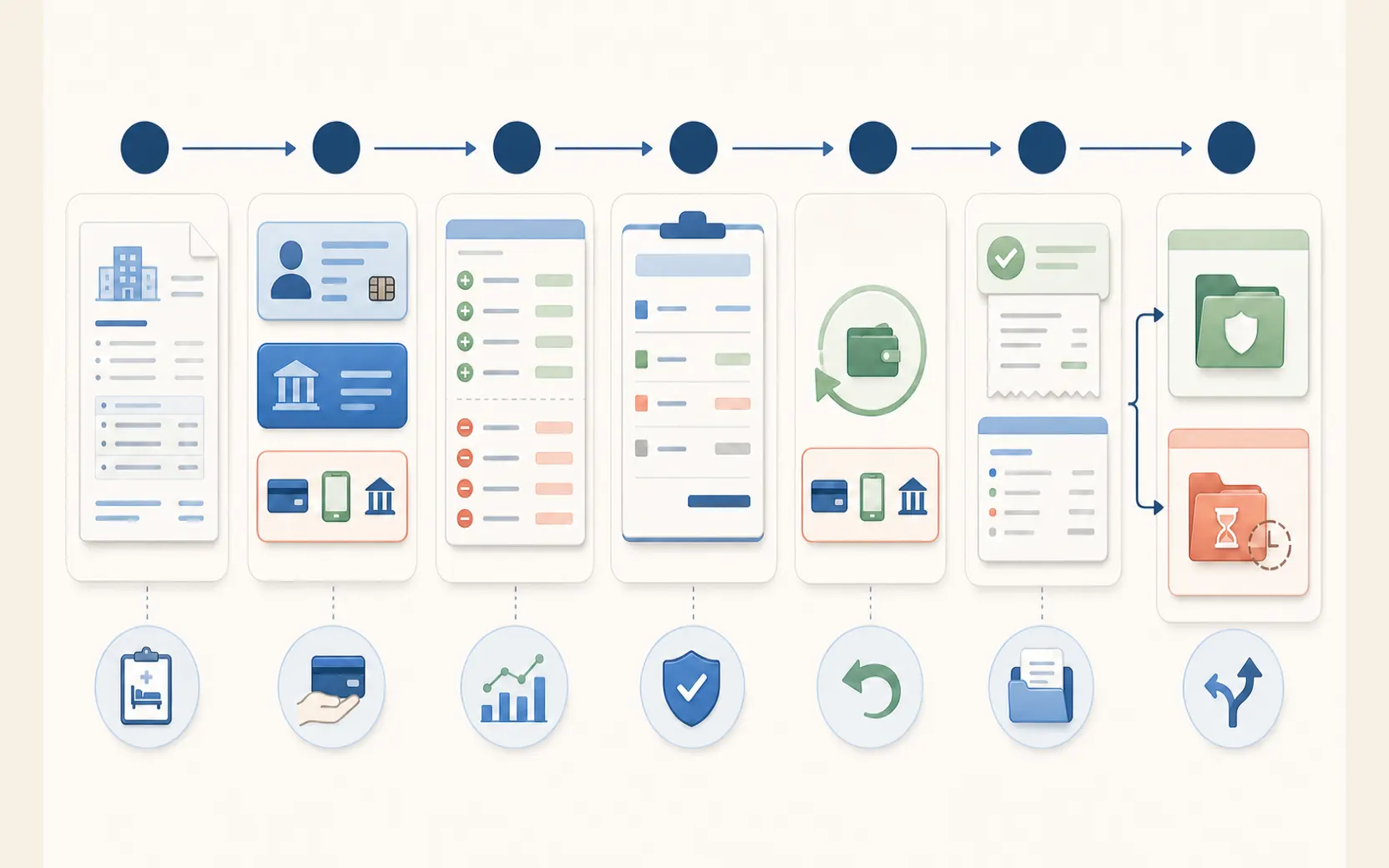
A hospital deposit is an advance payment, not the final medical expense and not proof that an insurer will pay. Keep it as one traceable entry that can later be matched to top-ups, the provider's final itemized settlement, any other-payer allocation and the amount actually returned or still owed. The 2025 national policy changes the advance-payment framework for the public medical institutions within its stated scope, while each hospital still controls its operational payment, settlement and refund route. Ask the exact provider before paying; do not infer a universal amount, app, counter, refund method or arrival time.
Use this as a practical starting point
Provider procedures can change, so confirm time-sensitive details with the hospital, insurer or service. A licensed professional must make clinical decisions for an individual patient.
At a glance
Key points
- Name the transaction before paying: estimate, deposit, top-up, service charge and final settlement are different records.
- Tie every deposit to the exact hospital, campus, patient account, payer and payment channel.
- Record deposits and top-ups separately so they are applied once, not counted again as final expenses.
- Reconcile the provider's final itemized total, other-payer amount, patient share, deposits and unused balance before closing the account.
- Confirm the hospital's actual refund route and any payer, identity, card or receipt requirements instead of assuming one national process.
- Keep the final settlement and refund confirmation before handing the remaining patient-paid amount to an insurer or delayed-refund workflow.
Name the transaction before paying
Ask the issuing desk to name the requested transaction and its purpose in writing. A cost estimate predicts possible charges; a deposit or advance payment funds an account before final settlement; a top-up increases that balance; a service charge pays for care already ordered or delivered; and the final settlement reconciles the account. Do not use those labels interchangeably in your records or insurance claim.
For public medical institutions within its stated scope, the March 2025 national notice stopped routine outpatient advance payments from 31 March 2025, while retaining voluntary exceptions for stated emergency, observation and surgical settings. It also changed how inpatient advance amounts are determined. The notice says non-public institutions may refer to the policy; it does not automatically place every private or international route under the same operational process. Peking University International Hospital separately publishes an advance-payment route for its premium self-pay service, illustrating why the provider and care route must be identified first.
- Exact provider, campus and billing desk
- Outpatient, emergency, day-care or inpatient setting
- Estimate, deposit, top-up, completed charge or final settlement
- Reason the amount is requested now
- Whether it will be applied, supplemented or potentially returned
A policy about public medical institutions does not prove that a particular payment request is wrong. First confirm the institution type, care setting, transaction label and any stated exception.
Verify the recipient, patient, payer and return route
Before transferring money, match the recipient to the hospital's current official cashier, account, counter, kiosk, app or other confirmed channel. Record the legal or displayed recipient, exact campus and department, patient name, hospital patient number and inpatient or admission number. A familiar-looking wallet account, QR code or message forwarded by an individual is not enough evidence that the provider owns the channel.
Also record who supplied the money and which card, bank account or wallet was used. Shenzhen Second People's Hospital, for example, ties several deposit routes to its hospitalization number and limits a published self-service settlement route by how the deposit was paid. Its eligible self-service refund goes back to the original payment method under its stated sequence. That is a useful provider example, not a nationwide rule. If a family member, employer or assistant pays, confirm before payment whether that person, device, original card or account may be needed later.
- Hospital and campus owning the payment request
- Patient name, patient number and inpatient number
- Payer name and relationship to the patient
- Payment channel, masked account or card and transaction reference
- Expected settlement and refund channel
- Identity, device, card or receipt needed at checkout
Do not pay from somebody else's account until the hospital explains how an unused balance would be returned and who must complete settlement.
Record the deposit as its own ledger entry
Create one ledger entry immediately after payment. Capture the amount and currency, payment time, transaction reference, payer and channel, patient and inpatient numbers, hospital recipient and the deposit receipt or provider-issued electronic record. Save the native record as well as a legible working copy; do not crop away the issuer, date, status or reference.
Label this entry 'deposit' rather than 'medical expense paid' until final settlement shows how it was used. Shenzhen Second People's Hospital asks patients using its inpatient billing counter to bring the deposit receipt alongside the discharge certificate and accepted identity or medical-insurance credential. Jiahui's patient-rights statement gives a separate provider example of asking for a charge summary, questioning bill accuracy and seeking clarification. Together they support keeping the deposit record traceable and asking the issuer to explain an unclear entry, without implying that every hospital requests the same documents.
- Amount, currency, time and transaction reference
- Patient, inpatient account and payer identity
- Official hospital recipient and payment channel
- Deposit receipt or provider-issued electronic record
- Purpose and current status
- Secure original or native file plus complete copy
A bank or wallet transaction proves that money moved. It does not by itself identify the hospital service, prove final expense or replace the provider's deposit record.
Monitor charges and top-ups without double counting
During an inpatient stay, keep each additional deposit or top-up as a new ledger entry rather than overwriting the first payment. Compare the sum of those advances with the hospital's displayed deposit balance and running inpatient charges. Record when and how the hospital communicated a low balance, what amount was requested and which transaction satisfied it. Use the separate inpatient daily-bill guide when you need a detailed day-by-day review.
The national notice directs covered public medical institutions to improve access to deposit-payment and inpatient-cost details. Shenzhen Second People's Hospital publishes several top-up channels tied to the hospitalization number. Jiahui states that patients may question bill accuracy and obtain charge information in its own setting. None of these sources turns a running charge list into the final bill or requires every hospital interface to update instantly, so preserve timestamps and ask the issuing desk about unexplained differences.
- Opening deposit and every later top-up as separate entries
- Running charges and displayed remaining balance
- Hospital request or low-balance notice
- Cancelled, reversed or duplicate transactions
- Questions raised and the hospital's case reference
- Latest timestamp before making another payment
Do not add the deposit, every top-up and the final itemized total together as separate medical expenses. Advances are reconciled against the final account.
Reconcile the final settlement before discharge
Ask for the provider's current final itemized bill and settlement record, then work from the provider total rather than the last deposit balance. Match the hospital and patient, service dates, itemized charges, insurer or other-payer allocation, patient share, every deposit applied, unused balance or remaining amount due. If the numbers do not reconcile, ask the billing office to explain or correct its own record before you submit anything elsewhere.
Peking University International Hospital states that its premium self-pay route issues a final detailed bill and verifies it against the advance payment, returning a remaining balance or collecting a shortfall under that route. Shenzhen Second People's Hospital publishes separate discharge-settlement channels and credentials for its inpatient route. United Family's direct-billing page shows why insurance must remain a distinct line: its route can still leave a plan-specific copayment or deductible. These provider examples do not establish one universal settlement document or guarantee that insurance removes the deposit or patient share.
- Final provider itemized total
- Insurer, local medical-insurance or other-payer allocation
- Patient share before applying advances
- Every deposit and top-up applied exactly once
- Unused balance or additional amount due
- Corrected and superseded document status
Estimate, deposit, insurer authorization, direct-billing statement, itemized bill, final settlement and provider receipt are related but non-interchangeable records.
Confirm the refund channel and requirements
When the settlement shows an unused balance, ask the hospital to state whether it will return the money automatically or requires a request, which department owns the case, which original or alternative channel it will use, whose identity or payment instrument is required and what confirmation will be issued. Record a case or transaction reference and the provider's stated next step. Treat any timing given by staff as that provider's operational estimate, not a national guarantee.
Provider routes differ. Peking University International Hospital publishes original-method or specified-method options for the remaining balance in its premium self-pay route. Shenzhen Second People's Hospital publishes original-method return for an eligible self-service route and separate counter requirements. The national notice sets a general objective for covered public institutions to complete inpatient fee settlement within three working days after discharge and progressively within 24 hours; that is a settlement-management rule within its stated scope, not proof that every bank, wallet, private hospital or international provider will deliver a refund within the same period.
- Unused balance confirmed by final settlement
- Automatic refund or patient-initiated request
- Original method, specified account or counter route
- Payer, patient, representative, card and identity requirements
- Refund amount, reference and current status
- Provider's stated next step and responsible department
There is no single national refund app, counter, channel or arrival time for every hospital. Verify the exact provider route before leaving or losing access to the original payer.
Close the evidence trail and route exceptions
Keep the deposit and top-up ledger, final itemized bill, settlement, current provider receipt or invoice, other-payer allocation, refund confirmation and evidence of the amount actually returned. If a refund changes or cancels an earlier billing record, obtain the issuer's current version rather than editing the old file. Jiahui's published billing-clarification route is one provider example of taking an accuracy question back to the issuer.
Only after settlement should you identify the patient-paid expense that may belong in an insurance claim. Allianz's standard-plan FAQ says an advance treatment deposit is considered for reimbursement only after treatment and remains subject to the member's benefit guide and other policy conditions; this is an insurer-specific example, not a promise of coverage. If the hospital says a refund has started but it has not arrived, preserve the case reference and move to the dedicated delayed-refund guide. Keep that provider refund case separate from an insurance claim, billing correction or disputed charge.
- Deposit and top-up ledger
- Final itemized bill and settlement
- Current receipt or invoice and other-payer record
- Refund instruction, confirmation and received transaction
- Separate insurance, correction or delayed-refund case number
- Final status and securely retained evidence
A deposit can become part of the payment history without becoming a covered insurance expense. The policy and insurer's written decision control reimbursement.
Avoidable problems
Common mistakes
- Treating an estimate, deposit, top-up and final charge as the same transaction
- Paying a recipient or QR code that the hospital has not confirmed
- Paying from another person's account without checking the return route
- Overwriting the first deposit instead of logging every later top-up
- Counting the deposit and final bill as separate medical expenses
- Closing the account from a running balance instead of the final settlement
- Assuming direct billing removes every deposit, copayment or record requirement
- Applying a public-institution policy or one provider example to every hospital
- Treating settlement timing as guaranteed refund arrival in a bank or wallet
- Submitting a superseded receipt after a refund changed the billing record
Common questions
Frequently asked questions
Are outpatient deposits prohibited at every hospital and in every situation?
No. The 2025 national notice stops routine outpatient advance payments at public medical institutions within its stated scope, but retains voluntary exceptions for specified emergency, observation and surgical settings. It says non-public institutions may refer to the policy. Confirm the institution type, care setting and transaction label before drawing a conclusion.
Is a hospital deposit the same as the final bill?
No. A deposit is an advance applied during final settlement. Keep it separate from the itemized bill, final settlement and provider receipt so the same money is not counted twice.
Does a GOP or direct-billing confirmation remove the need for a deposit?
Not automatically. The provider may still require an amount while authorization is verified or for patient-share and excluded charges. Ask the hospital and insurer what the document covers, what the patient must pay and how unused money is settled.
Will every hospital return a deposit to the original payment method?
Do not assume so. Some provider routes publish original-method refunds, while others may require a counter, specified account, original payer, payment card or additional verification. Ask the exact hospital before paying and again at final settlement.
What if a family member or employer paid the deposit?
Record both the patient and payer, the original channel and transaction reference. Ask whether the payer must be present, retain the original card or device, provide authorization or receive the refund. Do not substitute the payer's identity for the patient's hospital record.
What should I keep after the refund?
Keep the deposit and top-up records, final itemized bill, settlement, current provider receipt or invoice, refund confirmation and evidence of the returned amount. Also retain any insurer or other-payer allocation that explains the final patient share.
What if the hospital says the refund was issued but it has not arrived?
Record the provider department, refund reference, amount, channel, initiation date and any status evidence. Then use the delayed-refund guide to check the hospital, payment-channel and bank handoffs without mixing that case into an insurance claim or charge dispute.
Evidence
Sources consulted for this guide
National rules are separated from city and provider examples. Access dates show when a source was collected; source pages and procedures can change afterward.