
Insurance & costs
Hospital insurance claim documents before discharge
Build one traceable claim file from insurer checklist and patient identity to financial records, clinical documents, secure copies and submission tracking.
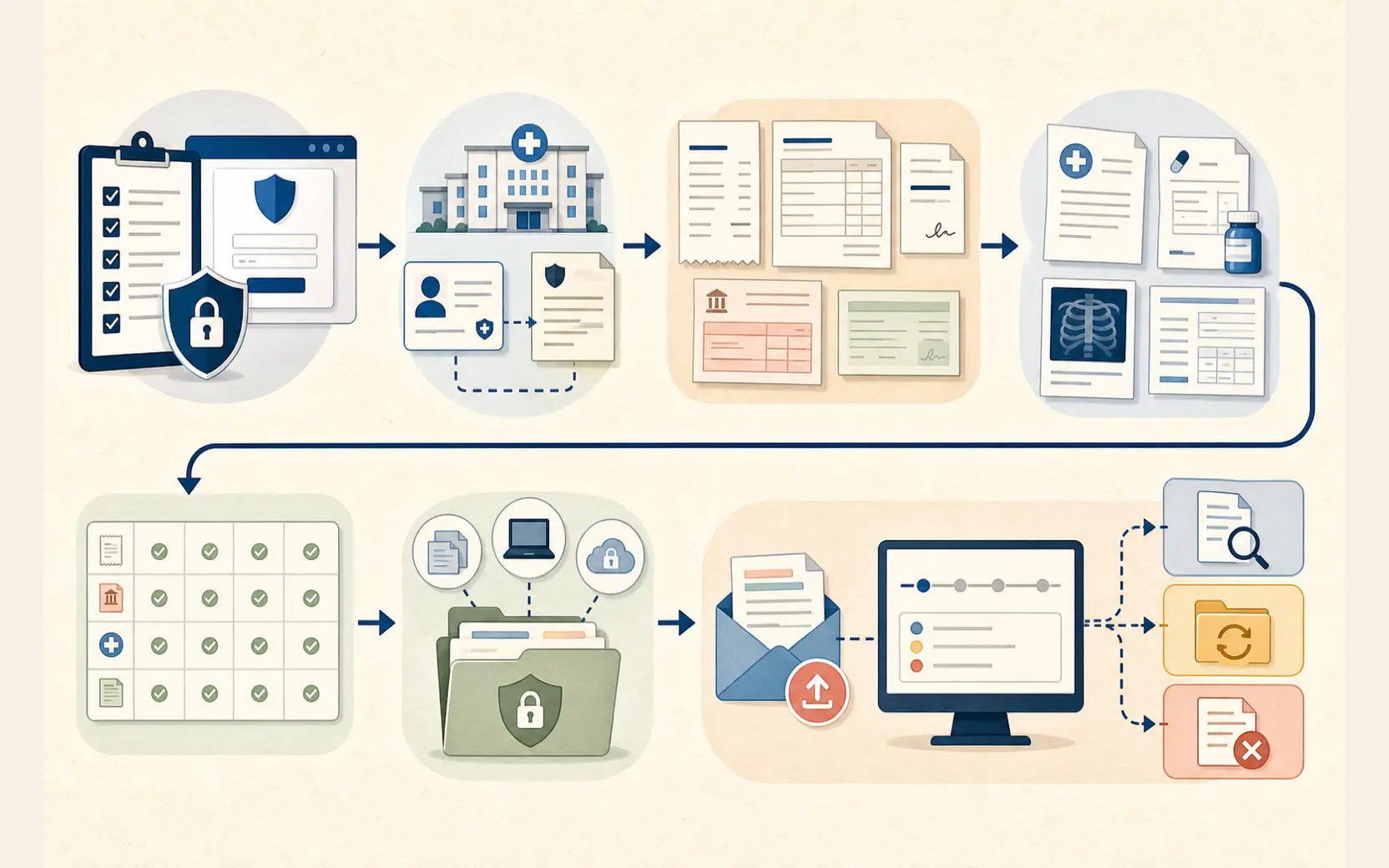
A hospital insurance claim file is a chain of evidence, not one receipt. It can connect the insurer's current checklist, the insured person and hospital visit, provider-issued financial records, requested clinical documents, original files and the later submission history. Build that chain before discharge or final checkout, when the issuing desks can still explain, retrieve or correct their own records. The policy and insurer instructions control the actual requirements; there is no single document list, deadline, translation format or payment promise for every China claim.
Use this as a practical starting point
Provider procedures can change, so confirm time-sensitive details with the hospital, insurer or service. A licensed professional must make clinical decisions for an individual patient.
At a glance
Key points
- Obtain the insurer's current benefit-specific checklist and submission route instead of copying another patient's file.
- Match the claimant, insured patient, policy, hospital, campus, visit and care dates across every record.
- Keep the receipt or invoice, itemized statement, settlement, deposit, refund and other-payer record as distinct evidence.
- Collect diagnosis, prescription, report and discharge material only to the scope the actual claim requires.
- Preserve originals and native electronic files even when the insurer initially accepts scanned copies.
- Track requests for more information, corrections, settlement decisions and denials as separate cases.
Start with the insurer’s current checklist
Open the claim instructions for the patient's current plan and the exact benefit before final checkout. Record who submits the claim, the authenticated portal or other official channel, the policy or member number, claim grouping, deadline, required financial and clinical records, accepted language, translation rule, original-document rule and payment destination. A general insurer FAQ is useful orientation, but the member's policy and current claim screen control the transaction.
Allianz and Cigna publish different insurer-specific routes. Allianz tells members to use the applicable benefit guide and may request receipts or invoices, proof of payment, diagnosis information and additional documents; its current page also gives a China tax-invoice or fapiao example for its own process. Cigna identifies an invoice, policy number and diagnosis or treatment explanation in its route. These examples show why there is no safe universal checklist.
- Exact plan, benefit and insured person
- Claim channel and submission deadline
- Required financial and clinical evidence
- Original, copy and translation requirements
- Claim currency and payment destination
- Insurer contact or case reference
Do not treat a China document name found in one insurer's instructions as mandatory or sufficient for every domestic, employer, travel or international policy.
Match the claimant, patient and visit identity
Create a claim cover record before collecting documents. Match the claimant, insured patient and policy member; the passport or other accepted identity; the hospital patient number; the exact provider, campus and department; the outpatient, emergency, day-care or inpatient setting; and the service, admission and discharge dates. If another person paid, record the payer without replacing the patient's identity.
Jiahui's patient-rights statement is one provider example that asks patients to provide complete and accurate personal details. Cigna asks members to state the policy number on submitted documentation, while Allianz separates claims by person and condition in its standard route. These are scoped examples, but they support a practical rule: do not let one visit become several unmatched names, dates or references.
- Claimant and insured-patient relationship
- Name and identity-document details used by the hospital
- Member, policy and claim references
- Hospital, campus, department and patient number
- Care setting and relevant dates
- Payer identity when different from the patient
If a name, date or identifier is wrong, ask the issuing hospital or insurer to correct its own record. Never edit a receipt, report, PDF or screenshot yourself.
Build the financial document set
Show the insurer's wording to the cashier, billing office or discharge desk and ask which provider-issued document matches it. Keep the receipt or invoice, summarized or itemized charge statement and final settlement as separate records. A card slip, bank entry or wallet screenshot can support proof of payment, but it does not replace the provider document or explain the underlying services unless the insurer explicitly says otherwise.
Reconcile advance deposits and refunds before stating the amount claimed. Preserve any direct-billing statement, applicable local medical-insurance settlement or other-payer allocation so the file shows what the provider charged, what another payer handled and what the patient actually paid. United Family and HKU-Shenzhen both show provider-specific direct-billing routes that can still leave a patient share; they do not establish how another hospital or policy coordinates payment.
- Provider-issued receipt or invoice required by the insurer
- Summarized or itemized charge statement
- Final settlement and patient-balance record
- Deposit and refund records where applicable
- Direct-billing or other-payer allocation
- Proof of payment when requested
Do not claim an estimate, deposit and final bill as three separate expenses. Label each document by its actual role and reconcile superseded amounts.
Collect the clinical-administrative set
Ask the insurer which clinical fact must support this benefit, then ask the hospital which office issues the corresponding record. The file may require a diagnosis or treatment explanation, prescription, test or imaging report, medical report, treatment plan, admission record or discharge summary. Do not request, translate or disclose an entire medical record when a narrower document is sufficient.
Allianz lists additional reports, prescriptions and admission or discharge records for particular claims, not every claim. Cigna says diagnosis confirmation or a treatment explanation can support its route. Jiahui's international office publishes medical-report preparation and claim-assistance services for its own patients. Confirm availability, timing, language and issuer at the exact hospital instead of assuming every document is ready at the discharge desk.
- Diagnosis or treatment explanation requested by the insurer
- Prescription for a medicine claim when required
- Relevant report, result or treatment plan
- Admission and discharge record for the stated inpatient benefit
- Issuer, date, patient identity and complete pages
- Later medical-record retrieval route for anything not ready
The presence of a diagnosis or discharge summary allows assessment; it does not prove medical necessity, policy eligibility or payment.
Run a cross-document check before leaving
Lay the claim cover record beside every financial and clinical document. Check the patient name and identity, member or policy reference where required, provider and campus, care setting, service and document dates, description, currency, amount, issuer and current status. Reconcile the itemized total, final settlement, patient payment and any other-payer amount rather than checking only the grand total.
Ask the responsible desk to explain an unclear field or charge and preserve the reply or case reference. If a document is missing, ask when and where the active version can be retrieved. If it is wrong, record the correction request and keep both the superseded and corrected versions without submitting them as separate expenses. Jiahui's published right to question bill accuracy is provider-specific, but it illustrates why the issuing desk should resolve the record before the patient leaves.
- Identity and policy match
- Provider, campus and care-setting match
- Service, admission, discharge and issue dates
- Description, currency, amount and patient share
- Issuer and original, copy, corrected or cancelled status
- Complete pages and readable attachments
Preserve originals, native files and secure copies
Save the hospital's native electronic files where available and make complete, legible copies of paper documents before sending anything. Use a consistent file name containing the visit date, document type and version without putting sensitive medical details in a public folder. Keep originals protected until the insurer's retention, audit and return rules are clear.
Allianz currently tells members who submit copies to retain originals because it may request original supporting documents later; Cigna's published route accepts scanned copies through named channels for relevant plans. Neither statement applies automatically to another insurer. Ask before paying for translation or certification, preserve the untranslated original and translated file separately, and submit through an authenticated portal or verified official channel.
- Paper original or provider-issued native electronic file
- Complete secure working copy
- Untranslated original and translation kept separately
- Version label for corrected or superseded records
- Verified submission channel and recipient
- Retention and original-return instruction
Do not email passport, payment and medical records to an address copied from an advertisement, broker message or unverified social account.
Submit, track and close each claim loop
Submit the file through the insurer's verified route and save the exact attachments, submission time, confirmation, claim number and current status. Record every request for more information with its deadline, requested document, responsible issuer and response confirmation. If the insurer pays, keep the settlement statement and confirm the payment destination and amount received rather than closing the file when the portal first changes status.
A partial payment or denial, a hospital billing question, a corrected receipt and a deposit refund are separate workflows. Route each issue to the organization that owns it and preserve the links between cases. A hospital correction does not automatically reopen an insurer decision, and an insurer denial does not by itself prove that the provider's charge is wrong. Use the dedicated China Care Desk denial, receipt-correction or refund guide for the next step.
- Submitted attachment inventory
- Claim number and confirmation timestamp
- Request-for-information log
- Settlement statement and received payment
- Correction, refund or denial case kept separately
- Final outcome and retained evidence
A complete document file supports assessment; only the insurer's written decision under the policy determines whether and how much it pays.
Avoidable problems
Common mistakes
- Using another traveller's checklist or deadline for a different policy
- Submitting only a payment screenshot or card slip
- Treating an itemized statement, receipt, deposit and final settlement as interchangeable
- Claiming an estimate, deposit and final charge as separate expenses
- Ignoring a passport spelling, campus, date, currency or total mismatch
- Sending originals without retaining complete copies and a submission record
- Editing a hospital or insurer document instead of requesting issuer correction
- Assuming direct billing means the patient has no share or no records to keep
Common questions
Frequently asked questions
Is an itemized bill the same as a receipt or invoice?
Do not treat them as synonyms. The itemized statement explains the underlying charges, while the provider's receipt or invoice records a financial transaction or amount billed. The insurer may require one, both or a provider-specific document, so show its wording to the issuing desk.
What if direct billing handled most of the hospital charge?
Keep the provider and insurer settlement records plus evidence of any patient payment. Direct billing can still leave a deductible, copayment or excluded amount, and another claim may need to see how the original charge was allocated.
Do Chinese hospital documents need translation?
There is no universal answer. Ask the insurer in writing which documents require translation, into which language, whether the entire document must be translated and what translator or certification standard it accepts before paying for the work.
Can I send scanned copies and discard the originals?
No general rule makes that safe. Some insurers accept scans for initial submission but reserve the right to request originals later. Keep complete copies and protect the originals until the actual insurer confirms its retention and return requirements.
What if another insurer or payer has the original receipt?
Ask that payer for its settlement or allocation statement and what endorsed copy or other evidence it can provide. Then ask the next insurer exactly what it accepts; do not conceal the earlier payment or submit the same expense as unpaid.
Evidence
Sources consulted for this guide
National rules are separated from city and provider examples. Access dates show when a source was collected; source pages and procedures can change afterward.