
Insurance & costs
Insurance documents for a hospital visit in China
Prepare the identity, policy, hospital, authorization and fallback claim records needed to confirm the payment route before a visit.
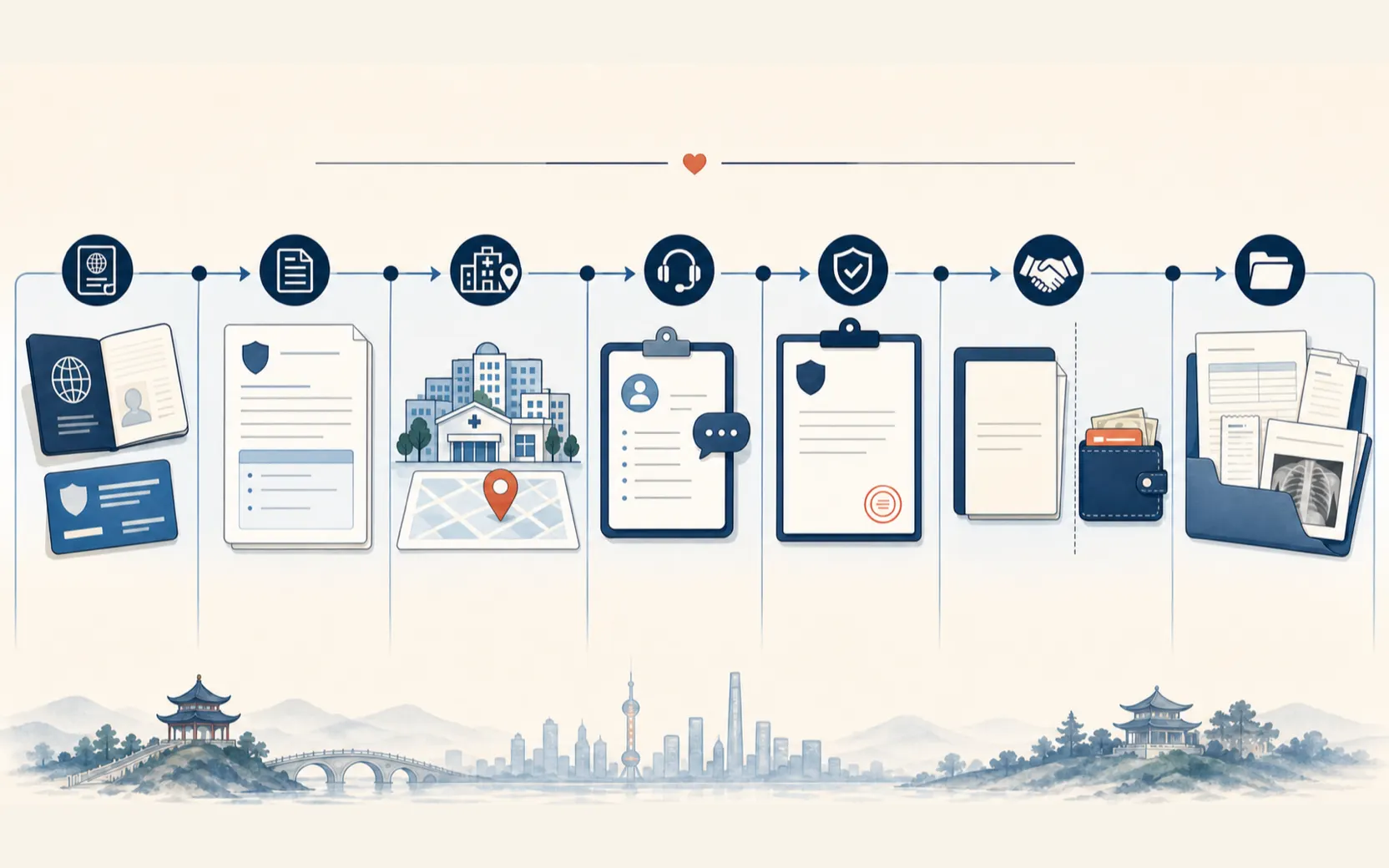
An insurance card, a hospital appearing on a partner list, an insurer authorization and a hospital's direct-billing confirmation are different records. None proves the others. For planned care, build one visit pack that ties the passport identity and member record to the exact campus, service and date, then records who will pay first. This guide covers document preparation and handoffs; it does not interpret a policy, decide coverage or replace an insurer's written decision.
Use this as a practical starting point
Provider procedures can change, so confirm time-sensitive details with the hospital, insurer or service. A licensed professional must make clinical decisions for an individual patient.
At a glance
Key points
- Match the passport name, member number and hospital patient profile before the visit.
- Verify the exact campus and planned service with both the insurer and the provider.
- Keep pre-authorization, a guarantee of payment and direct-billing acceptance as separate confirmations.
- An insurer or administrator logo on a hospital page does not prove that one policy or charge is eligible.
- Carry a fallback payment and reimbursement route even when direct billing is expected.
- Send identity and medical records only through a current channel controlled by the insurer or provider.
Match the insured person to the hospital patient record
Start with the exact name, date of birth and identity-document number used by the insurer. Compare them with the passport and the hospital appointment or existing patient profile. If a renewed passport, Chinese name, employer record or dependent record differs, ask the insurer and hospital how each organization records the link; do not silently create a second identity or edit a document.
Prepare the original identity document the provider accepts, the physical or digital insurance card, the member or policy number, the policyholder or employer group name when relevant, and a current insurer contact route. Jiahui's published patient-responsibility document, for example, asks for photo ID or passport and insurance or membership cards at initial registration; that is evidence of one provider's intake route, not a nationwide rule.
An insurance card identifies a membership record. It is not by itself a coverage decision, authorization, payment guarantee or hospital acceptance record.
Define the exact hospital, campus, service and date
Write the provider's legal or published name, campus, department or service, clinician when known, outpatient or inpatient status and planned date. A group-level agreement can coexist with campus, plan, service, room, medicine or benefit limits. Ask the insurer whether this exact combination is eligible and ask the hospital whether its insurance desk handles this exact policy or administrator.
Save the insurer's reply and the provider's reply as two records, including date, channel, representative or case reference and any conditions. Jiahui says its partner list changes, while Beijing United Family says plans differ and directs the patient back to the number on the insurance card for plan-specific coverage questions. Neither page proves an individual result.
Verify the transaction, not the logo: patient + policy + campus + service + date + payment route.
Name who pays first and what remains with the patient
Ask whether the planned visit is direct billed, paid by the patient and claimed later, settled through an applicable local social-medical-insurance route, or split across more than one route. Record the deductible, co-payment, excluded or non-covered items, deposit requirement and fallback if the insurer cannot confirm eligibility at check-in. Do not turn an estimate into a promise of the final balance.
Direct billing changes how an eligible charge is submitted; it does not necessarily remove patient payment. Beijing United Family explicitly describes plan-specific co-payments or deductibles and says its own direct-billing route accepts primary coverage only. Another provider, insurer or plan can use a different process.
Separate referral, pre-authorization and payment guarantee
Ask the insurer whether the planned service requires a referral, pre-authorization, case review, cost estimate, clinical records or a guarantee-of-payment document. Record who must submit each item, the secure destination, deadline, case number, approved provider and service, validity period and any amount or scope limit shown in the written response.
An insurer's approval does not book the hospital, and a hospital appointment does not prove authorization. A pre-authorization may confirm only the insurer's review of a stated request; a guarantee or direct-payment arrangement may be separate. Allianz's published process is one insurer example: it tells members to check the applicable benefits and form, submit specified planned-care requests in advance and treats direct payment as something arranged where possible.
Keep the request, the insurer decision and the provider acknowledgement. A case number without the decision's scope can be difficult to use at check-in.
Build one arrival pack with a secure digital backup
Put the passport or accepted photo ID, insurance card or digital membership proof, policy and member numbers, appointment confirmation, insurer contact, case or authorization reference, referral when required, written guarantee or direct-billing confirmation, and a backup payment method together. Add only the medical record, prescription, estimate or form that the insurer or provider has actually requested for this transaction.
Keep originals available when the provider requires them and retain a secure copy for recovery. Use the insurer's authenticated portal, app or a contact published on its current site, and use the provider's official patient or insurance route. Do not send passport or medical documents to an unverified broker, social-media account or forwarded address merely because it promises faster approval.
Reconfirm the billing route before chargeable services begin
At registration or the insurance desk, ask staff to match the patient identity, policy or administrator, authorization reference and planned service. Confirm whether the provider has received the insurer record, what the patient must pay now and which later orders would require a new approval. Keep the check-in or insurance-desk confirmation with the visit file.
If direct billing cannot be confirmed, ask for the written self-pay and reimbursement route before non-urgent services continue. For an emergency, obtain necessary emergency help first and follow the policy's current notification route as soon as practicable; this guide does not set an emergency deadline for every plan.
Preserve a fallback claim file before leaving
Even when direct billing is expected, retain the hospital's charge summary, patient payment evidence and any insurer or provider settlement reference. If the patient must claim later, obtain the exact official receipt or invoice, itemized bill and the clinical-administrative records the insurer names for that benefit. Check the patient identity, provider, dates and amounts before leaving the relevant desk.
Claim packages vary. Allianz's published guidance, for example, distinguishes pay-and-claim from direct payment and notes that certain claims may require a China tax invoice, reports, prescriptions, diagnosis information or admission and discharge records. Use the applicable policy and claim channel, then follow the separate China Care Desk claim-document guide for the post-visit file.
Do not alter a receipt, report or authorization. Ask the issuing organization to correct an error and preserve both the request and corrected record.
Avoidable problems
Common mistakes
- Treating an insurance card as proof that the visit is covered
- Checking only the hospital group instead of the exact campus and service
- Assuming a displayed insurer logo proves direct billing for one plan
- Using pre-authorization, a guarantee and direct billing as interchangeable terms
- Arriving with a case number but no written scope or provider acknowledgement
- Ignoring the deductible, co-payment, deposit or non-covered balance
- Starting planned chargeable care before a required approval is confirmed
- Sending passport or medical data to an unverified intermediary
Common questions
Frequently asked questions
Is my insurance card enough for a hospital visit in China?
Usually it is only one part of the file. The provider may also need an accepted photo ID, matching patient profile and a plan, authorization or billing reference. The card does not by itself prove that the exact campus, service or charge is covered.
What is direct billing?
It is a provider-insurer payment route for eligible charges. It can still leave deductibles, co-payments, deposits, exclusions or charges the patient must pay. Confirm the exact plan, campus, service and authorization rather than relying on a partner logo.
Is pre-authorization the same as a guarantee of payment?
Not necessarily. The names and legal effect depend on the insurer and plan. Ask what the document approves, whether it authorizes direct payment, its provider and service scope, validity dates, limits and conditions, and whether the hospital has received it.
Will the hospital contact my insurer for me?
Some providers publish insurance or international-patient support, but responsibility and timing differ. Record who will send the request, what the patient must supply, the case reference and what happens if confirmation is not received before the visit.
Should I bring paper documents or digital copies?
Ask both organizations. Carry originals when the provider requires identity or card inspection, and keep a secure digital backup. A screenshot may help identify a record but may not replace an authenticated app, original document or insurer-issued decision.
What if direct billing fails at the hospital?
Ask the provider and insurer to identify the failed handoff and the available self-pay or claim route. Keep the patient payment record, official receipt or invoice, itemized bill and supporting records the insurer specifies. Do not alter a hospital or insurer document yourself.
Evidence
Sources consulted for this guide
National rules are separated from city and provider examples. Access dates show when a source was collected; source pages and procedures can change afterward.