
Insurance & costs
Direct billing and reimbursement at hospitals in China
Choose and verify the payment route for one hospital visit—from insurer and hospital checks to patient share, final settlement and a fallback claim.
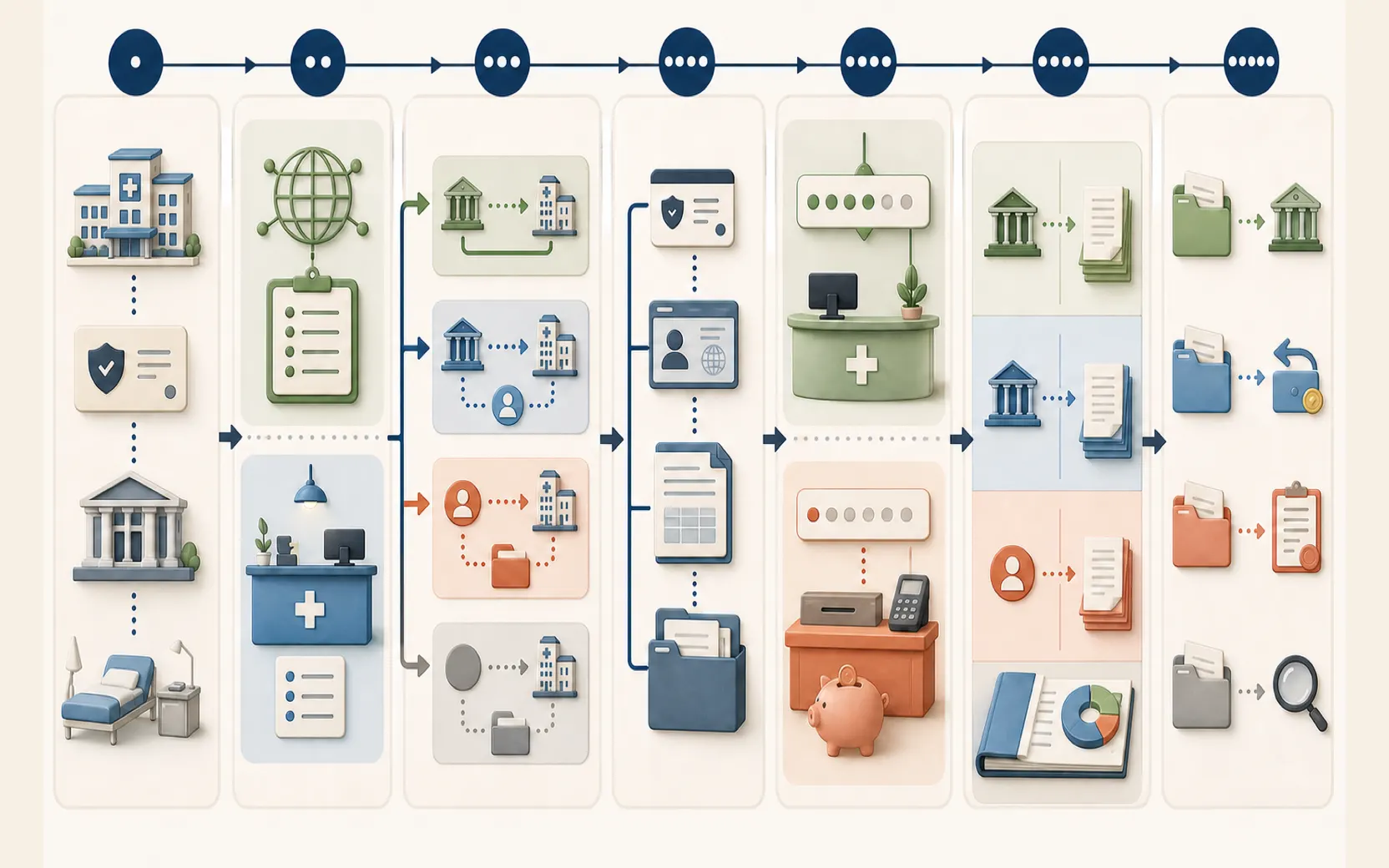
Direct billing and reimbursement describe how a hospital charge moves; they do not decide whether the care is covered. In a direct-billing route, the provider sends some or all eligible charges to an insurer or claims administrator. In a reimbursement route, the patient pays the provider and later submits the insurer's required evidence. One China hospital visit can also be partly direct billed, partly patient paid, still pending or moved from one route to the other. The current policy, exact provider relationship, written authorization where required, hospital acceptance, care actually delivered and final insurer decision control the result. There is no universal China network, cashless card, document list, payment deadline or reimbursement promise.
Use this as a practical starting point
Provider procedures can change, so confirm time-sensitive details with the hospital, insurer or service. A licensed professional must make clinical decisions for an individual patient.
At a glance
Key points
- Name the live payment state: full direct billing, partial direct billing, self-pay with a later claim or unresolved pending confirmation.
- Match the legal insurer or administrator, insured patient, policy, exact hospital entity, campus, department and care setting.
- Verify both sides: an insurer network entry is not hospital acceptance, and a hospital relationship is not confirmation for one policy and visit.
- Prepare the direct-billing record and a provider-accepted backup payment and reimbursement route before planned care.
- At registration and checkout, record what the insurer is billed, what the hospital collects and what remains pending instead of relying on the word cashless.
- Reconcile the final bill by payer, then keep a later claim, refund, billing correction or authorization problem as a separate case.
Name the payment state for this visit
Start one visit ledger and label the current route without predicting the final result. Full direct billing means the hospital expects to send the covered account to a payer and has not identified a patient collection beyond any confirmed share. Partial direct billing means the hospital sends one portion to the payer while collecting a deductible, copayment, excess, excluded item or other patient balance. Pay-and-claim means the patient settles the provider account and later asks the insurer to assess the documented expense. Pending means neither side has completed the operational decision.
These states can change as the visit develops. Cigna's published process describes provider invoices sent directly to it where possible, but also a route in which the patient pays and claims covered costs later, with deductibles or cost shares remaining in either route. Allianz's network guide says even an in-network provider may not guarantee direct billing and may require payment followed by a claim. HKU-Shenzhen describes direct billing as a provider-insurer arrangement whose effect depends on the patient's personal coverage. These are insurer- and provider-specific examples, not a universal definition of coverage.
- Full direct billing status, still subject to final settlement
- Partial direct billing plus a named patient share
- Patient pays the provider and opens a later claim
- Provider invoice sent to the patient for insurer handling
- Pending or unconfirmed route
- Final insurer-paid, patient-paid and unresolved amounts
Do not record direct billing as covered, paid or free. Record who is expected to receive the provider invoice and who must pay the hospital now.
Match the payer, patient and exact provider
Create a payment-route cover record before relying on a directory, card or logo. Identify the legal insurer and any claims administrator or assistance company, the insured patient and member or policy number, the active benefit period, and the exact hospital legal entity, campus, international or general department, outpatient, emergency, day-patient or inpatient setting, planned date and service. Keep an employer, broker, school, family payer or secondary insurer in a separate role field unless the current payer identifies it as the decision owner.
Provider networks are operational records, not permanent promises. Allianz says its network is dynamic and for reference and warns that direct billing is not guaranteed at every network provider. HKU-Shenzhen ties direct billing to an existing provider-insurer relationship and personal coverage and shows different outpatient-card and inpatient-GOP examples. United Family's Beijing page says its direct-billing arrangements vary by insurance plan and accepts primary insurance only for that provider route. None proves another campus, department, payer or policy will use the same arrangement.
- Legal insurer, administrator and assistance company
- Insured patient, member number and policy period
- Hospital legal entity, campus and billing department
- Outpatient, emergency, day-patient or inpatient setting
- Service and date for the actual encounter
- Primary, secondary, employer or family-payer role
A hospital group name on an insurer directory and an insurer logo on a hospital page are starting points only. Match the exact provider and visit on both sides.
Confirm the insurer route and hospital route separately
Ask the insurer or administrator whether the exact provider and setting can use direct billing under the current plan, which services need pre-authorization, what patient share or limit applies, what document it will issue and where the provider should send invoices. Save the authenticated response, case number and scope. Then ask the hospital insurance or finance desk whether it has a current operational relationship with that payer, has received the relevant card, authorization or GOP, can use it for this encounter and what it will collect from the patient.
Do not combine these answers. PKUIH's provider route starts with insurance-card information and benefit verification, moves through pre-authorization or a GOP for applicable planned care and later sends the bill to the insurer. That is its published hospital workflow, not a rule for every provider. A network confirmation is not pre-authorization, an authorization is not direct billing until the hospital accepts the arrangement, and hospital acceptance before care is not the insurer's final claim payment after the invoice is reviewed. Use the dedicated pre-authorization guide when a planned service needs that separate process.
- Insurer network and benefit status
- Pre-authorization or GOP requirement routed separately
- Patient share, limit and exclusions stated by the payer
- Hospital finance desk receipt and acceptance
- Provider invoice route and payer reference
- Separate current status for each organization
Two confirmations are required for a planned direct-billing route: what the payer says it can arrange and what the exact hospital says it can process.
Prepare both payment paths before care
For the direct-billing path, carry the identity and insurance evidence the provider requested and preserve the insurer or administrator case reference, current authorization or GOP where applicable, hospital acceptance, estimate and stated patient share. Confirm which original, digital card or form must be shown and whether the provider needs a signature at registration or checkout. Store sensitive records in a secure folder and use verified submission channels rather than addresses copied from an advertisement or informal message.
For the fallback route, identify a payment method the exact provider accepts, the likely deposit or patient-share collection, the insurer's current pay-and-claim instructions and the hospital desks that issue the final itemized statement, receipt or invoice and relevant clinical-administrative records. Cigna's route uses an invoice and claim information when the patient has paid; Allianz warns that payment followed by a claim may still occur even at some network providers. Preparing documents does not guarantee reimbursement. For emergency or urgent care, obtain the needed provider care and follow the actual policy notification route as soon as practicable rather than delaying for this administrative checklist or inventing a universal deadline.
- Identity and insurance evidence requested by the hospital
- Case reference and active authorization record
- Hospital acceptance and stated patient share
- Provider-accepted backup payment method
- Insurer's current reimbursement checklist and channel
- Hospital route for final financial and requested clinical records
A backup payment method protects access to the provider's payment route; it does not prove that the later insurer claim will be covered or reimbursed.
Check the live status at registration and checkout
At registration, ask the responsible desk to state the current route in operational terms: accepted direct billing, accepted with a patient share, waiting for payer or hospital confirmation, or self-pay. Record the hospital department, date and reference. If the provider collects money, ask whether it is a registration fee, deposit, deductible, copayment, excluded charge, full self-pay amount or another transaction and obtain the corresponding provider record. A card swipe, wallet entry or bank transfer alone does not explain what the money represents.
Recheck at checkout because services and status can change. United Family's provider page says the patient covers plan-specific copayments or deductibles in its direct-billing route. HKU-Shenzhen says personal coverage can leave full or partial medical expenses with the patient. PKUIH says its insured route can require patient out-of-pocket amounts before treatment and later produces a final bill. These examples show why partial direct billing is ordinary, but they do not determine one visitor's share or authorize the hospital to collect an unspecified amount.
- Registration status and responsible hospital desk
- Direct, partial, pending or self-pay route
- Deposit, deductible, copayment or other patient collection
- Provider-issued transaction record
- Changed service, setting or authorization status
- Checkout status before leaving the provider
Ask the hospital to name every amount it collects. Do not label all patient payment as a deductible or all uncollected charges as insurer paid.
Reconcile the final bill by payer
Build one final allocation from provider-issued records: total actual charges, any adjustment or refund, amount sent to the insurer or administrator, amount the payer has accepted, paid or left pending, amount collected from the patient and any unresolved difference. Keep the itemized statement, final settlement, provider receipt or invoice, direct-billing statement, deposit and refund record as distinct evidence. Do not count an estimate, deposit and final charge as separate expenses or treat an invoice sent to the insurer as proof that it was paid.
PKUIH publishes a final insured-patient bill that separates the insurer and patient portions in its own route. Cigna says a provider normally sends the invoice directly but may instead invoice the member, and its plan-specific deductibles or cost shares still apply. United Family also separates provider billing from the patient's plan-dependent share. The final hospital account and insurer settlement may not close at the same moment, so record sent, accepted, paid and pending as different statuses rather than filling missing information with an assumption.
- Actual provider charges and adjustments
- Amount invoiced to the insurer or administrator
- Payer accepted, paid and pending amounts
- Patient deposit, payment and refund
- Itemized statement, settlement and current receipt or invoice
- Unresolved balance and responsible organization
Direct billing describes an invoice route. Only the provider's final account and the payer's written settlement show what was actually allocated and paid.
Close each remaining route separately
If the patient paid an expense that may be claimable, use the current insurer checklist and submit the required provider financial and clinical-administrative evidence through the verified route. Save the exact attachments, confirmation, claim number, requests for more information and final decision. This page identifies the handoff only; use the dedicated claim-document guide to build the complete file and the delayed-or-declined authorization guide when the missing decision occurred before care.
Keep other problems separate. A wrong provider receipt belongs with the issuing hospital's correction process. An unused deposit belongs with the provider refund route. A hospital saying it sent an insurer invoice while the payer cannot find it is a direct-billing transmission or matching case. A partial or denied insurer payment is a claim-decision case. Cigna's pay-and-claim route and PKUIH's final settlement example show why the financial evidence must connect, but neither decides another case or promises recovery. Close each ledger only when its owner and written outcome are known.
- Reimbursement claim and submission record
- Direct-billing invoice transmission or matching case
- Hospital receipt or itemized-bill correction
- Deposit or overpayment refund
- Authorization delay or decline
- Final outcome and securely retained evidence
Do not merge a claim, hospital billing correction, deposit refund and authorization complaint into one request. Each organization can resolve only the record it owns.
Avoidable problems
Common mistakes
- Treating an insurer directory entry as guaranteed direct billing
- Assuming a hospital group relationship covers every campus, department and care setting
- Using an employer, broker or assistance company name without identifying the legal decision owner
- Combining network status, pre-authorization, GOP, hospital acceptance and final payment into one approval
- Recording direct billing as full coverage or zero patient payment
- Arriving without a provider-accepted backup payment method
- Calling every hospital collection a deductible without checking the transaction
- Leaving without final financial records because the hospital did not collect the full bill
- Treating an invoice sent to the insurer as an insurer-paid amount
- Claiming the estimate, deposit and final charge as separate medical expenses
- Merging reimbursement, refund, receipt correction and authorization problems into one case
Common questions
Frequently asked questions
Does direct billing mean I pay nothing?
No. It describes how some provider charges may be sent to a payer. A deductible, copayment, excess, excluded service, amount above a limit, deposit or unconfirmed charge may still be collected from the patient. Ask the hospital to name the transaction and preserve the final allocation.
Does an in-network hospital have to accept direct billing?
Do not assume so. Allianz's current network guide expressly says direct billing is not guaranteed with every network provider. The exact plan, provider entity, campus, setting, date, authorization and hospital finance status can all affect the route. Obtain current confirmation from both sides.
Is a direct-billing card the same as a GOP?
Not necessarily. HKU-Shenzhen publishes examples distinguishing an outpatient direct-billing card from an inpatient GOP. Other insurers and providers can use different terms. Ask what the document covers, for which setting and whether the hospital has accepted it for this encounter.
What if the hospital asks me to pay after direct billing was confirmed?
Ask whether the route is partial, still pending, mismatched or no longer usable and obtain the hospital's current status and transaction record. Pay through an accepted provider channel if required for the account, preserve the financial documents and ask the insurer how the self-paid amount should be assessed. Payment does not guarantee reimbursement.
Should I keep records after a fully direct-billed visit?
Yes. Ask for the itemized statement, final settlement and any provider receipt, invoice or direct-billing statement available for the route. Keep them with the insurer decision so you can see what was billed, what the patient paid and what remains pending or excluded.
Can I use two insurers for direct billing?
Do not assume the hospital coordinates them. United Family's Beijing page says its provider route accepts primary insurance only for direct billing. Ask each payer and the exact hospital how other-payer evidence and any later claim should work, and never submit the same unpaid amount twice.
Is reimbursement guaranteed if direct billing fails?
No. Pay-and-claim is a submission route, not a coverage decision. The insurer still applies the policy, authorization, network, benefit, patient-share and evidence rules. Obtain its current checklist and written decision rather than relying on the fact that the hospital required payment.
Evidence
Sources consulted for this guide
National rules are separated from city and provider examples. Access dates show when a source was collected; source pages and procedures can change afterward.