
Insurance & costs
Pre-authorization and GOP before planned care in China
Coordinate a planned-care insurance request from hospital estimate and insurer review to a scoped GOP, hospital acceptance, check-in and final settlement.
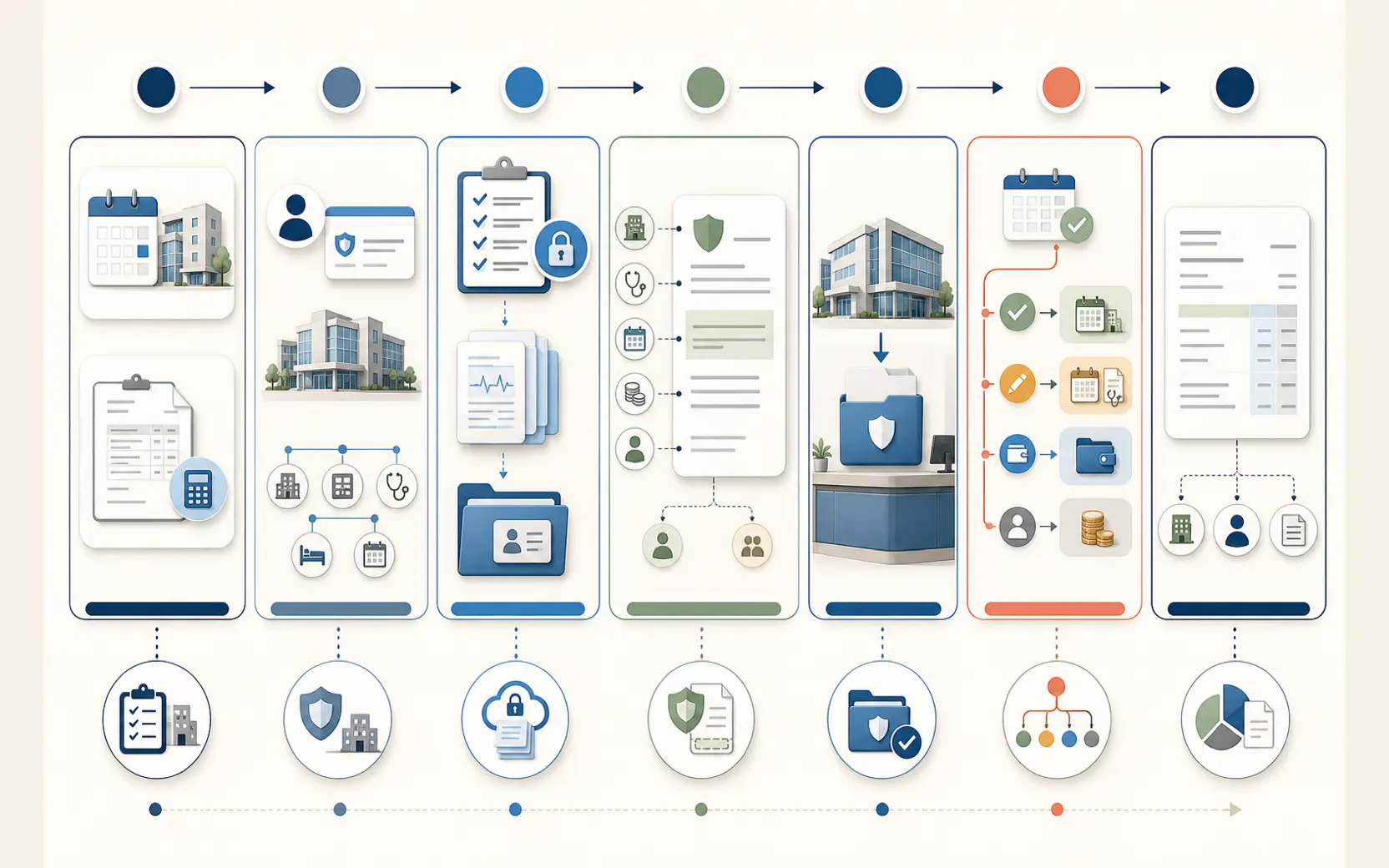
Pre-authorization, a guarantee of payment and hospital direct billing are related records, not one approval. For planned care in China, the patient may need to connect an actual appointment or admission plan and estimate to an insurer request, a written decision, a hospital finance check, the care that actually occurs and the final bill. A GOP can state what an insurer expects to pay within defined conditions, but it does not make the medical decision, reserve a bed, prove that the hospital has accepted the document or remove every patient payment. The current policy, insurer decision and exact provider route control the case; there is no universal China form, deadline, financial ceiling or result.
Use this as a practical starting point
Provider procedures can change, so confirm time-sensitive details with the hospital, insurer or service. A licensed professional must make clinical decisions for an individual patient.
At a glance
Key points
- Keep the appointment or admission plan, insurer eligibility, pre-authorization request, written decision, hospital acceptance and final settlement as separate records.
- Match the legal insurer or administrator, patient, policy, exact hospital entity, campus, department, care setting, service and date before submitting.
- Use the current plan checklist and record the request version, attachments, secure channel, case number and responsible submitter.
- Read a GOP for its named provider, treatment, setting, dates, currency, limit, patient share, exclusions and amendment route.
- Ask the hospital billing office to confirm that it has received and can use the document; insurer issuance alone is not hospital acceptance or an admission booking.
- Reconcile the care actually delivered and the final invoice, then preserve a self-pay claim route for amounts not handled directly.
Separate the six records before starting
Open one case record and give each stage its own status. The clinical or scheduling record shows the proposed provider, service, setting and date. The eligibility or network check asks whether the patient, benefit and exact provider route are recognized. The pre-authorization request is the versioned information sent for review. The insurer's decision or GOP states its scope and conditions. The hospital acceptance record shows whether the provider's finance team can use that decision. Direct billing and final settlement show what was actually charged, allocated and paid after care.
Do not collapse these stages into the word approved. Cigna's February 2026 product guide distinguishes prior authorisation from a GOP and describes the GOP in relation to estimated treatment at a particular provider before the later invoice is assessed. HKU-Shenzhen separately describes provider-insurer arrangements, personal coverage and different outpatient-card and inpatient-GOP examples. These are scoped insurer and hospital examples, but they explain why a network listing is not authorization, a case number is not a GOP, a GOP is not provider acceptance and direct billing is not proof that the patient owes nothing.
- Appointment, order, admission plan or estimate
- Patient eligibility, benefit and exact-provider check
- Pre-authorization request and submitted version
- Written decision, authorization or GOP
- Hospital finance receipt and acceptance
- Direct-billing allocation and final settlement
Pre-authorization is an insurance-administration process. It is not clinical approval, and a GOP is not a reservation for an appointment, procedure date, ward or bed.
Match the patient, policy, provider and planned encounter
Create a cover record before sending medical or financial documents. Record the legal insurer and any claims administrator, the insured person's name and member or policy number, the policy period and applicable benefit, the hospital's official entity and campus, department or clinician, outpatient, day-patient or inpatient setting, proposed service, planned date and estimate version. Keep the hospital patient number and the passport or other identity used for registration aligned without replacing the patient's identity with an employer, family payer or broker.
Provider and product details matter. A group name, English brand, hospital branch, clinic, international department and legal billing entity may not be interchangeable. HKU-Shenzhen says direct billing depends on both the provider-insurer relationship and personal coverage. PKUIH's published insurance route begins with card details and benefit verification and says major treatment or surgery may need pre-authorization. These provider examples support checking the precise encounter; they do not prove that the same insurer relationship, benefit or workflow exists at another campus.
- Legal insurer, administrator and plan or group
- Insured patient, member number and policy period
- Hospital legal entity, campus and billing route
- Department, clinician and care setting
- Proposed service, date and estimate version
- Employer, broker or family payer role kept separate
If the provider, campus, date, setting or service is still undecided, label the case provisional instead of presenting it as ready for authorization.
Build the request from the insurer’s actual checklist
Open the authenticated member portal, current benefit guide or verified insurer support route and identify the rule for the exact care setting and benefit. Record whether advance review is required, who submits, the current form, submission route, requested clinical and administrative material, estimate format, lead time, decision channel and amendment process. Ask the hospital which office can prepare its appointment record, estimate, treatment plan, admission certificate or other requested provider document, and send only what the actual checklist requires through a verified channel.
Allianz's current planned-care page tells relevant members to check the Table of Benefits, use the applicable form and submit listed treatment in advance; its published route uses at least five working days for those cases and may contact the hospital to arrange direct payment where possible. That is an Allianz-specific workflow, not a universal China deadline or outcome. Save the form edition, estimate version, attachments, submission timestamp and confirmation. If more information is requested, record what is missing, who must issue it and whether the insurer, administrator, hospital or patient owns the next action.
- Current benefit and pre-authorization rule
- Required form and estimate version
- Requested clinical and administrative documents
- Verified submission route and responsible submitter
- Submission confirmation and case number
- Request-for-information owner and response record
Do not copy another patient's form, attachment list or deadline. The current plan, benefit, service and care setting determine the actual request.
Read the authorization or GOP line by line
When a decision arrives, save the native document and check whether it is an acknowledgement, request for information, authorization, GOP, partial decision or denial. Match the patient and policy, exact provider and campus, department or clinician where stated, service and care setting, valid dates, currency, estimated or maximum amount, deductible, copayment or other patient share, exclusions, conditions, billing address or route, case reference and amendment instructions. Ask the insurer to correct its own record if a material field is wrong; never edit the PDF, email or screenshot yourself.
Cigna's specified 2026 product guide describes a GOP as an advance agreement to pay some or all costs of particular treatment at a particular provider, based on the estimate, with the relevant invoice considered after treatment and any shortfall handled through claim assessment. Allianz likewise ties pre-authorization to the plan's covered-treatment process and says direct payment is arranged where possible. These examples show why a GOP must be read as scoped financial administration rather than a blank cheque or a rewrite of the insurance contract.
- Document type and current status
- Patient, policy, provider, campus and department
- Service, care setting and valid dates
- Currency, estimate, ceiling and patient share
- Exclusions, conditions and billing route
- Case reference, amendment and correction route
A reference number alone does not establish what was authorized. Preserve the complete written decision and its stated scope.
Obtain hospital acceptance before relying on it
Send or route the document only through the insurer's and hospital's verified process, then ask the hospital billing or insurance desk to confirm receipt, legibility, patient match and operational acceptance for the exact encounter. Record the department, date, status and any hospital reference. Ask whether the patient must bring a card or original document, whether a deposit or patient-share amount remains, what happens if the estimated amount is exceeded and whether final discharge can wait for payer settlement. Do not rely on a broker forwarding message or an insurer's sent status as evidence that the hospital can bill it.
PUMCH's published commercial-insurance inpatient sequence, dated April 2022, separates a doctor's hospitalization certificate, the patient's insurer contact for a guarantee letter, later notice of the hospitalization date, admission-office checks and ward check-in. HKU-Shenzhen distinguishes outpatient direct-billing-card and inpatient-GOP examples, while PKUIH places provider benefit verification and the GOP before planned treatment in its own route. None proves a current entitlement at another provider; together they show that insurer issuance, hospital acceptance and admission scheduling are separate operational events.
- Hospital insurance or billing desk received the document
- Patient, provider, campus and encounter match confirmed
- Acceptance status and hospital reference recorded
- Required card, original or check-in evidence
- Deposit, deductible, copayment or excluded amount
- Escalation route if the hospital cannot use the GOP
A hospital may recognize an insurer yet still reject an incomplete, mismatched or out-of-scope GOP. Ask for the current reason and required next action instead of assuming coverage failed.
Reconfirm changes and check in with a fallback
Compare the live plan with the authorized record close to the appointment or admission. A changed hospital entity or campus, clinician, date, care setting, procedure, estimate, length of stay or additional service can require an amendment or new review. Tell the insurer and hospital through their official routes, record the requested change and wait for each party's current status. Do not overwrite the first decision or reuse an expired or mismatched GOP; keep each version and identify which one is active.
At check-in, bring the identity and insurance evidence the exact provider requested and retain a self-pay fallback. Ask the cashier to label any deposit or patient-share payment and issue the corresponding provider record. If direct billing cannot be confirmed, ask what must be paid now, which documents to preserve for a later claim and who continues the authorization case. For urgent or emergency care, obtain needed care first and follow the actual policy's notification route as soon as practicable; this planned-care checklist is not a reason to delay clinical attention or impose a made-up universal notification deadline.
- Active authorization or GOP version
- Provider, date, setting, service and estimate rechecked
- Insurer amendment status
- Hospital acceptance and admission status
- Identity, insurance evidence and patient payment route
- Self-pay claim file and emergency-notification fallback
Keep insurer status, hospital acceptance and appointment or bed status separate. A change can affect one without automatically cancelling or confirming the others.
Reconcile the final bill and close the case
After care, compare the authorized service and estimate with what was actually delivered and billed. Keep the itemized statement, final settlement, provider receipt or invoice, any direct-billing statement, deposit and refund records and evidence of the patient's payment. Identify the amount billed to the insurer, the amount accepted or pending, the patient share and any charge outside the GOP. Do not claim the estimate, deposit and final bill as separate expenses or treat a provisional insurer message as final settlement.
Cigna's product guide separates the estimated GOP from the later relevant invoice and claim adjudication. PKUIH's provider route describes a final bill that separates insurer and patient portions, and HKU-Shenzhen warns that personal coverage can still leave all or part of a charge with the patient. If direct payment fails or covers only part, build the later claim from the insurer's current checklist. If the authorization is delayed or declined, use the dedicated problem-resolution guide rather than mixing a complaint, hospital billing correction, refund and reimbursement claim into one case.
- Authorized scope and active GOP version
- Actual services and itemized final charges
- Insurer-billed, insurer-paid and pending amounts
- Patient share, deposit and refund reconciliation
- Provider receipt or invoice and settlement statement
- Separate claim, correction, refund or denial case
Only the insurer's written decision under the policy and the provider's final records establish the financial outcome; the pre-care estimate and GOP do not close the account.
Avoidable problems
Common mistakes
- Treating a network listing, eligibility check, pre-authorization, GOP and direct billing as the same approval
- Using a brand name without checking the hospital's exact legal entity and campus
- Submitting another plan's form, document list or deadline
- Reading a case number as approval without preserving the written scope
- Ignoring the GOP's dates, setting, currency, ceiling, conditions or patient share
- Assuming insurer issuance means the hospital received and accepted the document
- Treating a GOP as an appointment, procedure date, ward or bed reservation
- Reusing an old document after the provider, date, service or estimate changes
- Arriving without a deposit or self-pay fallback
- Sending passport, medical or payment records to an unverified address or social account
- Closing the case before the final bill and insurer settlement are reconciled
Common questions
Frequently asked questions
Are pre-authorization and a GOP the same record?
Not necessarily. Pre-authorization is the insurer's review process or decision for specified care. A GOP is a financial document used by some insurers and providers to describe an advance payment commitment within stated conditions. Ask the insurer and exact hospital how they use each term and preserve the written status.
How early should I request a GOP?
There is no universal China lead time. Start when the service, provider and estimate are sufficiently clear, then follow the current plan and provider deadlines. Allianz publishes at least five working days for listed planned treatment in its applicable route, but that deadline must not be generalized to another insurer, product or hospital.
Does a GOP guarantee that the hospital will accept direct billing?
No. The hospital still needs to receive, match and operationally accept the document for the exact encounter. Its provider-insurer arrangement, billing rules and the patient's coverage can affect the route. Record hospital acceptance separately from the insurer's issued status.
Does a GOP reserve my appointment, surgery date or hospital bed?
No. Scheduling and admission remain provider processes. PUMCH's published insurer route separates the guarantee letter from later notification of the hospitalization date and admission steps. Confirm the appointment, procedure or bed directly with the responsible hospital team.
Can the hospital still ask me to pay a deposit or patient share?
Yes. A deductible, copayment, excluded charge, amount above the GOP, unconfirmed authorization or provider operational rule can leave payment with the patient. Ask what the amount represents, how it will be settled and which provider record will be issued.
What if the provider, date, setting or estimate changes?
Tell both the insurer and hospital through their verified routes and ask whether an amendment, new estimate or new request is required. Keep the original and updated records, identify the active version and reconfirm hospital acceptance before relying on it.
What if direct billing is unavailable at check-in?
Ask the hospital what must be paid now and what financial records it will issue. Ask the insurer whether the authorization remains valid for reimbursement and obtain its current claim checklist. Keep that claim separate from any authorization delay, billing correction, deposit refund or complaint.
Evidence
Sources consulted for this guide
National rules are separated from city and provider examples. Access dates show when a source was collected; source pages and procedures can change afterward.