
Using hospitals
Hospital admission and discharge paperwork in China
Confirm admission status, passport registration, deposits, insurer guarantees, authorized contacts, discharge documents and follow-up.
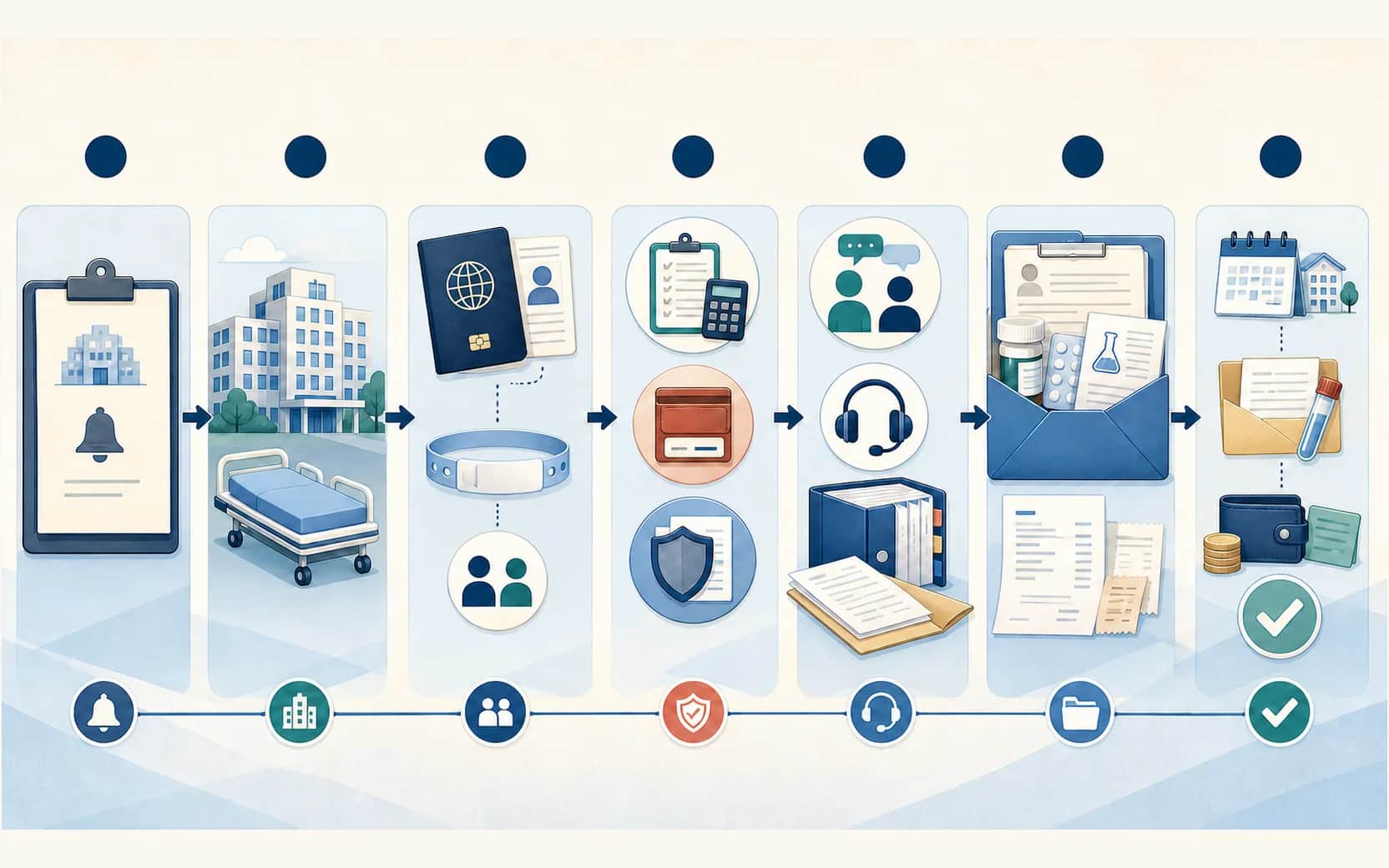
An admission notice, confirmed bed, inpatient registration, deposit, insurer guarantee, clinical consent, discharge decision and final settlement are separate states. Use the hospital's current route for each handoff, keep the financial and clinical records apart, and leave with named owners for every unfinished task.
Use this as a practical starting point
Provider procedures can change, so confirm time-sensitive details with the hospital, insurer or service. A licensed professional must make clinical decisions for an individual patient.
At a glance
Key points
- Confirm the exact campus, admitting department, arrival window and bed status instead of treating an admission notice as final confirmation.
- Keep the estimate, deposit, insurer guarantee, direct-billing decision and final bill as separate records.
- Register with the same passport identity used for care and define authorized contacts, language support and privacy access separately.
- The treating hospital decides clinical consent and discharge readiness; this guide only organizes the administrative chain.
- Before leaving, reconcile the discharge pack, follow-up route, pending results, claim documents and any refund or records request.
Confirm what has—and has not—been admitted
Ask whether you have only a clinician's admission recommendation or notice, a scheduled arrival, a confirmed bed or a completed inpatient registration. Record the hospital and campus, admitting department, ward or service, planned date and arrival window, admission contact and the office that will tell you if the date or bed changes.
Do not infer that a quoted date, surgery plan, insurer email or admission notice guarantees a bed or procedure time. Ask which conditions remain open, what proof of confirmation the hospital issues and whether the route is a conventional inpatient stay, observation, day care or another provider-controlled status. Follow only the responsible clinical team's preparation instructions for the exact admission.
An admission plan is not the same as a confirmed bed, completed registration or guaranteed procedure time.
Match identity, patient profile and authorized contacts
Use the passport or other identity document accepted by the hospital and keep the registered spelling, document number, date of birth and hospital number consistent. National patient-identification guidance uses at least two identifiers and does not treat a bed or room number as patient identity. Ask staff to resolve a mismatch rather than opening a second profile.
Write down an emergency contact, the person authorized for administrative updates, the person authorized to collect documents and the person who can help with language. These roles are not automatically the same and do not by themselves create clinical decision-making authority. Ask what written authorization and identity evidence the hospital requires for each role and what information it may disclose.
- Accepted identity document
- Registered name and hospital number
- Emergency contact
- Administrative update contact
- Document collection authority
- Language-support route
Separate the estimate, deposit and insurer decision
Keep five financial objects distinct: the provider's estimate, the requested advance payment or deposit, the insurer's authorization or guarantee, the provider's direct-billing decision and the final itemized bill. Any one can exist without the others. Ask which office owns each object, what reference it uses, what is still patient-payable and when an additional deposit may be requested.
The national advance-payment framework does not set one deposit for every hospital or patient. Provider examples also show that direct billing is plan-specific: Beijing United Family states that co-payments or deductibles can remain and describes its own primary-insurance rule, while Jiahui publishes its own insurer and settlement relationships. Neither page proves coverage for your admission. Confirm the exact patient, plan, campus, room, service and current guarantee status with both hospital and insurer.
- Written estimate and assumptions
- Deposit request and receipt
- Insurer case or authorization reference
- Guarantee-of-payment status
- Direct-billing status
- Patient balance and payment method
Identify every form, explanation and responsible signer
Ask staff to identify the purpose of each document before it is signed: inpatient registration, financial responsibility, privacy authorization, information-release authority, procedure or treatment consent, self-pay acknowledgement, transfer document or another form. Keep a copy or record of what the provider supplies and note unanswered questions.
If the patient does not understand the language or meaning, request the hospital's qualified language-support route and ask the responsible clinician or office to explain the form. Jiahui publishes rights to understandable information and interpreter assistance, while Beijing United Family publishes multilingual patient services. These are provider-specific examples, not a promise that every hospital has the same service. China Care Desk cannot decide capacity, consent validity, the correct signer or a treatment choice.
An authorized contact, interpreter, payer and clinical decision-maker are different roles. Confirm each role instead of assuming one person can do everything.
Maintain a stay ledger and name each handoff owner
Keep a dated ledger of the admitting team, ward contact, patient identifiers, deposit and payment receipts, insurer messages, new estimates or self-pay notices, external records supplied and documents requested. Ask the hospital how to obtain an interim charge statement or explanation and route an unexplained administrative issue to the responsible billing, insurance or patient-service office.
For a transfer, test performed elsewhere or change of service, record the sending team, receiving team, acceptance status, transport owner, record handoff and payment owner separately. National continuity guidance supports coordinated referral and information handoff, but it does not guarantee acceptance, a bed, transport, record visibility or insurer payment. Do not let an administrative spreadsheet replace the clinical team's instructions.
Build the discharge pack before leaving
The treating hospital decides whether the patient is clinically ready for discharge. Once discharge is planned, ask the team to identify the provider-issued discharge record or equivalent, current medicine instructions, reports and image-access route, pending results, follow-up department and contact point. Ask which items are available now and which require a later records request.
Separately collect the itemized bill, official receipts or invoices, deposit settlement, refund evidence, insurer claim or direct-billing documents and any medical certificate requested in advance. National inpatient-record rules describe many possible record components but do not prove that every item exists, is complete at discharge or is immediately copyable. Beijing United Family, for example, publishes a signed release route and provider-specific processing time for its own record copies; confirm the actual holder and current route at your hospital.
- Discharge record or summary
- Provider medicine instructions
- Reports and image-access instructions
- Pending-result owner
- Follow-up department and route
- Itemized bill and official receipts
- Deposit or refund record
- Insurer or claim documents
Close the follow-up, claim, refund and records loops
Before leaving the campus, write down four owners: who reviews clinical follow-up, who releases pending reports or formal records, who completes insurance or claim paperwork and who settles a deposit or refund. Record the next appointment type, acceptable substitute clinician, documents to bring, case references and the hospital's stated contact route or deadline for each unfinished task.
Confirm receipt rather than assuming that a referral, insurer message, uploaded record or refund request was completed. A provider or insurer may request another copy, translation, authorization or payment record. If the hospital gives urgent-care or time-sensitive follow-up instructions, act on those instructions instead of waiting for paperwork. This guide does not determine discharge readiness, interpret records or change treatment.
Avoidable problems
Common mistakes
- Treating an admission notice as a confirmed bed or procedure time
- Using a bed number as patient identity or opening a duplicate profile
- Assuming one companion is automatically authorized for updates, records and consent
- Treating an estimate, deposit, insurer guarantee and final bill as the same document
- Signing a form without identifying its purpose or requesting language support
- Assuming the insurer and hospital completed every handoff
- Leaving without the owner for pending results and follow-up
- Discarding deposit, refund, receipt or claim references after discharge
Common questions
Frequently asked questions
Does an admission notice mean my hospital bed is confirmed?
Not necessarily. Ask the hospital whether you have a recommendation or notice, a scheduled arrival, a confirmed bed or completed inpatient registration. Confirm the campus, department, arrival window, remaining conditions and the office that will notify you of changes.
Will insurance handle the admission automatically?
Do not assume so. An authorization, guarantee of payment and direct-billing decision are separate. Confirm the exact patient, plan, hospital, service, patient balance and any deposit with both hospital and insurer, and keep both reference numbers.
Can a family member receive updates or sign forms?
Hospitals follow authorization, privacy, capacity and signer procedures. Ask how the patient designates an update contact, document collector or representative and what identity or authority evidence each role requires. One role does not automatically create every other authority.
What if I do not understand an admission or consent form?
Ask the responsible hospital team to identify the form and arrange its qualified language-support route before signing. Do not rely only on an unverified machine translation for consent, treatment, medicine, payment or discharge instructions.
What should I collect at discharge?
Ask for the provider-issued discharge record, medicine instructions, reports or image-access route, pending-result owner and follow-up details. Separately collect the itemized bill, official receipts, deposit or refund record and insurer or claim documents. Some formal record copies may require a later request.
Who decides whether I am ready to leave the hospital?
The responsible treating hospital makes the clinical discharge decision. This guide is an administrative checklist only and must not be used to leave against medical advice, change treatment or decide whether a symptom is safe to manage outside the hospital.
Evidence
Sources consulted for this guide
National rules are separated from city and provider examples. Access dates show when a source was collected; source pages and procedures can change afterward.