
Tests, medicines & records
Hospital test results and follow-up in China
Track a China hospital test from order and preparation to report access, clinician review, follow-up booking and portable records.
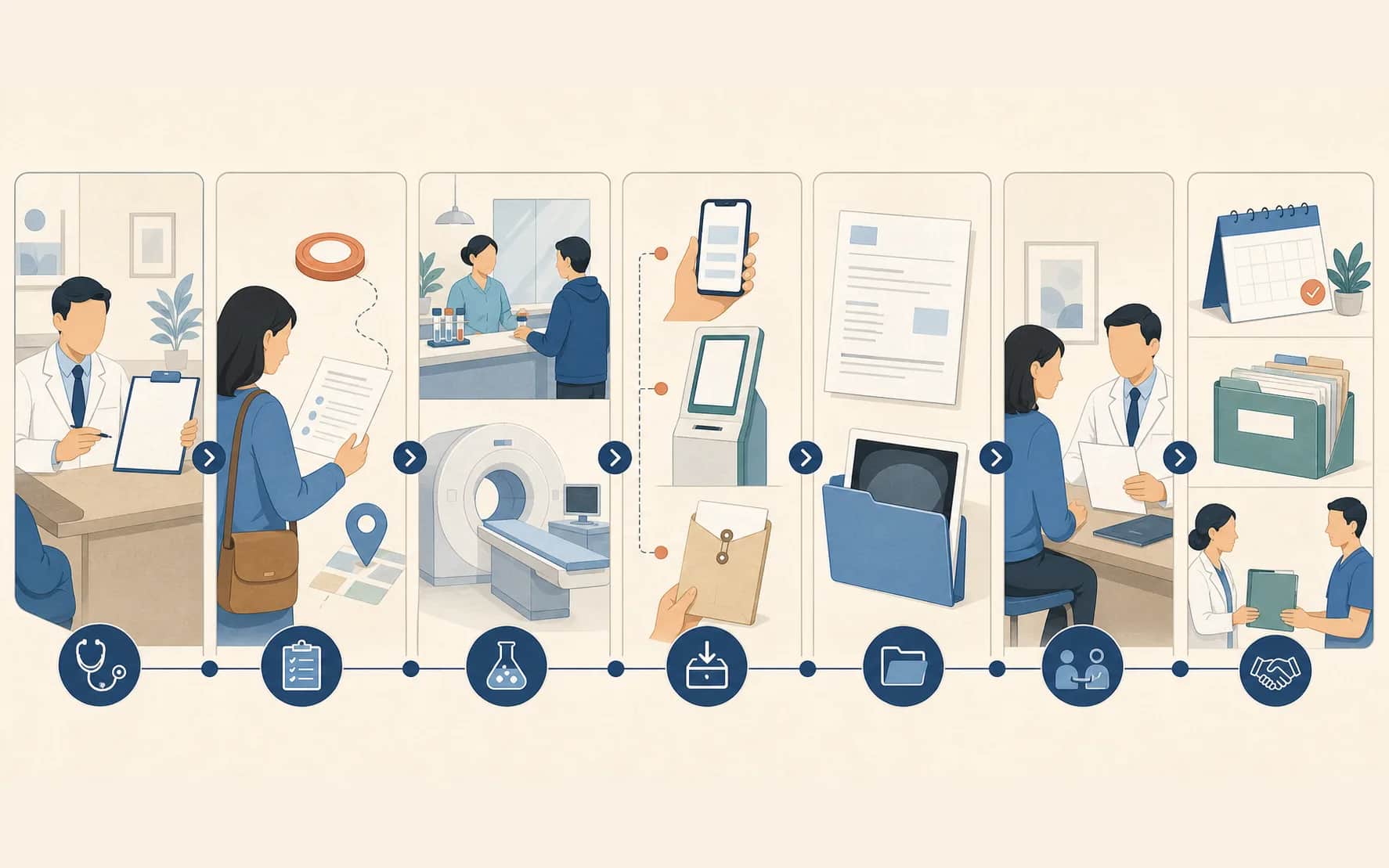
Getting a test in China is not one event. The order, payment, appointment, specimen or scan, preliminary status, signed report, images or other source files, clinician review and next appointment can sit in different systems and belong to different departments. A hospital app may show a result without proving that the ordering clinician has reviewed it. This guide gives international patients a provider-led administrative workflow for closing that loop. It does not select a test, supply personal preparation or medicine instructions, interpret a value, image or pathology phrase, decide urgency, or tell anyone to delay care.
Use this as a practical starting point
Provider procedures can change, so confirm time-sensitive details with the hospital, insurer or service. A licensed professional must make clinical decisions for an individual patient.
At a glance
Key points
- Order placed ≠ appointment booked ≠ test completed ≠ report final ≠ clinician reviewed ≠ follow-up closed.
- Before leaving the ordering visit, identify the exact test, campus, testing department, expected output and person or team responsible for review.
- Use only the written or directly confirmed preparation, medicine, consent and arrival instructions for the exact provider and order.
- Ask separately how to obtain the report, original images or DICOM data, pathology material, procedure record and any certified or translated copy.
- Match the passport spelling, hospital number, phone account and visit record before the test; duplicate patient profiles commonly break the access chain.
- A notification or coloured flag is not a personal interpretation. Route clinical questions and provider-issued urgent instructions to the responsible clinical team.
- Confirm whether review is automatic, by telephone, through a nurse or medical guide, by online consultation, or through a newly registered follow-up visit.
- Preserve the order, completion evidence, final report, source files, clinician explanation and follow-up plan as separate dated records.
- For another hospital, insurer or overseas clinician, confirm the recipient's required format and secure delivery route before requesting or translating files.
Start with a six-state test tracker
Create one line for every ordered test or examination. Record the exact name printed on the order, ordering clinician and department, hospital and campus, testing department, order number, payment status, booking status and expected output. Then add separate fields for completion, report release, clinician review and next action. This prevents a familiar failure: everyone knows that a scan or blood draw happened, but nobody can say whether the final report arrived or who owns the next step.
Use explicit states rather than one vague label such as pending or done. A useful sequence is ordered → paid or authorized → scheduled → performed or specimen accepted → report final → reviewed with a documented plan. Add a timestamp and contact route to each transition. If a provider uses another laboratory, imaging site or campus, identify both the organization performing the work and the organization issuing or explaining the result. The testing desk, ordering clinic, cashier, app support and records office may each control only one part of the chain.
- Exact provider-issued test or examination name
- Ordering clinician, department and campus
- Testing service and physical location
- Order, payment and appointment references
- Expected report, image or other output
- Named result-review and follow-up owner
Order placed ≠ appointment booked ≠ test completed ≠ report final ≠ clinician reviewed ≠ follow-up closed.
Confirm the exact campus, desk and appointment status
A hospital brand can cover several campuses, outpatient buildings and specialist centres. Confirm the full Chinese and English facility name, street address, building, floor, check-in desk and appointment time. Ask whether payment creates the appointment or whether a second booking action is required. For walk-in or same-day requests, ask whether the service can actually perform the test that day; arrival at a hospital is not a confirmed slot.
Keep the order screen or paper order, payment record and appointment confirmation separate. If the app displays only a department name, obtain the campus and room from a staffed provider channel. HKU-Shenzhen's published booking information, for example, separates online, telephone and on-site routes and warns that a same-day on-site request may not produce a same-day visit. That is a provider example, not a national rule, but it shows why a foreign patient should verify the exact route before travelling across a city.
Use only case-specific preparation and medicine instructions
Ask the ordering clinician or testing service for the written instructions attached to the exact order. Confirm arrival time, eating or drinking restrictions if any, current medicines, allergies, pregnancy or implant questions, clothing, consent, transport, companion needs, documents and post-test arrangements. Repeat the instructions back through an interpreter when language is a barrier. Do not merge advice copied from another hospital, an old test, a search result or a friend who had a similarly named procedure.
If instructions conflict, identify their source and date and ask the responsible provider to reconcile them before the appointment. Do not personally stop, delay, double or substitute a medicine because a generic page uses words such as fasting or contrast. Preserve the provider's final instruction and the staff or department that confirmed it. This page deliberately does not reproduce clinical preparation steps: test names that look similar can involve different equipment, protocols and patient factors.
China Care Desk cannot provide personal preparation, medicine or transport instructions. The ordering clinician and testing service must decide them for the exact order.
Keep identity, patient profile, order and payment connected
Before check-in, compare the name, date of birth, sex marker where used, passport or other accepted identity number, hospital number and mobile-account identity on the order and patient profile. Use the spelling under which the visit was registered, even when a preferred English name or a renewed passport is different. Ask registration staff to correct a mismatch through the official process; do not edit an image of the report, create a second profile or register another person's phone account merely to make a result appear.
Save the payment receipt or transaction reference and the test order together, but do not treat payment as proof that the specimen or examination was completed. If an insurer supplied an authorization, keep that as another record. When a result is missing, staff can then trace four distinct questions: was the order valid, was the service paid or authorized, was the work completed under the correct patient record, and was a final report released to the correct channel?
Inventory every output before the test
Ask what the service will produce and who holds each object. Possible outputs include a laboratory report, imaging report, original image data, DICOM study, viewer link, ECG trace, endoscopy or procedure report, pathology report, glass slides, paraffin blocks, cytology material, photographs, a health-screening summary or a clinician note. These are not interchangeable. A report describes findings; source images or retained material may be needed for a later review; a notification only says something changed in the system.
Write down the expected format, language, signature or stamp, release route, estimated window and retention or collection limits for each item. Beijing United Family publishes bilingual pathology reports for its own laboratory, while HKU-Shenzhen publishes separate collection routes for some pathology and department reports. Neither example promises that another campus, test or provider will issue the same language or format. Ask before testing when an overseas clinician, employer or insurer has a specific documentary requirement.
- Signed or final laboratory report
- Imaging report and separate image files
- DICOM download, disc or viewer access
- Pathology report and retained material route
- Procedure, ECG or other source record
- Clinician explanation and next-step record
Capture every official result-access route
Before leaving the testing desk, ask where the result will appear and how long that channel remains available. The route may be the hospital app, an official WeChat service, a kiosk, a patient-service centre, a nurse station, a medical-record office or a follow-up visit. Record the official account name or verified page, the patient profile required, the result category to select, collection hours, identity document and help route. A working path at one hospital is not a China-wide system.
PUMCH directs authenticated patients to its official app for available laboratory reports and notes limits for some report types. HKU-Shenzhen publishes app or WeChat access, kiosk printing, a service centre and department collection, with different handling for some reports. Those examples are useful because they expose the decision tree: digital visibility, printed collection and department-held results can coexist inside one hospital. Ask which branch applies to the exact order instead of repeatedly refreshing one screen.
Treat laboratory, imaging and pathology timelines differently
Do not apply one turnaround promise to every ordered item. Routine laboratory work, microbiology, send-out testing, radiology, ultrasound, functional tests, cytology and surgical pathology can have different processing, sign-off and release stages. Ask whether the quoted time means specimen processing, preliminary availability, final authorization, app visibility or collection. Record business days versus calendar days and whether weekends or holidays change the route.
Beijing United Family publishes that many results in its own clinical laboratory are available within hours and separately describes its pathology service; this is not a guarantee for a particular patient. HKU-Shenzhen's cardiology division publishes different completion messages and time examples for different cardiac examinations. The operational lesson is to obtain a provider-specific estimate for each item and a contact point for an overdue result, not to convert an example into a deadline for another service.
Separate preliminary, partial, amended and final results
A multi-part order may release in stages. Ask whether the visible document is preliminary, partial, pending verification, supplemented, amended or final, and whether another component is still outstanding. Save the issue time and version rather than overwriting the first file. If a provider replaces or amends a report, keep the provider-issued versions and the explanation route; never edit a PDF or screenshot to make the fields look consistent.
Build a reconciliation line for each component: ordered item → performed or specimen accepted → result status → final report identifier → review status. A portal notification may refer to only one component. Notification received ≠ report accessible ≠ record complete ≠ clinician reviewed ≠ next action confirmed. When an insurer or receiving clinician needs the final set, wait for the issuing provider to identify which document is final rather than guessing from timestamps or colour labels.
Troubleshoot a missing or inaccessible result in order
Start with the issuing provider, not a search engine. Confirm the test order, patient name and hospital number, completion date, testing department, expected release window and result type. Then ask whether the report is still processing, held for department collection, hidden from the current channel, linked to a different patient profile, amended, or available only after a clinician step. Record the case or service reference, date, channel and staff response.
Route the failure to the owner: app access to digital support or registration, a name mismatch to registration or records staff, an overdue report to the testing department, a missing formal copy to the relevant service or records office, and a clinical question to the responsible clinician. If the first service route does not resolve an administrative failure, use the provider's patient-relations or advocacy route with a concise timeline. Do not post the full report, passport or patient number publicly to seek help.
- Order and completion evidence
- Correct patient profile and hospital number
- Expected release date and result category
- Screenshots with unrelated personal details redacted
- Provider case number and prior response
- Specific requested resolution and secure reply route
Do not interpret the portal before clinician review
A number, reference interval, highlighted flag, machine comment, translated label or app explanation is not a complete clinical assessment. It may lack the reason for testing, specimen conditions, method, prior results, images, examination findings and the clinician's decision. Do not use this guide or a translation tool to diagnose a condition, decide that a result is harmless, change treatment or determine how long it is safe to wait.
Ask the ordering team how questions are handled and who can explain the result in a language the patient understands. Jiahui's patient-rights page says patients should receive understandable information and interpreter assistance within its provider process. That supports asking for communication help; it does not promise a particular language at every provider or replace a clinician. Preserve both the final report and the dated review note or instructions so the record shows what was explained and by whom.
A released report is evidence that a document became available—not evidence that a clinician reviewed it, that it is normal, or that no follow-up is needed.
Close the clinician-review loop explicitly
Before or immediately after testing, ask whether the ordering clinician reviews results automatically, whether a nurse or coordinator calls, whether the patient must send or return the report, whether an online consultation is available, or whether a new registration is required. Record the department, named clinician or accepted substitute, appointment type, booking channel, fee status and documents to bring. Do not assume that the laboratory or imaging desk owns clinical follow-up.
Provider workflows can differ even within one institution. HKU-Shenzhen publishes general initial and follow-up booking routes and a cardiology example in which reports are taken back through a nurse or medical-guide desk and some reviews require new registration. Jiahui describes clinician review and referral within its own health-management service. These examples show that 'the doctor will see it' needs an operational answer: which doctor, through which queue, by what date, and how the patient learns the documented plan.
Handle provider calls and urgent-result instructions safely
Ask the provider which phone number, app inbox or contact will be used for result communication and make sure the registered contact details work. Save the official hospital number where possible, but remember that caller ID can be incomplete. When someone calls, verify the institution, department, patient reference and a safe callback route before disclosing additional sensitive information or sending payment. Do not ignore a provider message merely because the report is not yet visible in the app.
If the provider gives an immediate-care, urgent-review or return instruction, follow that provider instruction or call the provider's verified clinical route now. For a perceived medical emergency in mainland China, call 120. China Care Desk cannot classify a result, compare symptoms with a report or say whether it is safe to wait. Administrative questions about access, payment or translation must not delay the emergency route selected by the responsible provider or emergency service.
Plan a follow-up appointment that can actually use the result
When booking, state that the purpose is review of a completed test and provide the original department, clinician, test date and report status. Ask whether the slot must be with the ordering clinician, the same specialty, a designated follow-up clinic or another service. Confirm whether all components will be final before the appointment and whether the clinician can access the source images or only the report. A booking with the wrong campus or a clinician who cannot see the record may create another visit without closing the loop.
Prepare the final report, image access, prior comparison, medicine list, provider-issued questions or instructions and interpreter arrangement. Do not prepare a self-diagnosis. If the appointment is delayed, ask the responsible provider whether another accepted review route exists; this website cannot decide whether waiting is clinically safe. HKU-Shenzhen's publication that not all departments offer online booking is a useful reminder to test the exact follow-up channel rather than assuming the initial-booking method will work again.
Distinguish routine screening from diagnostic follow-up
A health-check package may bundle tests, a summary and a post-assessment consultation, while a diagnostic order usually begins with a clinician and a defined clinical question. Ask who reviews every component, whether a combined report waits for all items, how a concerning or incomplete item is escalated, and how a referral is booked. Do not assume the package closes the loop merely because a printed booklet is collected.
Jiahui's health-management service publishes a provider-specific sequence that includes a detailed report, clinician explanation, referral and post-examination follow-up. That is evidence of one designed workflow, not a recommendation for screening or proof that another provider will do the same. If a screening provider recommends another consultation, obtain the signed report, source files and referral or booking instructions, then confirm acceptance with the receiving service. A marketing summary is not automatically the complete portable medical record.
Prepare a portable package for another China provider
Ask the receiving provider what it needs before sending anything: final report, original images, DICOM study, pathology slides or blocks, specimen details, procedure note, translation, referral letter or comparison study. Confirm accepted file types, upload limits, physical collection, authorization and whether the receiving clinician must repeat an assessment. A prior report can support continuity without obligating the new provider to adopt it or avoid another test.
Preserve provenance. Use the hospital-issued file, original filename, issue date, institution, department and patient identifiers; keep any translation beside the source rather than replacing it. Record sent → received → file opened → linked to correct patient → clinically reviewed → accepted or further information requested. Sent ≠ received ≠ technically usable ≠ clinically reviewed ≠ accepted for current care. Keep transport or courier details for physical pathology material separate from clinical acceptance.
Prepare records for an insurer or overseas clinician
Ask the recipient for a written checklist. An insurer may want a claim form, itemized bill, official invoice or receipt, order, report and clinician note; an overseas clinician may want source images, laboratory units and methods, pathology material or a certified translation. Do not assume one PDF serves every purpose. Match every document to the encounter and charge, and keep financial records separate from the clinical report.
For cross-border or second-opinion use, confirm patient consent, secure delivery, file-size limits, translation responsibility, receiving contact and acknowledgment. Jiahui's published international second-opinion workflow describes record collection, checking, translation and institution-to-institution transfer within its own service. It demonstrates the value of a controlled handoff but does not guarantee that a chosen overseas recipient will accept the file. Obtain explicit confirmation from the actual recipient before paying for translation, courier or repeat imaging.
Protect privacy without breaking the care handoff
Test results, images and pathology records can contain highly sensitive identity and health information. Use the provider's authenticated channels or a recipient-approved secure method. Verify the person, department and purpose before sending; share only the necessary record set; and keep a delivery log. Avoid public file links, social-media groups, shared hotel printers and unverified translation accounts. Redact unrelated information only on a working copy, never on the issuing provider's original.
A companion, employer, school, insurer or translator does not automatically have authority to receive the full record. Ask the provider and recipient what consent, representation or authorization they require. Jiahui's patient-rights statement distinguishes care-team access from third-party access with patient or authorized-representative permission within its process. When access is disputed or the patient cannot act personally, use the record holder's formal route rather than handing credentials to another person.
Finish with a documented next-action record
The workflow is complete only when the patient can identify the final result set, who reviewed it, the date of review and the provider-issued next action. Save the appointment outcome, clinician explanation, referral, new order, prescription status or instruction that no further provider action is currently scheduled. Do not translate silence, an empty task list or a normal-looking flag into a clinical conclusion. If the plan depends on another report, put that report back into the tracker as an open item.
Set a practical administrative reminder for any provider-stated release or follow-up date and preserve the verified contact route. A provider may use a call plus a later appointment, as Jiahui describes for one same-day-surgery pathway, or a nurse-desk handoff plus new registration, as HKU-Shenzhen describes for one cardiology workflow. The pattern matters more than the example: every pending result needs an owner, every owner needs a reachable channel, and every completed review needs a record that can travel with the patient.
Notification received ≠ report accessible ≠ record complete ≠ clinician reviewed ≠ next action confirmed.
Avoidable problems
Common mistakes
- Treating the order, booking, test, report and review as one event
- Assuming payment automatically booked or completed the test
- Going to the correct hospital brand but the wrong campus or testing desk
- Copying fasting or medicine instructions from a generic article
- Using instructions from a prior test or another provider
- Changing medicine without the responsible provider's instruction
- Registering under a nickname that does not match the visit record
- Creating a duplicate patient profile when a report is missing
- Assuming every result appears in the same app
- Refreshing an app while ignoring a department collection route
- Treating a notification as the final signed report
- Missing a partial, amended or still-pending component
- Applying one turnaround time to laboratory, imaging and pathology work
- Saving only a screenshot when a formal report is required
- Saving only the imaging report when a recipient needs source images
- Treating a viewer link as a permanent portable archive
- Assuming a pathology report includes access to slides or blocks
- Reading a coloured flag or reference interval as a diagnosis
- Using machine translation as clinical interpretation
- Assuming the ordering clinician reviewed the result automatically
- Booking any doctor without checking record access and department
- Waiting for an insurer or translator when the provider gave an urgent instruction
- Sending a full report and passport through an unverified messaging account
- Giving a companion account credentials instead of arranging accepted authorization
- Editing the provider-issued PDF to correct a name or translation
- Sending records without confirming the recipient can open or link them
- Assuming another provider must accept a prior test or avoid a repeat
- Paying for translation before confirming the recipient's language and certification needs
- Mixing invoices and receipts with the clinical report as if they prove the same fact
- Treating a screening booklet as a completed specialist follow-up
- Closing the tracker because the report looks normal to the patient
- Leaving China without the final report, source files and review plan
Common questions
Frequently asked questions
How do I get hospital test results in China?
Ask the exact provider and result type. The route may be an official app or WeChat service, kiosk, patient-service centre, nurse station, records office or follow-up visit. Confirm the patient profile, expected release window, formal-copy route and whom to contact if it does not appear.
Will my test results automatically go to the doctor?
The result may enter a hospital system without proving that the responsible clinician reviewed it. Ask whether review is automatic, by callback, through a nurse or coordinator, by online consultation, or through a new registration and appointment.
Why is my result not visible in the hospital app?
It may still be processing, linked to another patient profile, excluded from that channel, held for department collection, amended or waiting for another step. Contact the issuing provider with the order, patient number and completion date; do not create a duplicate profile to force access.
Is an app screenshot an official medical report?
Not necessarily. Ask whether the recipient needs a signed or final PDF, stamped printout, imaging report, original images or another provider-issued record. Preserve the screenshot as access evidence but obtain the required formal object from the issuing provider.
How long do hospital test results take in China?
There is no single nationwide turnaround for every test. Ask the testing service what its estimate means—processing, preliminary status, final sign-off, app release or physical collection—and whether it uses business days. Do not apply one hospital's published example to another order.
Can I receive a medical report in English?
Language availability is provider- and result-specific. Some providers publish bilingual reports for particular services, but that is not a nationwide promise. Ask before the test and confirm whether the recipient wants the original, a provider-issued English version or a formal translation.
What is the difference between an imaging report and the images?
The report is the provider's written result; the source images may be a DICOM study, disc, download or viewer. A later clinician may request one or both. Ask the imaging service and recipient for the exact format and access route.
How do I request pathology slides or blocks?
Start with the issuing pathology department and the receiving provider's written requirements. The report, glass slides, paraffin blocks and other retained material are different objects and may require identity, consent, authorization, deposit, courier or return arrangements. Use the dedicated pathology-record guide for the full handoff.
Do I need another appointment to discuss results?
Possibly. Ask the ordering team whether it reviews automatically, calls, accepts reports through a nurse desk, offers online review or requires a new registration. Confirm the department, clinician or accepted substitute and whether all components will be final before the appointment.
What should I do if a hospital calls about a result?
Verify the institution, department, patient reference and safe callback route. Follow any provider-issued urgent or immediate-care instruction. For a perceived medical emergency in mainland China, call 120. China Care Desk cannot determine urgency from a call or report.
Can China Care Desk tell me whether a result is normal?
No. China Care Desk does not interpret values, flags, images, pathology wording or urgency and does not recommend treatment. Contact the responsible clinical team and use language support if needed.
Can another hospital use my existing test results?
It may consider them, but the receiving provider decides what it can use for current care. Ask what report, images, source data, translation or material it needs and whether another assessment is required. Delivery does not equal clinical acceptance.
What should I send to my insurer?
Request the insurer's current checklist. It may distinguish the claim form, itemized bill, official invoice or receipt, order, report and clinician note. Match each document to the encounter and do not assume the clinical report proves payment.
How can I send results to a doctor outside China?
Confirm the recipient, consent, secure delivery method, file type, image format, translation and acknowledgment first. Send the hospital-issued source and keep any translation beside it. Record whether the recipient received, opened and linked the file to the correct patient.
What if my passport number or name changed?
Use the hospital's formal identity-correction or record-linking route. Bring the old and new identity evidence it requests. Do not edit the report or create a second profile; the issuing provider must preserve and explain the record chain.
When is the test-and-follow-up process finished?
When the final result set is identified, the responsible clinician or team has reviewed it, and the provider-issued next action, owner and date are documented. A notification, report download or empty app task list alone does not prove the loop is closed.
Evidence
Sources consulted for this guide
National rules are separated from city and provider examples. Access dates show when a source was collected; source pages and procedures can change afterward.