
Using hospitals
Using Shekang and family-doctor services in Shenzhen
Use Shenzhen community health services without mixing visits, contracts, health records, referrals, insurance selection or emergency care.
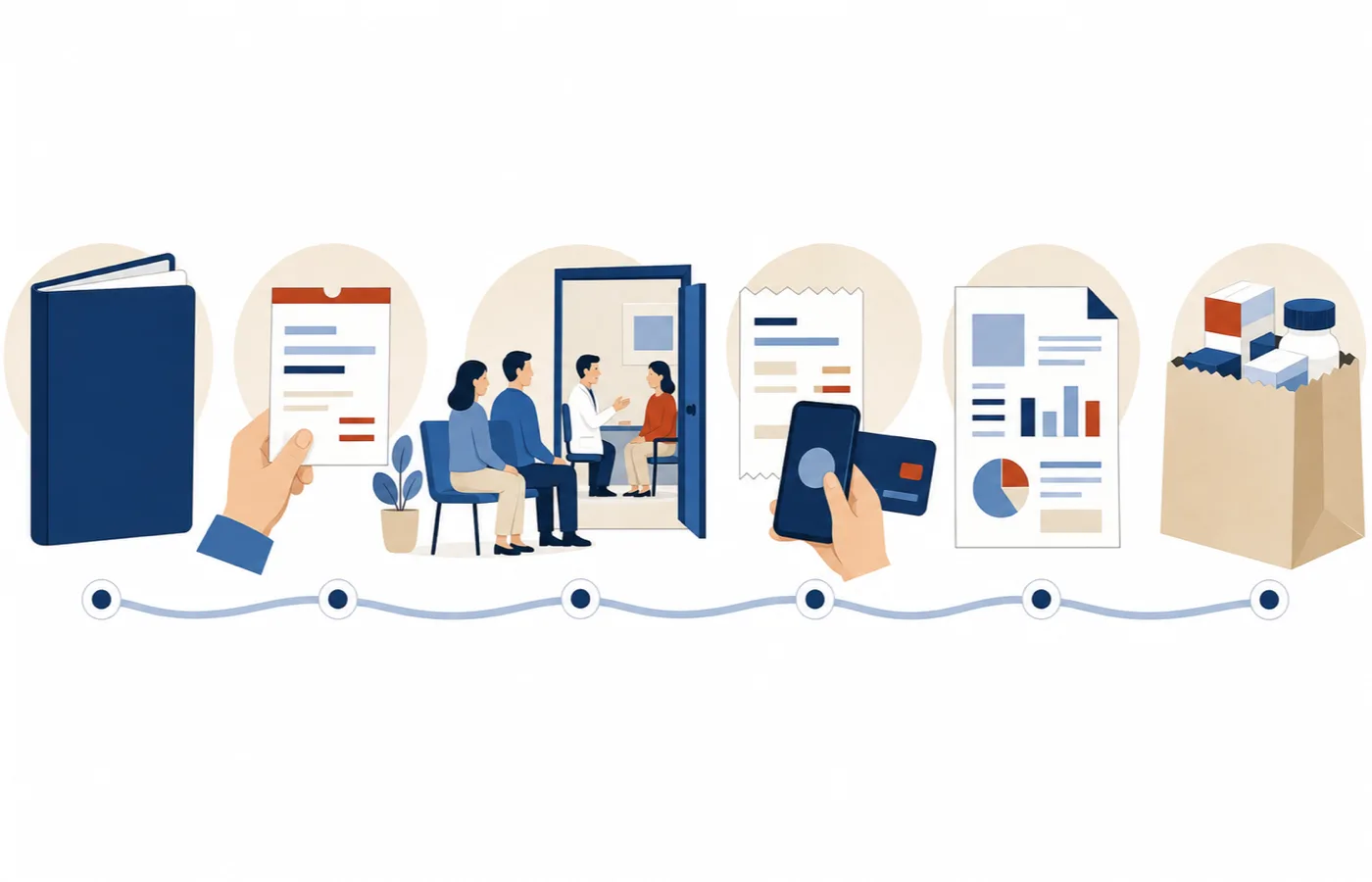
In Shenzhen, a 社康, commonly called Shekang, is a community health service institution within the city's primary-care system. It may provide ordinary outpatient care, basic public-health work, resident health management and family-doctor services, but access to one function does not create the others. Shenzhen's current family-doctor package rollout, Community Health Connect platform, resident electronic health-record rules and medical-insurance provider-selection rules each have their own identity, residence, agreement and system steps. This guide helps a foreign resident separate those workflows and ask the exact institution for a documented route. It does not select a clinical service, assess symptoms, recommend treatment, confirm that a passport or overseas telephone number will work, guarantee English support, determine insurance benefits or replace a Shekang institution, district health authority or treating professional. For a possible medical emergency, call 120 in the Chinese mainland or use the emergency service where the person is; do not wait for a Shekang appointment, family-doctor message, health-record creation, facial verification, referral or insurance selection.
Use this as a practical starting point
Provider procedures can change, so confirm time-sensitive details with the hospital, insurer or service. A licensed professional must make clinical decisions for an individual patient.
At a glance
Key points
- Use the Shenzhen Municipal Health Commission's Shekang directory to identify the legal institution, responsible hospital and exact address, then confirm services and hours directly.
- A normal Shekang visit, a family-doctor agreement, a resident electronic health record and a free basic public-health service are separate transactions.
- Shenzhen's December 2025 official launch described family-doctor packages for residents living in Shenzhen for more than six months regardless of household registration, but it did not expressly confirm every foreign-passport route.
- Community Health Connect and related official platforms can support online applications, yet facial verification, mainland telephone, family relationship and identity requirements can make an in-person route necessary.
- Current Shenzhen rules allow a resident to choose a community institution as the health-record responsibility unit, but the published identity examples do not expressly settle passport or romanized-name handling.
- A family-doctor package is not private 24-hour care, automatic home service, a guaranteed specialist appointment or an emergency service.
- Shekang provider selection for basic medical insurance is distinct from family-doctor signing. A referral may need clinical, provider and insurance steps.
- Public-health services, family-doctor packages, ordinary medical charges and medical-insurance payments must be labelled separately before assuming a service is free or covered.
- Call 120 for a possible emergency without waiting for the family doctor, Shekang or insurer.
Understand what Shekang means before choosing an administrative route
Shenzhen uses 社康机构 for community health service institutions. The municipal system includes centers and other community sites connected to responsible hospitals or primary medical groups. Current rules position these institutions as local platforms for resident health management, general outpatient and other services within their licensed scope. That system role does not mean every Shekang has the same departments, tests, medicines, public-health responsibility, family-doctor team, weekend hours or foreign-patient support.
Start by naming the transaction: ordinary outpatient registration, family-doctor signing or package purchase, resident electronic health-record creation, basic public-health service, referral, medical-insurance provider selection or identity correction. Reception staff may route each request to a different desk or system. Do not ask only whether the clinic 'does family medicine' or 'takes医保'. Ask which exact transaction the legal institution can perform for the person's identity, address and insurance category.
This is not a clinical triage guide. If a professional assessment may be needed, ask the Shekang or another licensed provider how to register. If a medical emergency may be occurring, call 120 in the Chinese mainland or use the emergency service where the patient is. A family-doctor chat, Community Health Connect message, general outpatient queue, insurer hotline or health-record desk is not ambulance dispatch. Immediate care comes before signing, facial verification, referral and settlement administration.
Shekang is a local service institution, not one universal product. Confirm the legal site, requested transaction and current capability each time.
Find a legal Shekang institution and verify the exact site
Use the Shenzhen Municipal Health Commission's official community health service center directory. It publishes district, responsible hospital, Shekang name and address for institutions undertaking basic public-health work. Record the Chinese legal name and responsible hospital rather than relying on an English translation or map brand. A medical group can have multiple Shekang sites, and provider-selection or referral rules can depend on the institutional relationship.
Contact the exact site and ask whether it is open, whether the intended service is available at that address and whether an appointment is required. Confirm ordinary outpatient registration, family-doctor office, health-record or public-health desk, pharmacy, testing and insurer cashier separately. The city's 2026 plans and published network size demonstrate broad coverage, not identical service capacity. A nearby site may route the resident to another campus for a particular department or public-health service.
For public-health or resident-record work, ask whether the institution is the health-management responsibility unit for the current address or whether the person may choose it. For ordinary outpatient care, ask whether it accepts patients outside that service grid. For medical insurance, ask whether it is the participant's selected institution or within the selected institution's affiliated network. These answers can differ even when the same Shekang name appears in each conversation.
Save the official directory result and the center's dated confirmation. If the directory shows one address but the institution reports a move, renovation or changed telephone, ask the district health authority or official hospital group channel to verify the new site. Do not send identity documents to a number copied from an unverified map listing.
- District, legal Shekang name and exact address
- Responsible hospital or primary medical group
- Current hours and appointment channel
- Ordinary outpatient services at this site
- Family-doctor team and package availability
- Health-record and public-health responsibility
- Insurance selection and affiliated-provider relationship
- Foreign-document and language support
Keep an ordinary visit independent from signing and package purchase
An ordinary Shekang visit is a patient-registration, clinician and billing workflow. Ask which identity document creates the patient record, whether a mainland mobile number or electronic health code is needed, whether same-day registration is possible and what fee and payment methods apply. Bring relevant records for the clinician, but do not assume a registration clerk can translate or clinically interpret them. Successful registration does not by itself sign the patient with a family-doctor team.
A family-doctor agreement creates an ongoing relationship under a defined package and term. Shenzhen's official December 2025 launch described four package types: a no-charge basic package, paid general-population and priority-population packages with stated medical-insurance and personal shares for eligible Shenzhen-insured residents, and district or institution-designed personalized packages. Treat the published figures as the launch framework and obtain the current package and price from the exact Shekang before signing.
Read the agreement and package line by line. Identify the team, one-year term, included contact channel, public-health items, ordinary medical items, health-management items, frequency, appointment or referral assistance, fees, renewal, team-change rule, institution-change restriction, complaint route and data authorization. Ask what happens if the team changes or the resident moves. A package description or online application screen is not enough; keep the active agreement or official confirmation.
A family doctor is not a private on-call doctor. Signing does not guarantee a named doctor at every visit, continuous messaging, a home visit, family bed, long prescription, test, medicine, specialist appointment or hospital admission. Each service remains subject to the agreement, professional assessment, institution capacity and applicable rules. For possible emergencies, call 120 rather than waiting for a contract contact.
Apply online only after checking Community Health Connect identity limits
Shenzhen's current launch material says residents can apply online through the 社康通 Community Health Connect mini-programme or related official platforms, while on-site signing remains available. It also describes relationship documents for applications involving a spouse, parent or child and facial verification for family members other than children aged zero to six. Those public instructions were written for the general resident workflow; they do not expressly confirm how every foreign passport, overseas telephone number, romanized name or non-Chinese family document is handled.
Before starting, ask the Shekang which official online entry it currently supports and whether it accepts the exact passport or foreign permanent-resident identity document. Confirm mainland mobile number, facial verification, Chinese name, residence-duration evidence, health-record status and family relationship requirements. If a foreign document cannot pass the automated check, ask for an authorized on-site process. Do not use another person's resident identity card, face or telephone account to force the application through.
The official launch says signing and package purchase are directed to residents who have lived in Shenzhen for more than six months regardless of household registration. That is an important local boundary, but it is not proof that every foreign resident qualifies in practice or that a passport establishes the required duration. Ask the institution which address or residence evidence it accepts and whether its system can register the foreign identity consistently. Obtain the answer for the actual person, package and date.
Track the steps separately: account creation, identity verification, health-record check, application, team review, agreement, package payment and active status. A submitted application or successful face check is not necessarily an active agreement. Save only the necessary confirmation and avoid storing unredacted passport and health information in an unofficial chat. If the platform shows the wrong institution, team or identity, use the institution's correction route rather than creating a duplicate profile.
Online route confirmed; universal foreign-passport and overseas-phone compatibility not confirmed. An official on-site route is the safe fallback.
Create and maintain the resident electronic health record separately
Shenzhen's current resident electronic health-record measures let a resident choose one community health institution as the health-management responsibility unit; where none is chosen, the institution serving the residence takes that role. The record can contain identity, address, insurance and health-service information and is managed through municipal and district health information systems. It is not the same as one hospital's medical chart, a family-doctor agreement, a Shekang outpatient card or the medical-insurance account.
The current basic public-health rules say a resident receiving those services should establish the electronic health record at the chosen health-management institution or the Shekang serving the residence. The published examples of valid documents include a resident identity card, residence permit or social-security card, but they do not expressly explain every foreign-passport case. Ask the exact institution whether a passport or foreign permanent-resident identity card is accepted, which residence and telephone evidence is required, and how a romanized name is entered.
If the record already exists, ask which institution is responsible and whether the name, document type, number, date of birth, telephone and address are correct. A renewed passport, inconsistent spacing or a Chinese alias can create a mismatch. Ask the authorized record unit to correct or merge the record and preserve old-to-new document linkage. A correction in the resident record may not update the hospital patient record, family-doctor agreement, social-security card or insurance record, so verify each separately.
When moving, ask for the health-management responsibility and electronic record to be transferred or updated under the official process. This may be separate from changing a family-doctor team or medical-insurance selected Shekang. Obtain an effective date and confirm which institution handles a pending public-health service or follow-up. Share only the minimum data required and use official authorization channels for record access.
Distinguish free public-health work from paid packages and medical care
Shenzhen's 2024 basic public-health measures state that people within the local 常住居民, or usual-resident, category receive the applicable basic public-health services free through designated institutions. That wording is not the same as foreign permanent-resident immigration status, and the exact Shekang must confirm how it applies to a foreign resident. The service institution must record the work and cannot improperly charge for those publicly funded items. That rule does not make all Shekang care free; ordinary medical care, paid packages, personalized services and other requests can follow another funding route.
Ask the staff to label the service before consent: basic public-health service, no-charge family-doctor basic package, paid general or priority package, personalized package, ordinary medical service, medical-insurance transaction or wholly self-paid service. If one visit combines categories, request a written itemization. Do not infer the funding route from the room, doctor or app menu. The same team can provide services under different legal and payment bases.
The current family-doctor launch described particular annual package prices and medical-insurance contributions for eligible Shenzhen-insured residents. Confirm that the package is live at the selected Shekang, that the resident meets the insurance and residence conditions, what personal amount is due, whether a personal account may pay it, and what happens after cancellation. A non-enrolled person or a foreign resident whose eligibility is not confirmed must obtain a written current answer rather than applying the insured price by analogy.
For every package item, ask what it actually includes, how often it can be used, where it is delivered and whether a clinician must approve it. Referral assistance means help with a route, not a guaranteed hospital slot. A long prescription depends on the professional and applicable rules. A family bed or home visit has separate eligibility and assessment. A package must not be used as a clinical promise.
Build a referral that works clinically, administratively and for insurance
Shenzhen's health regulation places community institutions within a tiered system and requires providers to maintain and publish referral processes. Family-doctor and Shekang teams can help coordinate with a responsible hospital or medical group, and municipal policy gives community-originated appointment and referral work an important role. That framework does not guarantee that a requested department accepts the case, that a slot is available or that the insurer will pay.
Ask what the Shekang is issuing: a clinical referral note, an electronic provider-network referral, a hospital appointment request or an insurance-valid referral transaction. Obtain the receiving legal institution, campus, department, reason stated by the professional, reference number, date, validity and contact point. The receiving hospital may still require its own patient record, appointment and document check. Confirm those requirements before travelling.
Basic medical-insurance rules add another layer. Shenzhen participants have different ordinary-outpatient selected-provider structures by insurance category. A selected Shekang can have a responsible settlement hospital and affiliated institutions, while some transactions outside the selected network can require a referral. Family-doctor signing and medical-insurance selection are not the same action. Ask the insurance desk which institution is selected in the live record and whether the planned receiving provider and service fit the route.
If the hospital cannot see the referral, ask both institutions to reconcile the reference rather than registering under a different identity. If the referral is clinically declined or the department changes, return to the responsible professional for a revised plan; do not alter the document. If insurance settlement fails, record the error and ask whether the clinical referral, provider-network referral, selected institution or credential is missing. Do not assume that a medical referral automatically repairs an insurance issue.
- Clinical reason and responsible professional
- Provider-network transfer or appointment request
- Receiving institution, campus and department
- Reference, date and validity
- Hospital acceptance and appointment confirmation
- Medical-insurance selection or referral requirement
- Records and identity document the hospital requires
Verify Shenzhen medical insurance without confusing it with signing
Before expecting medical-insurance settlement, verify that Shenzhen is the active insured place, identify the participant's employee tier or resident category, confirm entitlement dates and check the currently selected ordinary-outpatient institution. A Shenzhen address, social-security card, resident health record, Shekang registration or family-doctor agreement does not prove active pooling-fund benefits. The Shekang being in an official directory also does not prove it is selected for this participant.
Present the medical-insurance credential accepted by the exact cashier route and ensure the hospital patient identity matches the insurance record. A passport used for clinical registration is not automatically a medical-insurance credential. If a renewed passport or different romanization creates a mismatch, ask which record owns the error and use the official identity-change route. Do not create a second patient, borrow a family member's credential or ask staff to use the more favorable record.
At settlement, obtain the medical receipt, itemized list and insurance statement. Distinguish the family-doctor package charge from ordinary outpatient services and from free public-health work. Review fund payment, personal-account payment and cash payment where shown. The Shenzhen rules determine the eligible portion from the live record and coded charges; a family-doctor relationship cannot make an excluded item payable.
If settlement fails, request the exact error code or reason: inactive entitlement, wrong selected institution, missing referral, identity mismatch, credential failure, provider capability, system outage or non-covered item. Ask whether the Shekang can correct and rerun the transaction. Full self-payment does not guarantee later reimbursement. Keep the insurance resolution separate from any complaint about the family-doctor package or health record.
Plan for foreign identity, language, relocation and continuity
Before the first Shekang visit, send a short enquiry through the institution's official telephone or account. State that the person is a foreign resident, identify the document type without sending the full number, give the current district and address, and ask what original, copy, residence-duration proof and telephone number are accepted. Ask separately about patient registration, resident health record, family-doctor signing, online facial verification and insurance settlement because each system can have different identity support.
Ask about language before signing or consenting. Shenzhen's international profile and the existence of international medical institutions do not prove that every Shekang has English-speaking registration, family-doctor or clinical staff. Ask whether professional interpretation is available, whether an adult support person can attend and whether the agreement and consent terms can be explained in a language the resident understands. Do not rely on an unverified broker to interpret clinical decisions or hold the only passport copy.
When a passport changes, preserve the old passport or official linkage evidence and ask each responsible system to update the identity: Shekang patient record, resident electronic health record, family-doctor agreement, social-security or insurance record and any referral. Confirm the corrected name, document type and number in each system. One change does not necessarily propagate across all platforms.
When changing address, ask whether the resident can remain with the same Shekang and team during the agreement term, whether the health-record responsibility must move, and whether medical-insurance provider selection must be changed separately. Shenzhen's launch material describes limits on changing the contracted institution during the one-year cycle, so obtain the institution's current rule before moving or signing. Preserve pending referral and follow-up ownership in writing.
Keep a compact continuity file: legal Shekang name, responsible hospital, active family-doctor agreement, package and receipt, health-record responsibility unit, selected insurance provider, referral confirmations, identity corrections and language arrangement. For a possible emergency, call 120 first and provide this administration later when safe. Never delay urgent care to preserve a preferred Shekang or insurance route.
Useful language
Navigation phrases
Show the Chinese characters when pronunciation is uncertain. Use the copy button to send one phrase through a trusted channel without retyping it.
Avoidable problems
Common mistakes
- Treating every Shekang site as if it offers the same departments, hours and public-health services
- Assuming an ordinary visit automatically creates a family-doctor agreement
- Believing the resident health record, family-doctor contract and insurance-selected provider are one record
- Reading the six-month resident wording as proof that every foreign passport is accepted
- Using another person's identity or face when Community Health Connect rejects a foreign document
- Assuming the published package price applies without confirming live eligibility and institution rollout
- Treating signing as a promise of home visits, 24-hour care or specialist access
- Confusing a clinical referral with hospital acceptance and an insurance-valid referral
- Creating duplicate records after a passport renewal or romanized-name mismatch
- Waiting for the family doctor or insurer during a possible emergency instead of calling 120
Common questions
Frequently asked questions
What does Shekang mean in Shenzhen?
It refers to a community health service institution in Shenzhen's primary-care system. The exact services, responsible hospital, hours, public-health role and family-doctor capacity vary by site, so use the official directory and confirm directly.
Can I see a clinician at Shekang without buying a family-doctor package?
An ordinary outpatient visit and a family-doctor agreement are separate. Ask the exact institution about registration and service scope. A professional must still decide whether the available service is clinically appropriate.
Can every foreign resident who has lived in Shenzhen for six months sign online?
The official launch describes the service for residents living in Shenzhen for more than six months regardless of household registration, but it does not expressly confirm every foreign-passport, facial-verification or overseas-phone workflow. Ask the Shekang for an individual answer and an in-person route.
Do I need a resident electronic health record before buying a package?
The official launch says residents with an existing record can proceed and those without one can establish it at Shekang. Confirm the identity and residence evidence accepted for a foreign resident and do not assume the online record is the same as a hospital chart.
Is my family-doctor Shekang automatically my selected insurance provider?
No. Family-doctor signing and medical-insurance provider selection are different records. Verify the active selected institution and affiliated network in the medical-insurance system for the participant's category.
Does a family-doctor referral guarantee a hospital appointment and coverage?
No. Confirm the clinical note, provider referral, hospital acceptance, appointment and any insurance-required referral separately. A referral is not admission, a guaranteed slot or a payment decision.
Should I wait for my Shekang team to respond during a possible emergency?
No. Call 120 in the Chinese mainland or use the emergency service where the person is. Provide the family-doctor, health-record and insurance information after urgent care is underway when safe.
Evidence
Sources consulted for this guide
National rules are separated from city and provider examples. Access dates show when a source was collected; source pages and procedures can change afterward.