
Using hospitals
How China’s healthcare system works for foreigners
Understand community care, hospital levels, public and international routes, passport registration, payment, insurance and follow-up.
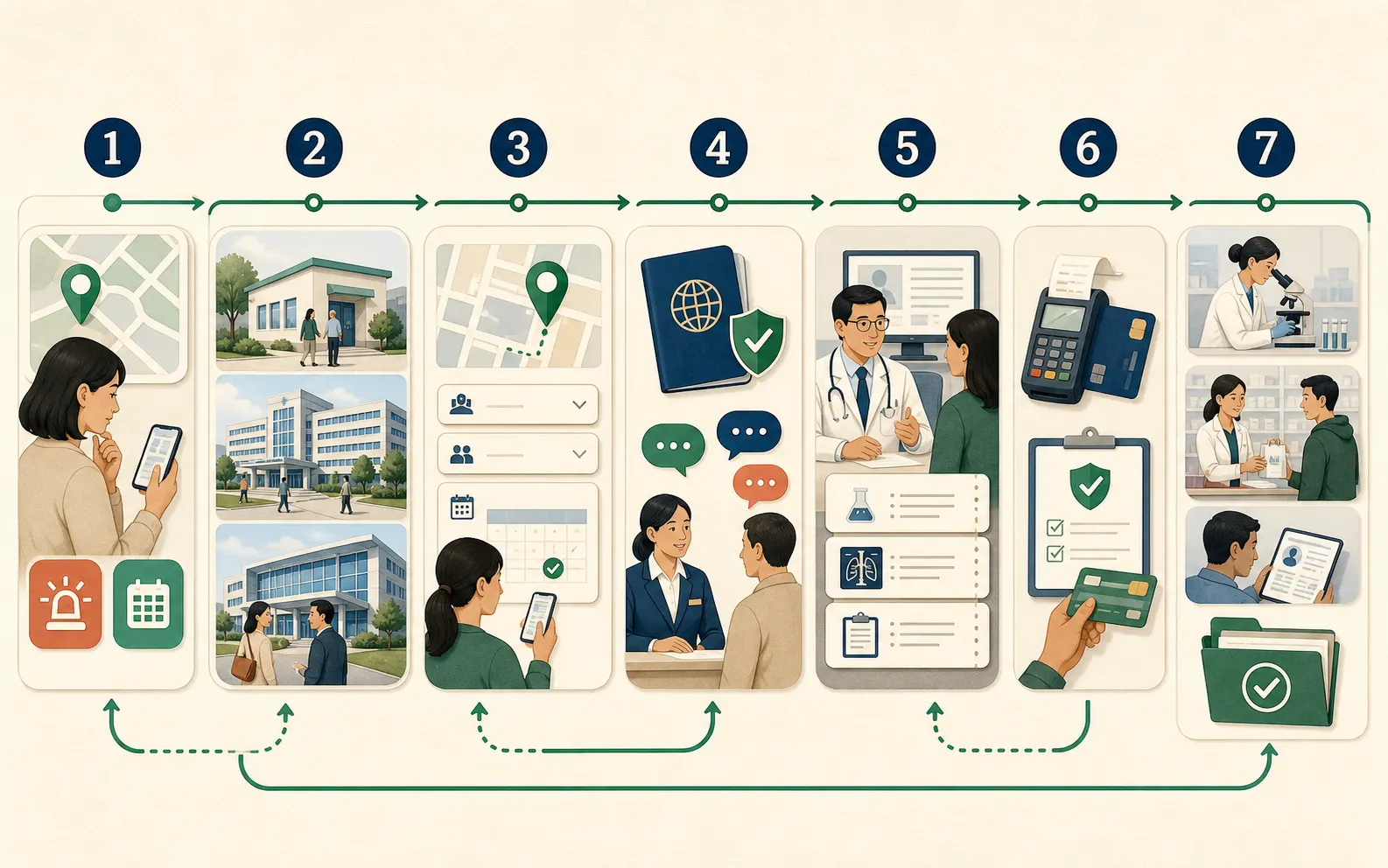
China does not have one front door, one national appointment app or one visitor pathway. An international patient may use a community health service centre, a general or specialist hospital, a public hospital's separate international medical service, or a private provider. The useful way to navigate the system is to separate institutional role from the actual patient route: urgency, exact campus and department, booking, passport registration, language, orders, payment, insurance, pharmacy, results and follow-up. This guide explains that administrative map. It does not rank hospitals, diagnose urgency, choose a department for an individual or promise that a service accepts a foreign document or insurance plan.
Use this as a practical starting point
Provider procedures can change, so confirm time-sensitive details with the hospital, insurer or service. A licensed professional must make clinical decisions for an individual patient.
At a glance
Key points
- Start with urgency and the required service, not a hospital level or brand.
- Primary, secondary and tertiary labels describe system roles; they are not a personal quality ranking.
- A public hospital can have a distinct international service with different booking, payment and insurance arrangements from its general route.
- Confirm the exact provider, campus, department, date and appointment channel before travelling.
- Registration, check-in, consultation, payment, tests, pharmacy and follow-up can be separate transactions.
- Hospital acceptance, insurer coverage, authorization and direct billing are different decisions.
- Referral and basic-insurance incentives can be local, so verify the rule that applies to the actual patient and city.
1. Start with urgency, not the hospital hierarchy
Separate an immediate emergency route from planned or routine navigation before comparing hospitals. A hospital's level, ownership or English website cannot determine how urgent an individual's condition is. This page provides no symptom checklist and should not be used to decide that a potentially serious situation can wait.
For a medical emergency in mainland China, call 120 and follow the dispatcher's instructions. For non-emergency care, define the administrative task without self-diagnosing: a general first consultation, an already named specialty, continued care, a test ordered by a clinician, a prescription review, rehabilitation, maternity care or another confirmed service. That definition makes the next facility check specific enough to verify.
- Urgent dispatch or planned appointment
- Exact service already requested or referred
- City and travel radius
- Language or accessibility need
- Self-pay, basic insurance or commercial insurance route
China Care Desk maps administrative routes. It does not assess symptoms, select treatment or tell a patient whether to wait.
2. Read facility level as a role, not a quality score
The primary-care network includes community health service centres and stations in cities, township health centres and village clinics in other settings. Current national planning describes these facilities as access points for basic medical and public-health services, with local departments, equipment, medicines and links to higher-level providers. It does not mean every centre offers the same service or can process a passport in the same way.
The 2026 tiered-care measures position secondary hospitals as a bridge between primary facilities and tertiary hospitals and direct tertiary hospitals toward critical, complex, referral and inpatient work. The 2025 tertiary-hospital standards describe an institution-level accreditation framework. None of these labels proves that one department is available today, that one hospital is best for a person, or that a named clinician, language service, price or result is guaranteed.
- Primary facilities: local basic care, prevention and continuing management where available
- Secondary hospitals: broader local services and a bridge role
- Tertiary hospitals: complex, critical, referral and inpatient roles
- General hospitals: multiple departments
- Specialist hospitals: a defined field or patient population
Level, grade, ownership, hospital type and international-service status answer different questions. None is a substitute for checking the exact service.
3. Compare the general, specialist and international routes
A large public hospital may operate a standard outpatient route and a separate international medical service. Peking Union Medical College Hospital is one current example: its International Medical Department publishes distinct outpatient, emergency, inpatient, appointment and commercial-insurance services. That does not prove the same separation, scope, price or language arrangement at another hospital—or even across every service at PUMCH.
Private and internationally oriented providers may publish English-language coordination, interpretation, estimates or insurer links. Beijing United Family describes patient-services and language support at its Beijing route; Jiahui describes a multilingual international office and a route for individualized estimates. These are provider-specific examples, not features guaranteed by the words private or international. Compare the exact campus on service capability, access, language, estimate, payment and follow-up.
- General outpatient route inside a public hospital
- Specialist-hospital route for a defined service area
- International service inside a public hospital
- Private or internationally oriented hospital or clinic
- Community or family-doctor route where locally available
4. Confirm the exact provider, campus, department and appointment
Use the provider's current official website or verified service account. Record the legal provider name, campus, general or international service, department, appointment date, arrival window, entrance and change route. Similar hospital-group names, translated department names and multiple campuses create preventable wrong-place visits.
Confirm whether the selected service is appointment-only, accepts on-site registration or provides a staffed fallback when an app cannot handle a passport. PUMCH publishes English-web and bilingual-app booking for its own International Medical Services, while its general outpatient notice documents several registration and check-in steps. Those examples demonstrate why the exact route matters; they are not a national booking rule.
- Hospital and campus
- General, special or international service
- Department or clinician if already named
- Official booking channel and confirmation
- Arrival, registration and check-in instructions
- Cancellation, rescheduling or late-arrival route
Do not use a generic 'best hospital' list as proof that the required department, appointment, passport route or language support is available.
5. Build one patient identity and map every transaction
Bring the original identity document the provider says it accepts and use one exact spelling, document type and number across booking, registration, insurance and records. PUMCH's current general outpatient notice explicitly lists a passport among accepted original identity documents for its first-visit record creation. That is evidence for this provider route only, not proof that every hospital app, machine, clinic or insurer supports the same document.
Treat the visit as connected but separate states: create or retrieve the patient record, check in, consult, pay, schedule or complete tests, collect medicine, retrieve reports and arrange follow-up. PUMCH's notice separates these steps and directs patients to a visit guide after payment. Language must also be confirmed by step: an English booking page does not establish interpretation at registration, consent, pharmacy and follow-up. United Family's Beijing page is one provider-specific example of broader language support.
- One passport spelling and patient number
- Appointment confirmation and arrival status
- Registration and payment category
- Consultation orders and destination instructions
- Separate test, pharmacy and report transactions
- Qualified language support for important communication
6. Separate estimate, payment, insurance and direct billing
Ask the exact provider what it can estimate and which charges may remain outside that estimate. Then name who pays first: the patient, a local basic-insurance settlement route, a commercial insurer through accepted direct billing, an employer or another payer. A hospital's relationship with an insurer does not prove the patient's membership, benefit, authorization, deductible, copayment or approval for the selected service.
United Family's Beijing page states that the amount owed depends on the specific plan and can include a copayment or deductible. Jiahui directs international patients to request an individualized estimate. PUMCH publishes commercial-insurance services for its International Medical Department while its general outpatient notice distinguishes reimbursement categories. These different provider examples show why price display, estimate, hospital acceptance, insurer decision, patient payment and later reimbursement must remain separate records.
- Written estimate and its exclusions
- Deposit or prepayment
- Basic-insurance settlement eligibility
- Commercial-insurance network and benefit check
- Preauthorization or guarantee of payment where required
- Copayment, deductible and non-covered balance
- Itemized bill, receipt and fallback claim file
Direct billing is a transaction route, not a promise that the insurer will pay every charge.
7. Close results, pharmacy, records, follow-up and referral
Before leaving each stage, record what is complete, what is pending and who owns the next action. A test result visible in an app is not proof that the responsible clinician has reviewed it. A prescription is not proof that payment, stock or dispensing is complete. Ask where reports and images appear, how medicine is collected, how another appointment is booked and which office corrects an identity, billing or record problem.
National policy supports two-way referral and directs regions to define operational referral rules around local resources and insurance arrangements. Do not assume a referral is always required or never required. Preserve the patient number, orders, receipts, itemized charges, prescription, dispensing record, reports and follow-up instructions, then confirm the receiving provider or insurer actually received what it needs.
- Completed and pending orders
- Report access and clinician-review route
- Prescription and dispensing status
- Official record-copy route
- Follow-up department and booking channel
- Referral destination and receiving confirmation
- Insurance or employer document handoff
Avoidable problems
Common mistakes
- Treating tertiary or 3A status as a personal quality ranking
- Choosing a hospital brand without checking its exact campus and department
- Assuming every public hospital has the same passport workflow
- Assuming an English website proves language support throughout the visit
- Confusing a public hospital's general route with its international service
- Assuming a private or international label guarantees every specialty or emergency service
- Treating booking, registration and check-in as one completed transaction
- Assuming consultation payment also schedules tests or dispenses medicine
- Treating an insurer logo or provider list as individual coverage approval
- Assuming direct billing eliminates copayments, deductibles or excluded charges
- Assuming referral rules and basic-insurance incentives are identical nationwide
- Leaving without a result-review, record, pharmacy or follow-up route
Common questions
Frequently asked questions
Must I always start at a community health centre?
No single access rule covers every city, service, patient and insurance arrangement. National policy promotes primary first contact and local coordination, while regions, providers and payers define operational routes. Confirm the actual requirement before the visit.
What do primary, secondary and tertiary mean?
They describe broad institutional roles in the tiered system. Primary facilities emphasize local basic and continuing services; secondary hospitals have a bridge role; tertiary hospitals focus more on complex, critical, referral and inpatient work. The label does not choose the right provider for an individual.
Does 3A mean a hospital is best for every patient?
No. A grade is an institution-level accreditation label, not a personal recommendation, department ranking, appointment guarantee or outcome promise. Verify the exact campus, department and service needed.
Can foreigners use public hospitals in China?
Some public hospitals publish routes that accept passports; PUMCH's current general outpatient notice is one example. Acceptance can differ by hospital, campus, app, machine, service and insurer, so confirm the exact provider and use a staffed route if a digital channel cannot process the document.
Is an international department a separate hospital?
Not necessarily. It can be a distinct outpatient, emergency or inpatient service inside a larger public hospital, with its own booking, entrance, prices and insurance process. PUMCH is one provider example; other institutions structure these services differently.
Do I need a referral to see a hospital specialist?
There is no responsible nationwide yes-or-no answer for every visit. Referral availability and requirements can depend on the city, medical alliance, provider, service and insurance arrangement. Ask the sending and receiving providers and the payer when relevant.
Will my international insurance be direct billed?
Only after both the hospital and insurer confirm the exact patient, policy, campus, service and date. Even an accepted direct-billing route can leave a copayment, deductible, excluded charge or pending authorization.
Why can one outpatient visit involve several payments or queues?
Hospitals can treat registration, consultation, tests, treatment and medicine as separate orders and transactions. Follow the provider's current visit guide and keep each order, payment result, receipt and destination instruction.
When is the visit administratively complete?
When completed and pending orders are known, medicine collection is resolved, results have a clinician-review route, records and receipts are retained, and any follow-up, referral or insurance handoff has a named owner and receiving confirmation.
Evidence
Sources consulted for this guide
National rules are separated from city and provider examples. Access dates show when a source was collected; source pages and procedures can change afterward.