
Tests, medicines & records
Prescriptions and pharmacies in China
Follow a China prescription from hospital or clinic to pharmacist review, lawful dispensing, medicine checks, receipts and follow-up.
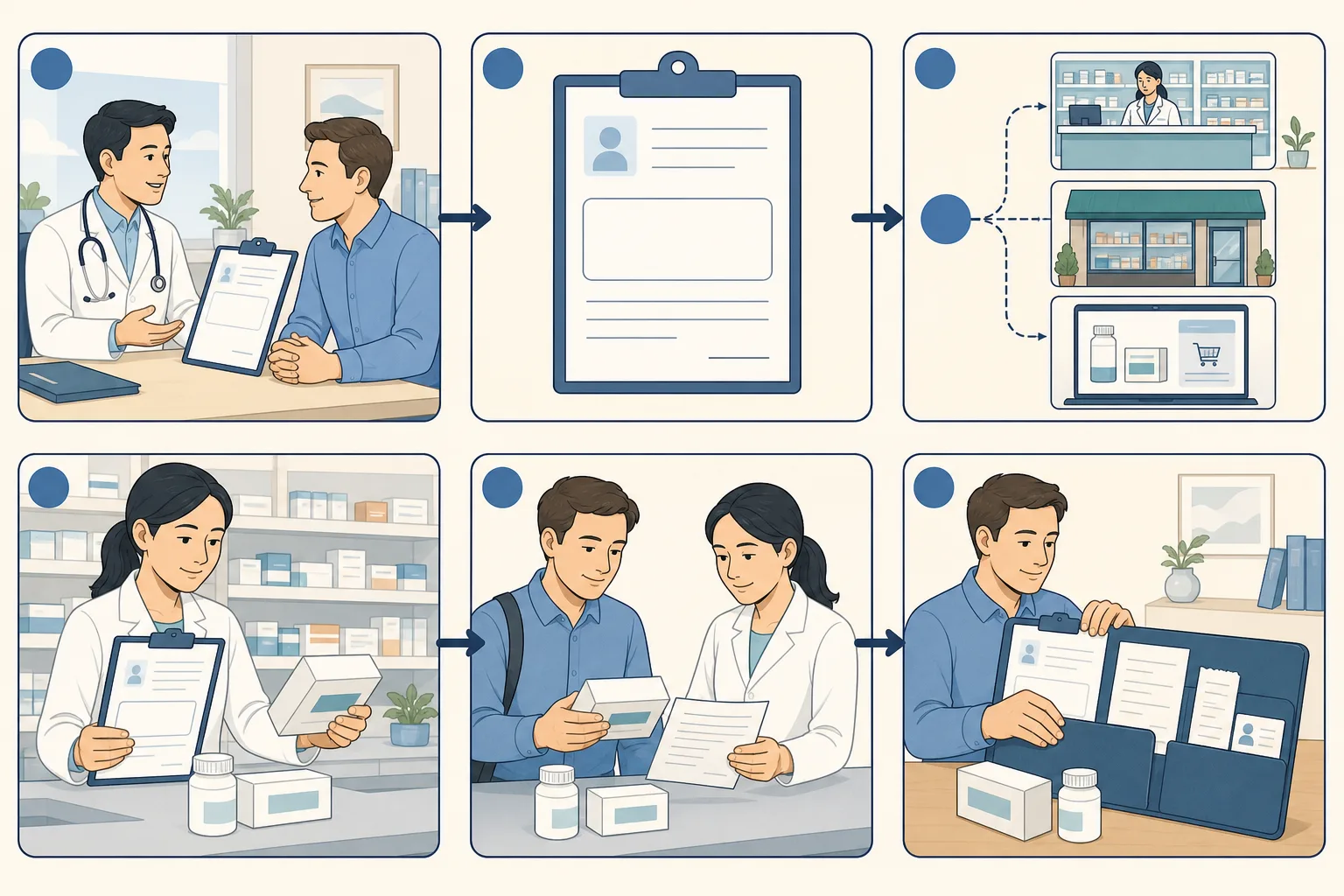
A consultation, prescription, dispensing decision, medicine package and sales receipt are different records. The route can also divide between a hospital pharmacy, licensed retail pharmacy and regulated online seller. This guide connects those steps for foreigners in China without recommending a medicine, equivalent product, dose or treatment change.
Use this as a practical starting point
Provider procedures can change, so confirm time-sensitive details with the hospital, insurer or service. A licensed professional must make clinical decisions for an individual patient.
At a glance
Key points
- Confirm that a prescription was issued and whether it is paper, electronic or limited to the provider's own system.
- Ask where it is intended to be dispensed before leaving the hospital or clinic.
- Prescription validity, legal acceptance, stock and insurance payment are separate checks.
- Expect a qualified pharmacist to review the prescription before dispensing a prescription medicine.
- Check the package and written directions with the pharmacist, then keep the prescription, receipt and original packaging.
Map the prescription-to-pharmacy route before leaving
Ask whether the clinician issued a prescription and where it appears: a paper document, hospital app, electronic prescription or provider-only system. A consultation note, medicine list, payment page or screenshot is not automatically the prescription record a pharmacist needs.
Then identify the intended dispensing route. It may be the provider's own pharmacy, an external licensed retail pharmacy or a regulated online route. A foreign prescription, long-term prescription and controlled medicine can involve additional steps. Do not start by searching for a product or translating a brand name; start with the prescription and the responsible dispensing service.
- Prescription format and issue date
- Hospital or clinic that issued it
- Intended pharmacy route
- Patient identity required
- Payment or insurance route
- Prescriber or pharmacy contact for problems
Verify that the prescription record is usable now
The National Health Commission's current-regulations library still lists the Prescription Management Measures as effective. Those measures define a prescription as a medical document issued by an authorized prescriber and reviewed, prepared and checked by qualified pharmacy personnel. The prescribed record includes patient and provider details, issue date, medicine name, dosage form, strength, quantity, directions and professional sign-off fields.
The measures state that a prescription is generally valid on the day it is issued. If the prescriber records a justified extension, the stated maximum is three days. General quantity limits and special-medicine rules are instructions for responsible professionals, not a formula for patients to calculate their own supply, duration or dose.
Do not change the issue date, medicine, quantity, directions or patient identity to make a prescription pass a pharmacy check. Return the problem to the issuing service.
Confirm the exact dispensing route, stock and payment
Before travelling to a pharmacy, ask whether the prescription can leave the provider's system, which paper or electronic format is accepted, whether identification is needed and whether the selected pharmacy can lawfully receive that prescription. Confirm stock separately; a valid prescription does not prove that a medicine is available.
Hospital examples show why the route must remain provider-specific. PUMCH International Medical Services publishes an on-site pharmacy with consultation, patient education and medicine supply for its own patients. HKU-Shenzhen Hospital describes outpatient and inpatient dispensing and medicine consultation. Shanghai United Family describes an on-site pharmacy that fills prescriptions. None of those provider pages establishes the route, stock or hours at another hospital or retail pharmacy.
Also ask whether payment is self-pay, basic-insurance settlement, commercial direct billing or later reimbursement. A licensed or designated pharmacy name alone does not prove that the medicine, prescription, patient and claim all qualify for the intended payment route.
Expect pharmacist review before medicine handover
A prescription medicine should pass professional prescription review and dispensing checks. The pharmacist may need the prescriber to clarify, correct or reissue an incomplete, expired, incompatible or otherwise unprocessable prescription. A refusal or delay can therefore be a request to repair the record rather than proof that the medicine is unavailable everywhere.
Ask for the exact reason and the official next step. Do not ask a seller to bypass the review, copy an old order, alter the patient identity or silently replace the prescribed product. A generic name, brand name, formulation, strength and package size are not interchangeable labels for a patient to resolve alone.
China Care Desk does not select substitutes or doses. A prescriber and pharmacist must resolve any change to the prescribed medicine or directions.
Check the medicine and instructions with the pharmacist
Before leaving, compare the medicine handed over with the prescription and label. Confirm the patient when shown, medicine name, dosage form, strength, quantity, package integrity, expiry information and the written directions supplied by the provider. Ask the pharmacist to explain storage, measuring devices or other written instructions that are unclear; do not infer them from package color or a translated brand name.
Provider examples support this handover step. Shanghai United Family says its dispensed medicines carry labels with the doctor's instructions and that additional printed information is available on request. PUMCH International Medical Services describes medicine consultation and patient education, while HKU-Shenzhen Hospital describes drug consultation as part of its pharmacy service. These statements apply only to those providers, but they show the questions worth confirming at the actual pharmacy.
- Patient identity when shown
- Medicine name as dispensed
- Dosage form and strength
- Quantity and intact package
- Written directions
- Storage and expiry information
- Pharmacy contact for clarification
Use an online route only when the review trail is visible
For online prescription-drug sales, check the legal seller, displayed drug-distribution credentials and pharmacy-professional information. The route should use real-name purchase, a genuine and reliable prescription source, pharmacist review before dispensing, a traceable sales record and suitable delivery controls. Save the seller, prescription, order and delivery evidence together.
The 2026 national compliance guidance reinforces that responsible pharmacist review must not be replaced by another job role or artificial intelligence. The broader online-sales rules also exclude specified controlled categories. If a service offers a prescription medicine without identity or prescription review, hides the responsible seller or treats a questionnaire as automatic approval, stop and verify the route.
Keep the evidence and route each problem to its owner
Keep the prescription or access record, pharmacy sales document, original package, label, printed directions, payment record and any online order or delivery record. These records can support a follow-up visit, clarification, insurer claim or lawful travel enquiry, but each recipient can require a different format.
Send an expired, incomplete or rejected prescription back to the issuing provider. Send a dispensing, label, quantity or sales-document question to the pharmacy. Ask the insurer about coverage or reimbursement separately. For a foreign prescription, long-term refill, online order, medicine package or border question, use the dedicated guide linked below instead of assuming that one general rule answers every route.
Avoidable problems
Common mistakes
- Treating a visit summary, payment page or medicine list as the dispensing prescription
- Waiting beyond the prescription's recorded validity before checking the route
- Assuming every hospital prescription works at every retail pharmacy
- Travelling before checking prescription acceptance and stock separately
- Choosing a product from a translated brand name or similar-looking package
- Accepting a changed medicine, strength or directions without the responsible professionals resolving it
- Buying a prescription medicine online without a genuine prescription and pharmacist-review trail
- Discarding the prescription, receipt or original package before follow-up is complete
Common questions
Frequently asked questions
How do I get prescription medicine in China?
Use a lawful clinical route to obtain a prescription, then follow the issuing provider's hospital, retail or regulated online dispensing instructions. The prescription, medicine and pharmacy must all pass the applicable checks; China Care Desk cannot issue a prescription or select a medicine.
How long is a prescription valid in China?
The current national Prescription Management Measures say prescriptions are generally valid on the day of issue. If the prescriber records a justified extension, the stated maximum is three days. Special prescription categories and long-term prescriptions can follow additional rules.
Can I fill a hospital prescription at a retail pharmacy?
Do not assume every prescription can be transferred to every pharmacy. Ask the provider whether an external paper or electronic prescription is available, then ask the retail pharmacy whether it can lawfully accept that format, review it and supply the medicine.
Will a pharmacy accept my foreign prescription?
A foreign prescription can document prior care but does not guarantee local dispensing. A China-based clinical assessment and local prescription may be required. Use the dedicated foreign-prescription guide for the preparation workflow.
Can prescription medicines be bought online in China?
Some can follow a regulated online route with real-name purchase, a genuine prescription, pharmacist review and traceable delivery records. Specified controlled categories are excluded, and an online product page or questionnaire is not itself approval.
What should I do if the medicine is out of stock or the prescription is rejected?
Ask the pharmacist for the exact reason and return prescription changes to the issuing provider. Do not select a substitute, different strength or new directions yourself. Stock, lawful acceptance, prescribing and payment are separate problems.
Evidence
Sources consulted for this guide
National rules are separated from city and provider examples. Access dates show when a source was collected; source pages and procedures can change afterward.