
Medicines & pharmacies
How to read a Chinese medicine package
Map the outer box, inner container, insert and pharmacy label, then record identity, approval, batch, expiry and storage fields for a pharmacist.
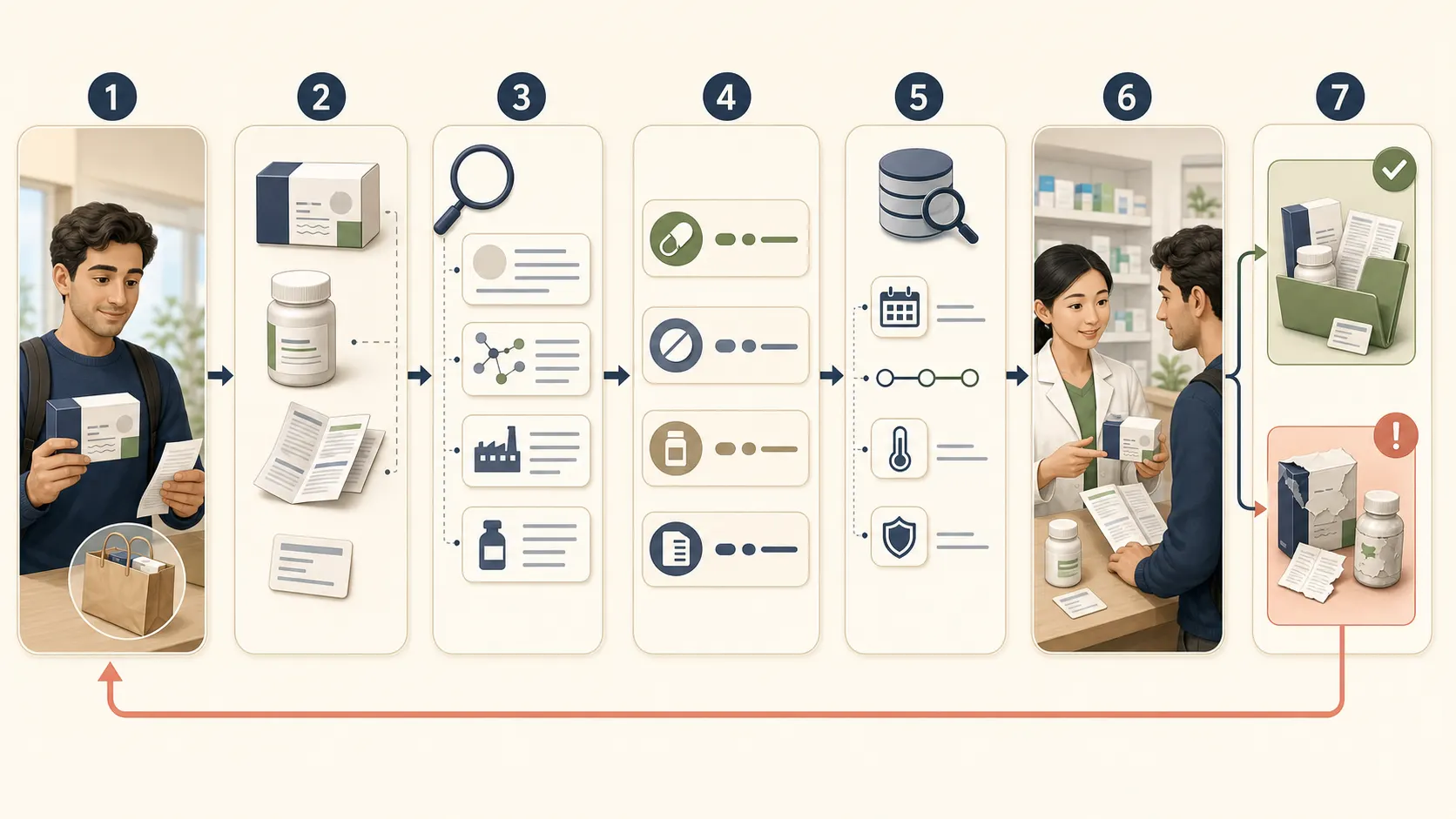
A Chinese medicine package is a set of linked records, not one front panel. The outer sales package, immediate container, approved insert, pharmacy-applied dispensing label and receipt or order record can carry different parts of the identity and handoff. Build a factual field map from the package as received, then ask the dispensing pharmacist or responsible clinician to explain medicine-specific meaning. This guide does not select a medicine, interpret a personal dose, prove a physical box genuine or decide whether two products are interchangeable.
Use this as a practical starting point
Provider procedures can change, so confirm time-sensitive details with the hospital, insurer or service. A licensed professional must make clinical decisions for an individual patient.
At a glance
Key points
- Keep the intact package, insert, pharmacy label and purchase or dispensing record together until every field and any problem are resolved.
- Read the information in layers: the outer carton, immediate container, insert and pharmacy-applied label do different jobs and one does not replace the others.
- Identify the exact approved presentation from its Chinese adopted or generic name, all active ingredients, dosage form, specification and responsible company—not from colour or trade name alone.
- Keep specification or strength, dosage form, package quantity and written directions in separate fields; none can safely be inferred from another.
- Compare the approval number and recorded identity through the NMPA data-query entry, but do not treat a database match as proof that a physical box or seller is genuine.
- Read batch, production, expiry, storage and seal information together because an expiry statement assumes the stated storage conditions were followed.
- Return a mismatch, missing item, damaged seal or unclear instruction to the pharmacist, seller or issuing clinician that owns that part of the handoff.
Preserve the package and supply record as received
Before translating or looking up a field, keep the exact package connected to the supply event. Record whether it came from a hospital pharmacy, retail pharmacy or online order; the patient or recipient identity used; the dispensing or delivery date; and the receipt, order or collection record. A provider label and sales record identify the handoff, while the manufacturer's package identifies the product presentation.
Photograph every side of the unopened outer package, the seal, any delivery damage and the full receipt or order record before discarding wrapping. If the medicine has already been opened, record that fact without reconstructing a seal or moving contents into another container. The Ningxia hospital-pharmacy notice is one provider example of checking the dispensed product at the window and bringing the prior package when seeking another supply; another pharmacy may use a different correction or return process.
- Hospital, retail or online supply route
- Patient or recipient and date
- Receipt, collection slip or order record
- Unopened or opened state, seal and visible damage
- Delivery or storage issue already observed
Do not throw away the box, insert, pharmacy label or sales record while a mismatch, damage, storage or reimbursement question is open.
Separate the outer box, container, insert and pharmacy label
Lay out each information layer without separating medicine from its original immediate container. The outer sales package usually provides prominent product and regulatory fields; the bottle, blister or other immediate container must remain attributable to that same product; the approved insert carries fuller directions and warnings; and a dispensing pharmacy may add a patient-specific label or printed instruction derived from the clinician's order.
A receipt, order page or delivery label belongs to the transaction layer, not the approved product label. Likewise, the manufacturer's insert does not prove which patient received the product or what a clinician instructed for that patient. Mark a layer as missing rather than copying a field from a different object and presenting it as if it appeared there.
- Outer sales package
- Immediate container or inner label
- Approved package insert
- Pharmacy-applied label or printed directions
- Receipt, order or delivery record
Keep photographs and notes grouped by layer. A complete front-panel photograph is not a substitute for the side panels, container, insert or pharmacy label.
Identify the exact approved presentation
Start with the approved Chinese adopted or generic name and keep a trade name, if present, as a secondary field. Record every active ingredient shown, especially for a combination product, followed by the dosage form, specification or strength, responsible marketing-authorization holder or manufacturer and the approval number. Do not translate a brand and use it as the product identity.
Use the approval number as the strongest search key in the NMPA data-query entry, then compare the record's name, ingredients or presentation details and responsible company with the physical package. A name-only search can return several presentations. A matching record supports regulatory identity comparison; it does not authenticate this particular box, seller, delivery or storage history.
- Chinese adopted or generic name
- Trade name, recorded separately if present
- All active ingredients
- Dosage form and specification
- Marketing-authorization holder or manufacturer
- Approval number
Do not reduce a combination product to one familiar ingredient, and do not infer equivalence from a shared ingredient or translated brand.
Keep specification, dosage form, pack quantity and directions separate
Create four distinct rows in your notes. Copy the printed specification or strength exactly with its units; record the dosage form as a separate field; record how many containers, blisters or units the sales package contains; and preserve the pharmacy or clinician directions without converting them into your own schedule. A number printed on a box is not meaningful until it is attached to the correct field.
Written directions can be patient-specific, while the package insert describes the approved medicine more generally. If the pharmacy label, written clinical instructions and your understanding do not align, stop and ask the dispensing pharmacy or issuing clinician to reconcile them. This page cannot calculate a dose, convert units, decide how to use a device or tell a person to start, stop or substitute a medicine.
- Specification or strength, copied with units
- Dosage form or release form
- Sales-package quantity
- Patient-specific written directions, if supplied
Never turn package quantity into a dose or use a general insert to overwrite patient-specific directions. Ask the responsible professional to resolve the actual record.
Check approval, batch, expiry, storage and seal together
After matching the approved presentation, copy the approval number, production batch, production date, stated expiry date, storage conditions and any seal or tamper state from the package layers where they actually appear. Keep the complete printed date format rather than shortening it in translation. The Beijing regulator's expiry explainer links the approved validity period to the stated storage conditions, so a visible future date does not answer whether a product was stored or delivered correctly.
Do not calculate an extension from the production date, invent an after-opening period or assume that a database record resolves physical damage. If the batch or date is unreadable, the immediate container is detached from its identifying package, the seal is broken unexpectedly, or required storage may have failed, preserve the evidence and return the question to the dispensing pharmacy or seller before use.
- Approval number and matched regulatory record
- Production batch
- Production date and stated expiry date
- Printed storage conditions
- Seal, immediate-container and delivery condition
The NMPA query is a regulatory-record comparison, not a physical-product authentication service. A package can still require pharmacist or seller review when the record matches.
Ask the dispensing pharmacist to explain medicine-specific meaning
Take the complete package, immediate container, insert, pharmacy label and prescription or visit record to the dispensing pharmacist. Ask them to point to the exact name, specification, dosage form, written directions, warnings, storage instructions and any device steps that apply to the supplied presentation. If spoken language is a barrier, ask the provider what interpreter, bilingual pharmacy or written-information route it actually offers.
PUMCH International Medical Services and Shanghai United Family are provider examples that describe pharmacy consultation or patient education; Shanghai United Family also describes dispensed labels carrying the doctor's instructions and printed information on request. These examples show useful questions to ask, not services guaranteed at another hospital or retail pharmacy. Keep any clarified written instructions with the original package rather than replacing the source label with an informal translation.
- Which printed name and presentation were dispensed?
- Which label contains the clinician's patient-specific directions?
- What warnings, storage or device instructions need explanation?
- What written or interpreted communication route is available?
- Who should be contacted if a field later proves different?
Return a mismatch to the owner of that handoff
Stop the workflow when the supplied name, ingredient set, specification, dosage form, approval number, manufacturer, batch, expiry, storage state, seal or written directions do not match the prescription, order, regulatory record or what the pharmacist explained. Do not choose the nearest-looking package or accept an informal substitution based on colour, translated brand or one shared ingredient.
Return a dispensing mismatch or unclear pharmacy label to the dispensing pharmacist; a clinical-instruction conflict to the issuing clinician; an online listing, delivery, damage or missing-item problem to the legal seller and platform route; and a regulatory-record mismatch to the pharmacy or seller supplying the physical product. Preserve the box, container, insert, receipt or order page and uncropped photographs, and record the case number and written resolution before closing the handoff.
- Exact field that differs or is missing
- Owner: pharmacist, issuing clinician, seller or platform
- Complete package and transaction evidence
- Case number, corrected record or replacement outcome
- Follow-up package retained with the patient's medicine record
China Care Desk can help you map the fields and the responsible route. It cannot verify authenticity, approve a substitute or tell you to use a questionable product.
Avoidable problems
Common mistakes
- Keeping only the front-panel photograph
- Discarding the receipt, order record, pharmacy label or insert too early
- Mixing an inner container with a different outer box
- Matching a product only by colour, logo or translated trade name
- Leaving out one active ingredient in a combination product
- Confusing specification or strength with package quantity
- Treating written directions as the same field as the approved insert
- Copying a number without recording whether it is an approval, batch, date or quantity field
- Assuming a future expiry date proves storage conditions were maintained
- Treating an NMPA record match as proof that a physical box or seller is genuine
- Assuming a shared ingredient makes two presentations interchangeable
- Opening, using or discarding a damaged or mismatched package before preserving evidence
- Asking a general website to calculate a dose or approve a substitute
Common questions
Frequently asked questions
Where is the generic name on a Chinese medicine package?
Look for the approved Chinese adopted or generic name on the package and confirm it against the ingredient set, dosage form, specification, responsible company and approval number. Keep a trade name as a separate secondary field rather than translating it into the product identity.
Which part should I photograph for translation?
Photograph every side of the outer box, the immediate container, complete insert, pharmacy-applied label and receipt or order record. Keep the images grouped by layer and do not crop out approval, manufacturer, batch, date, storage or quantity fields.
What if the box, bottle, insert and pharmacy label show different information?
Some differences are expected because the layers serve different purposes, but product identity and patient-specific directions must remain attributable to the same supply. Do not reconcile a conflict yourself; ask the dispensing pharmacist to identify each layer and return clinical-instruction conflicts to the issuing clinician.
Can the NMPA approval-number search prove my box is genuine?
No. It can compare the approval number with an official regulatory record for the product identity. It does not authenticate one physical box, seller, delivery or storage history. Preserve the package and ask the dispensing pharmacy or seller to investigate a mismatch.
How should I read an expiry date shown only as a year and month?
Copy the complete printed format and ask the pharmacist to explain it for the actual package. Do not calculate an extension or after-opening period. The stated validity also assumes the printed storage conditions were followed.
What should I do if the insert or inner label is missing?
Keep the remaining package and transaction evidence and return the missing-layer question to the dispensing pharmacy or seller before relying on a copied online insert. A document found online may belong to a different approval, specification or revision.
Does the same ingredient mean two packages are equivalent?
No. The full ingredient set, specification, dosage form, release characteristics, route and approved presentation can differ. Only the responsible clinician and pharmacist can evaluate a substitution for the actual patient and prescription.
What if I cannot discuss the label in Chinese?
Ask the actual provider or pharmacy whether it offers a bilingual pharmacist, interpreter or written-information route. Keep the original Chinese label beside any translation so the responsible professional can check the source wording and exact package.
What should I preserve when an online order is damaged or different?
Keep the listing and seller identity, order and payment records, delivery label, unopened package state, all product layers and uncropped photographs of the damage or mismatch. Use the seller and platform's documented case route, and ask a pharmacist or clinician about any medicine-use question rather than treating a refund decision as clinical approval.
Evidence
Sources consulted for this guide
National rules are separated from city and provider examples. Access dates show when a source was collected; source pages and procedures can change afterward.