
Medicines & pharmacies
Buying medicine online in China
Verify the legal seller, exact product and OTC or prescription route, then preserve payment, delivery and receipt evidence for an online medicine order.
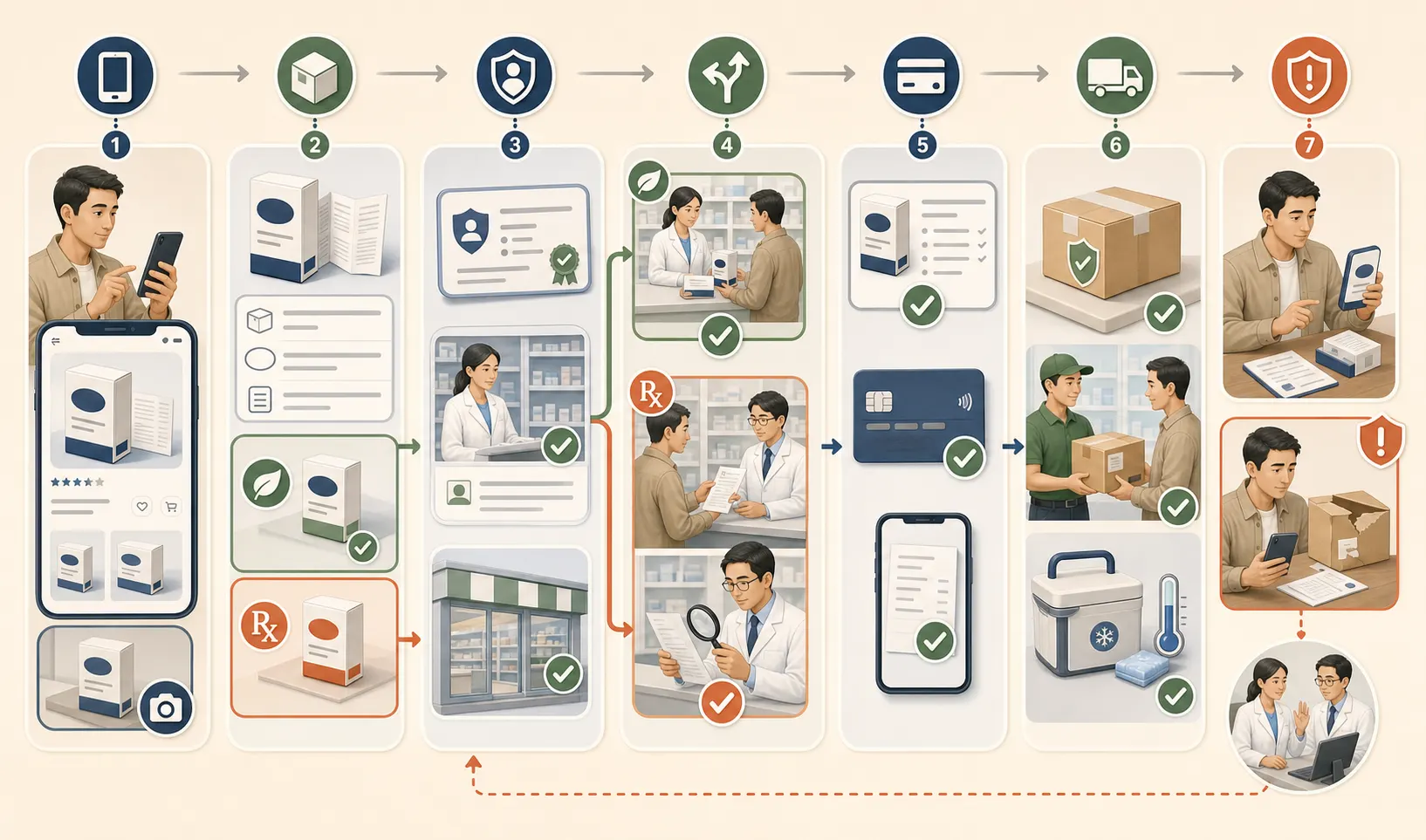
Buying medicine online is a retail transaction with several separate owners: the app or marketplace, the legal seller, the prescription source when one is needed, the reviewing pharmacist, the payment recipient and the delivery service. A familiar app, a product photograph or a fast-delivery promise does not prove that the exact seller and product can complete every gate. This guide starts at the product page and follows the order through classification, seller verification, prescription or OTC routing, payment, delivery and receipt. It does not recommend a platform or medicine, diagnose a condition, create a prescription, approve a substitute or guarantee stock, price, delivery or insurance payment.
Use this as a practical starting point
Provider procedures can change, so confirm time-sensitive details with the hospital, insurer or service. A licensed professional must make clinical decisions for an individual patient.
At a glance
Key points
- Record the exact product page, storefront and legal seller shown for the order; the marketplace name and seller are not necessarily the same entity.
- Match the Chinese-market package, generic name, ingredients, dosage form, strength or specification, approval information and OTC or prescription classification.
- The online seller should display its drug-distribution credentials and the qualifications of its pharmacists or other pharmacy professionals.
- An OTC mark is a classification, not personal permission to self-select; ask a qualified pharmacist about the actual product and person.
- Online prescription sales require real-name purchase, a reliable prescription source and review by a licensed pharmacist before the purchase gate opens.
- Being prescribable through an internet hospital and being permitted for online retail are separate questions; specially controlled categories are excluded from online sale.
- Keep seller, prescription, order, payment, sales-proof, package and delivery records until any clinical follow-up, correction, refund or insurance claim is closed.
Capture the exact listing and seller before checkout
Open the full product page rather than ordering from a search card, chat link or previous-order shortcut. Record the date, app or website, storefront, legal seller, product title, package photograph, displayed classification and delivery origin. Recheck the seller at checkout because a marketplace can host multiple merchants and the payment page may identify a different legal business from the app brand.
First decide whether the listing is actually presented as a medicine rather than a supplement, food, cosmetic, medical device or another product category. Do not apply a medicine checklist to a look-alike product or treat a wellness claim as proof that a product is an approved medicine. If the category is unclear, ask the seller to identify the exact legal product type and evidence before paying.
- Full product-page and storefront record
- Legal seller shown at checkout
- Product category and package presentation
- Date, delivery origin and promised route
- Seller service and problem-reporting channel
A marketplace, mini-program or delivery app is the route into the transaction; it is not automatically the seller, pharmacy, medical institution or prescription issuer.
Match the exact product and its China classification
Use the Chinese package and current product page to match the generic name, every active ingredient, dosage form, strength or specification, manufacturer or marketing-authorization holder, approval number, package quantity and storage statement. Similar translated brands, ingredients or photographs do not prove an exact match. A change in specification, route or presentation can matter to classification and dispensing.
Prescription medicines and non-prescription medicines should be displayed separately online. Approved OTC medicines carry the designated OTC mark and are divided into Class A and Class B, but the mark does not establish suitability, interactions, directions or a safe substitute for one person. If the page, package and seller description disagree, stop and ask the pharmacist to identify the controlling current record before ordering.
- Chinese generic name and all active ingredients
- Dosage form, strength or specification
- Manufacturer or marketing-authorization holder
- Approval number and minimum sales package
- Prescription, Class A OTC or Class B OTC state
- Storage conditions shown for the exact product
Verify the legal seller, pharmacist and platform roles
An enterprise selling medicine online must be a marketing-authorization holder or a drug distributor able to support online sales, and a business selling directly to individuals needs retail qualification. The seller should continuously display its drug-manufacturing or drug-distribution certificate information on the main sales page and an online retailer should also display the qualifications of its pharmacists or other pharmacy professionals. Match the enterprise name and business scope to the legal seller at checkout rather than accepting a badge or platform name alone.
Separate the third-party platform from the settled seller. The platform has seller-audit and monitoring duties, but the retailer remains responsible for its medicine sale and delivery quality. Record which entity answers product, prescription, payment, delivery and complaint questions. HKU-Shenzhen Hospital's 2024 external-pharmacy selection notice illustrates the checks one provider used—retail licences, prescription-review staff, storage areas, collection, delivery and cold-chain capability—but it is not a current directory or endorsement for a consumer order.
If the displayed licence belongs to another enterprise, is incomplete, cannot be matched to the seller or does not cover retail sales to individuals, do not rely on customer-service reassurance alone.
Complete the OTC or prescription gate without bypasses
For an OTC listing, keep the exact classification and product match, then use the seller's qualified pharmacist service for questions about directions, warnings, interactions and whether the actual product is appropriate. Do not choose from colour, popularity, a translated symptom or a prior purchase alone. OTC status changes the retail route; it does not turn this page into personal medicine advice.
For a prescription listing, expect the purchase route to match the patient identity, use a reliable prescription source and hold the sale until prescription review is complete. The 2026 compliance guidance specifies that the retailer's prescription review is performed by a licensed pharmacist rather than another role or artificial intelligence. A questionnaire, chatbot, product search, uploaded old package or prior order is not itself the prescription or the pharmacist review. If a clinical encounter or electronic prescription is required, use the separate internet-hospital prescription and delivery workflow linked below.
Also ask whether the exact category may be sold online. National rules exclude vaccines, blood products, narcotic drugs, psychotropic substances, toxic drugs for medical use, radioactive drugs, pharmaceutical precursor chemicals and other nationally specially controlled medicines from online sale. Treat this as a reason to check the exact product with the responsible seller and pharmacist, not as a patient-made master list or a way to infer a product from its brand name.
- OTC classification matched to the exact package
- Patient identity matched when prescription purchase requires it
- Reliable prescription source identified
- Licensed pharmacist review completed before purchase
- No AI, customer-service or buyer-created prescription shortcut
- Online-sale eligibility confirmed separately from online-prescribing eligibility
Lock the exact order, payment and sales proof
Before paying, compare the approved product route with the cart: legal seller, patient where relevant, Chinese generic name, ingredients, dosage form, strength or specification, manufacturer, package quantity, number of packages, delivery address and any storage or recipient restriction. Do not accept automatic replacement of a manufacturer, strength, form, package or directions; send a proposed change to the responsible pharmacist and prescriber when clinical authorization is required.
Record the displayed amount, discounts, delivery fee, payment recipient and expected electronic sales proof as separate facts. National online-sales rules require proof of sales and retained traceable sales records, but they do not guarantee insurance cover, one refund result or that an app payment screen contains every document a claim requires. PUMCH and Renji describe provider-specific official-app routes that separate consultation or follow-up, prescription information, payment and delivery choices; neither example establishes what a marketplace order, another provider or an insurer will accept.
- Exact minimum sales package and quantity
- No unapproved product replacement
- Payment recipient and legal seller reconciled
- Item amount, discount and delivery fee separated
- Electronic sales proof available after payment
- Insurance or claim-document answer obtained from the payer separately
Verify storage, delivery and recipient handoff
Ask the retailer which entity stores, packs and delivers the medicine, the dispatch location, expected time, tracking route and how the required temperature and humidity will be protected. The retailer remains responsible for delivery quality even when it appoints another delivery business. The package should travel in an appropriate, separate and traceable space; an ordinary courier logo or fast-arrival estimate does not prove that the exact storage condition is protected.
For a product with a stated temperature requirement, ask what packaging, monitoring, delay response and failed-delivery process applies before dispatch. HKU-Shenzhen's external-pharmacy notice included storage and cold-chain capability among its provider-selection checks. Shanghai Children's Hospital's dated cloud-pharmacy example described pharmacist review before payment, a dispensing list, temperature-managed transport and handover to the recipient. These are useful questions to copy, not current promises about another order or even the same provider today.
- Storage and dispatch entity identified
- Required temperature and humidity route recorded
- Courier, tracking and expected handoff known
- Recipient identity or representative rule confirmed
- Delay, failed-delivery and temperature-excursion owner known
- Package not diverted to an unsuitable unattended location
If the seller cannot explain how a stated storage condition survives packing, transport, delay and handoff, pause the order rather than assuming speed is the same as quality control.
Reconcile the delivery and return a problem to its owner
Before using or discarding anything, compare the delivered legal seller, patient where shown, medicine name, ingredients, dosage form, strength or specification, manufacturer, package count, batch, expiry, seal, label, storage state and sales proof with the order and prescription trail. Photograph an unopened mismatch or damaged parcel, keep the outer packaging and delivery label and record the delivery time. Ask a qualified pharmacist what to do with the actual product; this guide cannot decide whether it remains usable.
Send a prescription-source, patient-identity or needed medicine-change problem to the issuing clinical provider. Send a wrong product, damaged seal, missing sales proof, storage, dispensing or quality concern to the legal seller and its pharmacist. Send tracking or handoff evidence to the delivery service while keeping the retailer involved. Send payment reversals to the seller or platform transaction route and coverage questions to the payer. Keep each case number and written answer, and do not return, discard, replace or start the medicine until the responsible professional has given handling instructions for the exact situation.
- Order, prescription and delivered package reconciled
- Seal, batch, expiry and storage state checked
- Electronic sales proof and payment record saved
- Outer package, delivery label and tracking retained
- Mismatch or damage recorded before opening further
- Seller, platform, courier, provider and payer cases kept separate
Avoidable problems
Common mistakes
- Ordering from a search card, chat link or previous-order shortcut without reopening the full listing
- Assuming the marketplace, storefront and legal seller are one entity
- Treating a supplement, device or cosmetic as a medicine because of a wellness claim
- Matching only a translated brand or package photograph
- Treating the OTC mark as personal permission to choose or substitute a product
- Accepting a licence badge that cannot be matched to the checkout seller and business scope
- Buying a prescription product without a real-name, reliable-prescription and licensed-pharmacist review route
- Treating a questionnaire, chatbot, AI review or prior order as the prescription gate
- Assuming anything that can be prescribed online can also be sold and delivered online
- Accepting a different strength, form, manufacturer, package or directions as an automatic replacement
- Paying without checking the legal seller, payment recipient and electronic sales proof
- Assuming fast delivery protects every temperature or storage requirement
- Opening, using, discarding or returning a mismatch before preserving evidence and asking the responsible pharmacist
- Deleting order, prescription, payment and delivery records before follow-up or claims are closed
Common questions
Frequently asked questions
Can I buy medicine online in China as a foreigner?
A foreign customer can use a lawful seller's route if the exact product, identity, prescription and delivery requirements can be completed. Passport support, language, payment method, delivery coverage and prescription eligibility vary, so confirm each gate with the actual seller or provider before paying.
How can I tell who is actually selling the medicine?
Look beyond the app and storefront names. Match the legal enterprise shown at checkout and on the sales proof to the drug-distribution certificate, retail scope and pharmacy-professional information displayed on the main sales page. If the identities differ, ask for a documented explanation before ordering.
Can prescription medicine be sold online in China?
Some prescription medicines can follow a regulated online retail route, but the seller must use real-name purchase, a reliable prescription source and licensed-pharmacist review. Specially controlled categories are excluded, and the exact product and route still need confirmation.
Can AI or customer service approve my online prescription?
No. The 2026 compliance guidance requires the retailer's prescription review to be performed by a licensed pharmacist rather than another role or artificial intelligence. A separate clinical provider may also be needed to issue a lawful prescription.
Does an OTC mark mean the medicine is safe for me to choose?
No. It identifies a non-prescription classification for the exact approved product. It does not decide suitability, interactions, directions, pregnancy or child use, or whether a similar-looking product is equivalent. Ask a qualified pharmacist about the actual person and package.
Is an online consultation the same as buying from an online pharmacy?
No. The clinical encounter and prescription source belong to the internet-hospital or other medical-provider route; the legal seller and pharmacist then control the retail and dispensing route. Use the separate internet-hospital prescription and medicine-delivery guide for the clinical chain.
What should I keep after an online medicine order?
Keep the seller and product pages, prescription and pharmacist-review trail where applicable, order, payment record, electronic sales proof, tracking, outer parcel, delivery label, medicine package and any problem case numbers until follow-up, correction, refund and insurance work is complete.
What should I do if the delivered medicine does not match?
Do not use it based on appearance or a customer-service assurance. Preserve the unopened package, outer parcel, label, order, sales proof and delivery time; contact the legal seller and its pharmacist, and involve the issuing provider if the prescription or intended product must change.
Does China Care Desk recommend an online pharmacy or medicine?
No. This guide provides a seller, transaction and evidence workflow. It does not recommend a platform, pharmacy, medicine, treatment, dose or substitute and cannot guarantee one seller's current service.
Evidence
Sources consulted for this guide
National rules are separated from city and provider examples. Access dates show when a source was collected; source pages and procedures can change afterward.