
Medicines & pharmacies
Hospital pharmacy vs retail pharmacy in China
Decide whether to collect at the hospital or use an external retail pharmacy, then verify prescription transfer, pharmacist review, stock, payment and records.
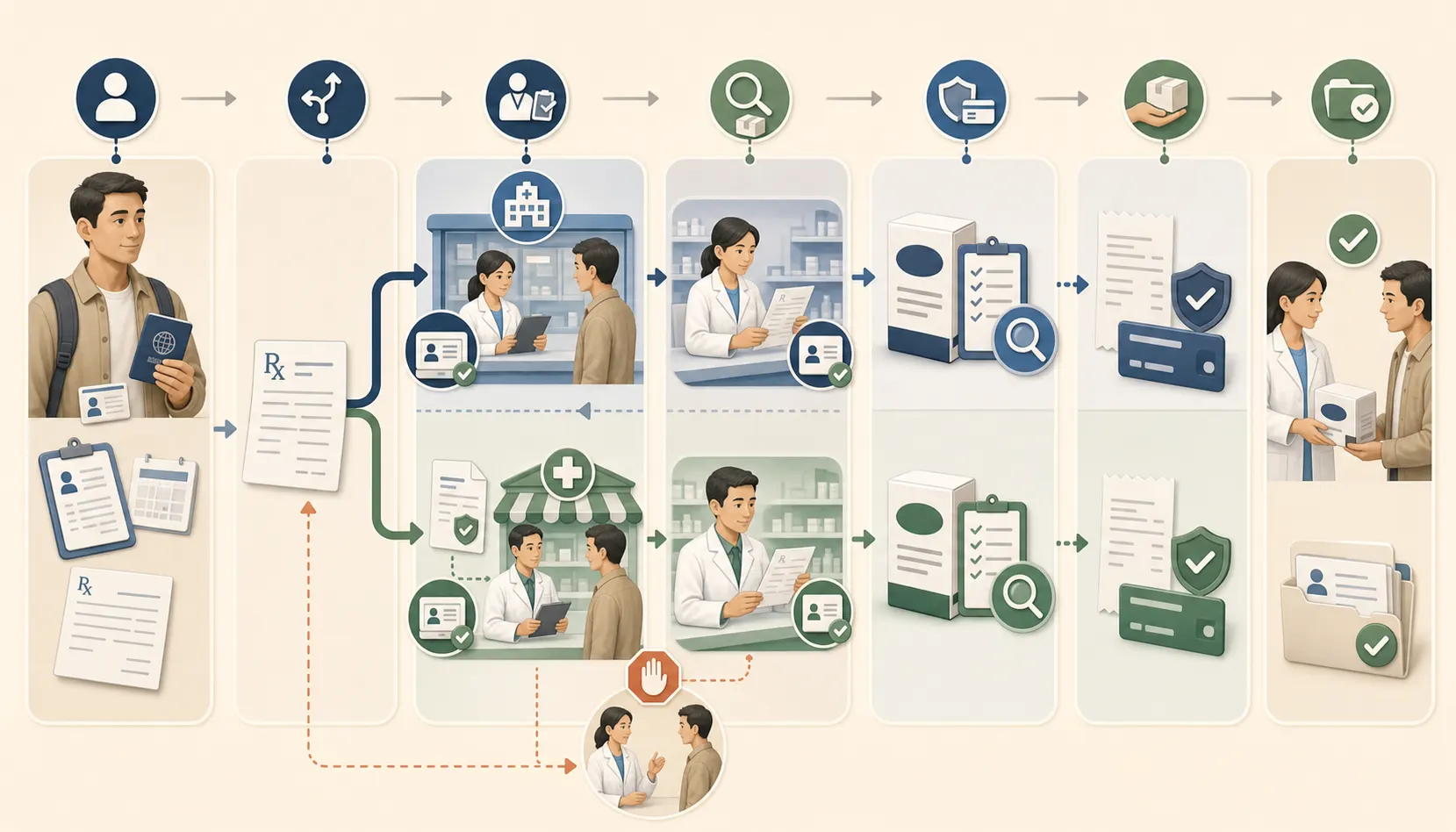
A hospital order, a hospital-dispensable prescription and an external prescription are not the same object. A hospital pharmacy usually works inside one provider's patient, prescriber, stock and payment systems; a licensed retail pharmacy is a separate dispensing business that must be able to receive the usable prescription, verify identity where required, complete its own pharmacist review, supply the exact product and support the intended payment route. Neither route is automatically cheaper, faster, better stocked, covered by insurance or transferable to another campus. This guide helps an international patient identify the route and preserve the handoff without choosing a medicine, changing a prescription or recommending a pharmacy.
Use this as a practical starting point
Provider procedures can change, so confirm time-sensitive details with the hospital, insurer or service. A licensed professional must make clinical decisions for an individual patient.
At a glance
Key points
- First confirm whether the clinician issued a prescription and whether it is usable only inside the hospital, printable for external purchase or transferable through an electronic system.
- Use the hospital pharmacy when the instruction names that hospital, campus or window; another campus or retail store cannot be assumed to see the same order.
- Use a retail pharmacy only after the issuing provider confirms the external route and the selected pharmacy confirms format, identity, pharmacist-review and product acceptance.
- Prescription acceptance, exact stock, permitted substitution, price and insurance payment are separate decisions.
- A basic-insurance designated-pharmacy sign does not by itself prove that one prescription, medicine, patient or local benefit can settle there.
- Do not edit, screenshot, copy or reuse a prescription to make it travel between systems; ask the issuer to print, transmit, correct or reissue the proper record.
- Keep the prescription trail, pharmacy label, package, sales proof and payment record so a rejection, mismatch or claim can return to the responsible service.
Identify what the clinician actually issued
Open the provider's official patient record and separate the consultation note, diagnosis, medicine list, prescription, payment order and collection instruction. Ask the prescriber, pharmacy or service desk whether the prescription is active, which patient profile and encounter it belongs to, where it appears and whether it is paper, electronic or visible only inside the hospital system. Record the issue time and any displayed collection or expiry state without trying to calculate a new one.
The national prescription framework treats a prescription as a medical document issued by an authorized prescriber and reviewed, prepared and checked by qualified pharmacy personnel. A visit summary, old package, payment screen, translated medicine name or screenshot is not automatically the record a second pharmacy can dispense. If the service says no prescription was issued, return to the clinical route rather than starting with a pharmacy search.
- Issuing hospital, campus and department
- Patient name, identity record and hospital number
- Prescription issue time and current status
- Paper, hospital-app or external electronic format
- Named collection window or external route
- Issuer contact for correction or reissue
Compare the two routes before paying or travelling
For a hospital-pharmacy route, confirm the exact campus, building, floor or window shown by the provider, whether payment must occur first and whether the order is already linked to that pharmacy. PUMCH's Xidan guide, for example, sends patients to the window and campus on the instruction sheet and says a Dongdan prescription cannot be collected at Xidan. Shanghai United Family describes on-site prescription filling, pharmacist counselling and labels carrying the doctor's directions. These are provider examples, not nationwide promises.
For an external retail route, ask who releases the prescription, where the patient chooses the pharmacy and whether the route is paper, a provider-selected service or an electronic prescription centre. HKU-Shenzhen Hospital's 2024 selection notice illustrates how one provider assessed licences, prescription-review staff, storage, collection, delivery and cold-chain capability for an external-medicine cloud-pharmacy list. It does not prove that every hospital maintains such a list or that any retailer can accept the prescription.
Choose the route from the current provider instruction—not from the nearest map result, a delivery-app listing or the assumption that every branch shares one system.
Obtain a prescription that can enter the external route
If the hospital confirms external purchase, ask it to identify the exact handoff: a printed external prescription, a signed original, an electronic record sent through a named platform or a provider-selected pharmacy service. Confirm whether the patient must collect a paper copy at the hospital pharmacy, as in the PUMCH Xidan example, or select a participating retail pharmacy inside an official system. Save the provider instruction and do not crop out the issuer, patient, issue date or professional sign-off.
Basic-insurance external-prescription rules are narrower than the general idea of buying outside a hospital. The 2024 national notice strengthens electronic-centre and reconciliation controls and makes the electronic route mandatory from 2025 for designated retail pharmacies dispensing specified dual-channel medicines. That statement does not abolish every paper prescription, apply to every self-pay purchase or prove that a hospital, city, pharmacy or product participates. Ask the provider and local payer route for the current answer.
- External-dispensing permission recorded by the issuer
- Exact paper or electronic prescription format
- Named transfer platform or participating-pharmacy route
- Patient identity and representative requirements
- Current issue, use and cancellation state
- Correction or reissue owner
Let the retail pharmacy verify and review the prescription
Before travelling, give the retail pharmacy only the information it needs to check the route: the issuing institution, prescription format, patient identity type, medicine's exact Chinese generic name, dosage form, strength or specification and quantity. Ask whether that branch can receive the record and whether a qualified pharmacist will be available to review it. A chain brand, basic-insurance sign or marketplace page does not prove that one branch, system or shift can complete the transaction.
The retail distribution framework requires prescription review and related dispensing and record controls. The designated-retail-pharmacy framework separately requires pharmacist review for covered prescription medicines, identity matching and retained external-prescription and purchase records. A pharmacist may stop the transaction and return an incomplete, inconsistent, expired or otherwise unprocessable prescription to the issuer. Ask for the exact reason; do not ask staff to bypass review or enter another person's identity.
A lawful prescription can still fail at a particular pharmacy because transfer, identity, review, business scope and stock are separate gates.
Confirm exact stock without approving a substitute yourself
Ask the hospital or retail pharmacy to match the prescription to the exact Chinese generic name, ingredients, dosage form, strength or specification, manufacturer or approval record when relevant and prescribed quantity. Record whether stock is available now, reserved for this prescription, available only at another branch, requires an approved external-service route or cannot be supplied. A search result, price page or verbal 'same medicine' statement is not a reservation or professional substitution decision.
If the full quantity is unavailable, ask what the pharmacist can legally dispense, whether the prescription can be partially used, transferred or returned and which professional must resolve the remainder. If a different manufacturer, package, form, strength, ingredient or directions are proposed, pause and send the change to the responsible pharmacist and prescriber. Do not split the prescription across shops, reuse it after dispensing or accept an informal replacement without the required professional record.
- Exact product presentation confirmed
- Current stock and reservation owner
- Branch, campus or delivery location
- Cold-chain or storage route where applicable
- Partial-supply state and remaining prescription
- Prescriber approval for any recorded change
Verify price and insurance as a separate transaction
Ask for the amount and payment route before dispensing: hospital self-pay, retail self-pay, basic-insurance direct settlement, commercial-insurance direct billing or later reimbursement. Confirm the legal seller on the receipt and whether the medicine, prescription source, patient identity, pharmacy branch and local benefit are all eligible. Do not infer price or cover from the word hospital, international, retail, designated or network.
The designated-retail-pharmacy measures require qualifying pharmacies to support applicable settlement, identity and purchase-record controls, but local agreements define the actual route. The 2024 external-prescription notice adds electronic and reconciliation requirements for affected medical-insurance prescriptions. Neither source guarantees that a foreign resident is enrolled, that a commercial insurer accepts the pharmacy, that a product is covered or that a receipt will satisfy a later claim. Ask the payer separately and keep any written answer.
Check the handover and return failures to the right owner
Before leaving or accepting delivery, compare the patient identity where shown, medicine name, dosage form, strength or specification, quantity, intact package, batch, expiry, storage condition and pharmacy label with the prescription and order. Ask the pharmacist to explain the written directions and record who supplied the medicine. Keep the prescription or transfer record, pharmacy label, package, sales document, payment proof and delivery record as separate evidence.
Send a missing external option, expired or cancelled record, identity error or needed prescription change to the issuing provider. Send an acceptance reason, dispensing mismatch, stock statement, label, package or receipt problem to the supplying pharmacy. Send coverage, direct-billing or reimbursement questions to the payer. If the pharmacy cannot identify the exact problem, record the branch, time and status and use its official service route; do not solve a failed handoff by changing the record or medicine yourself.
Avoidable problems
Common mistakes
- Treating a consultation note, medicine list, payment screen or screenshot as the dispensing prescription
- Assuming an order in one hospital campus is visible at another campus or branch
- Leaving the provider without asking whether an external prescription can be printed or transmitted
- Choosing a retail pharmacy before confirming that it can receive the exact format
- Treating chain branding, a marketplace listing or a basic-insurance sign as proof of acceptance
- Travelling before checking pharmacist availability and exact stock separately
- Assuming a valid prescription guarantees a complete supply
- Splitting, copying or reusing a prescription without an approved route
- Accepting a different ingredient, strength, dosage form, package or directions as an informal substitute
- Assuming the hospital route is always cheaper or the retail route is always faster
- Expecting basic or commercial insurance settlement without checking the product, patient, branch and prescription
- Discarding the label, package, receipt or transfer record before follow-up and claims are complete
Common questions
Frequently asked questions
Can I take any hospital prescription to a retail pharmacy in China?
No. Ask whether the hospital issued a usable external paper or electronic prescription, then ask the chosen branch whether it can receive that format, match identity, complete pharmacist review and supply the exact medicine. A hospital order or screenshot may work only inside the issuing provider.
Is a hospital pharmacy better than a retail pharmacy?
Neither route is universally better. A hospital pharmacy may be integrated with the encounter and prescriber; a retail pharmacy may offer another location or an approved external route. Transfer, stock, price, insurance, counselling and delivery still need separate confirmation for the actual prescription.
How do I get an external prescription from a hospital?
Ask the prescriber, hospital pharmacy or service desk whether external dispensing is supported and whether the record must be printed, signed or transmitted through a named electronic system. One PUMCH campus guide, for example, directs patients with externally purchased medicines to print the prescription at the pharmacy, but another provider may use a different route.
Can a retail pharmacist change the prescribed medicine if it is out of stock?
Do not approve a change yourself. Ask the pharmacist to state the exact mismatch and whether the prescriber must correct, reissue or approve a documented alternative. Ingredient, dosage form, strength, package and directions are separate checks.
Can one prescription be filled partly at two pharmacies?
Do not assume it can. Ask the first pharmacist how partial dispensing affects the remaining prescription and whether the record can be returned or transferred. Never copy or reuse a prescription after it has been marked as dispensed without an approved process.
Does a designated retail pharmacy guarantee basic-insurance payment?
No. Designated status is only one condition. The prescription source and format, medicine, patient eligibility, branch, local agreement and benefit rules must also qualify. Commercial-insurance direct billing is a separate payer route.
Do I need my passport at the pharmacy?
Identity requirements depend on the prescription and payment route. Ask which original document or patient credential is required and make sure it matches the hospital record. A representative can face additional document and identity checks.
Can China Care Desk tell me which pharmacy has the cheapest medicine?
No. Prices, stock, seller identity, insurance settlement and prescription acceptance change by product, branch and time. Confirm them directly through the responsible hospital, pharmacy and payer; China Care Desk does not recommend a seller or medicine.
Evidence
Sources consulted for this guide
National rules are separated from city and provider examples. Access dates show when a source was collected; source pages and procedures can change afterward.