
Medicines & pharmacies
Using a foreign prescription in China
Prepare a foreign prescription for China care with original records, exact medicine details, translation, local assessment and a verified pharmacy route.
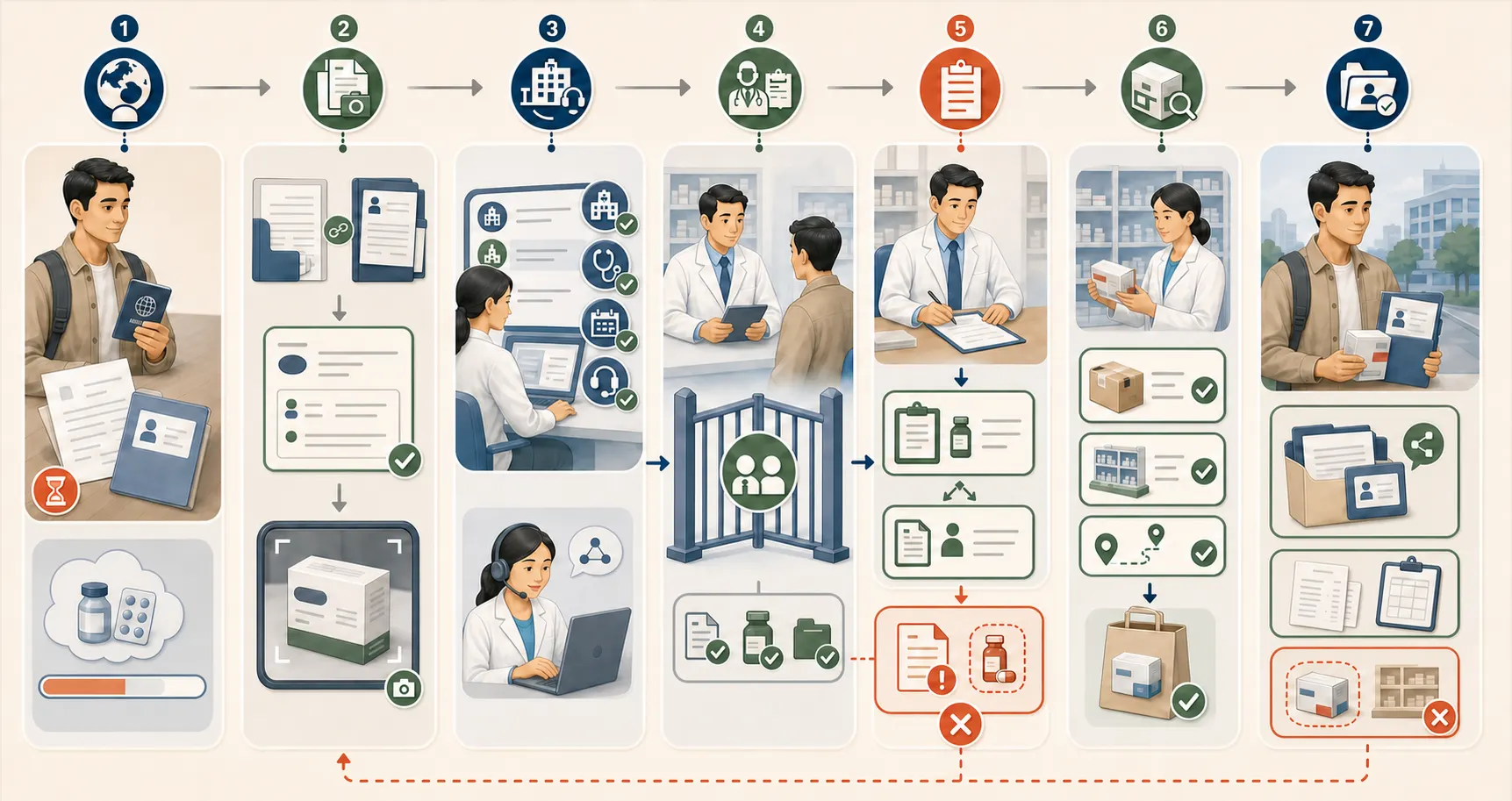
A foreign prescription can be valuable evidence of prior care, but it is not a universal pharmacy voucher in China. The practical task is a clinical handoff: preserve the source record, identify the exact medicine and patient, confirm what the receiving provider can review, complete any China-based assessment and then follow the prescription and dispensing route that provider actually creates. This guide does not decide that every foreign prescription is accepted or rejected, identify an equivalent, recommend a medicine, alter treatment, clear medicine through Customs or guarantee stock, payment or continued supply.
Use this as a practical starting point
Provider procedures can change, so confirm time-sensitive details with the hospital, insurer or service. A licensed professional must make clinical decisions for an individual patient.
At a glance
Key points
- Start with the receiving clinician, not a translated brand name or an unverified pharmacy listing.
- Keep the original prescription beside any translation and bring the prescriber, diagnosis, monitoring, allergy and current-medicine records that explain it.
- Identify every active ingredient, strength, dosage form, route, manufacturer and package separately; none proves equivalence by itself.
- Expect the China provider to decide whether it needs a new assessment, records, tests or a locally issued prescription.
- Treat product authorization, stock, prescription usability, pharmacy route, payment and continuity as separate checks.
Define the handoff before medicine supply runs out
Name the actual task first: an initial China consultation, continuity of an established treatment, transfer to a new clinician, a repeat supply after local assessment or an urgent shortage. A border question about medicine already carried into China and a pharmacy question after a usable local prescription exists are different workflows. Use the dedicated Customs and dispensing guides for those tasks.
Begin while there is enough time to identify a provider, obtain source records, arrange an accepted translation and attend an assessment. Confirm the legal provider, campus, department, appointment route and language-support route from a current provider page. PUMCH, for example, publishes a specific International Medical Services booking route for foreign patients; that does not establish another provider's process or promise that one specialty or medicine is available.
- Treatment-continuity task and remaining supply timeline
- Exact provider, campus and department
- First visit, follow-up or records-review appointment
- Language and interpreter request
- Separate border, dispensing and insurance questions
If there is an immediate medical emergency, use emergency care rather than waiting for a routine prescription handoff. China Care Desk cannot judge whether a symptom or missed medicine is urgent.
Build an original evidence pack
Keep the original prescription unchanged and add a separate index explaining what each file is. Include the patient's identity as it appears on the prescription; issue and expiry dates if shown; prescriber name, institution and verifiable contact or registration information where available; the diagnosis or treatment summary; current medicine list; allergy or adverse-reaction history; and recent records or monitoring results relevant to the receiving clinician. Do not edit an original to make names or dates match.
First-party provider examples support this records-first approach. United Family's published first-visit FAQ asks for identity, recent records and images, and the names and packages of current medicines. Jiahui asks patients to provide complete and accurate past and present health, hospitalization and medication information. Those examples help define a useful pack but do not make every item sufficient or mandatory at every hospital.
- Original prescription and full-page scan
- Patient name and identity-document match
- Prescriber and issuing-institution details
- Diagnosis or treatment summary
- Current medicine list and last documented plan
- Allergy and adverse-reaction history
- Relevant reports, images and monitoring records
- Original medicine package and insert if available
Identify the exact medicine without declaring an equivalent
Create a factual product record from the prescription, package and insert: adopted or generic name, every active ingredient, strength, dosage form, route, manufacturer, pack size, source country or region and any approval or product number printed on the source package. Photograph all sides without cropping the batch, expiry, manufacturer or strength fields. Record what the source says; do not translate a trade name into a claimed Chinese product.
China's label rules show why the exact presentation matters: marketed packages carry fields such as the adopted Chinese name, ingredients, strength, directions, approval number, batch, expiry and manufacturer. A matching ingredient, similar box or translated brand does not prove the strength, form, release characteristics, route or product is interchangeable. Only the responsible clinician and pharmacist can assess the actual product and patient context.
This page intentionally contains no medicine examples or equivalence table. It cannot select a Chinese substitute or confirm that two products are the same.
Confirm the receiving provider and translation route
Before sending health information, ask the receiving service whether it reviews records before booking or during the visit; which file formats, languages and translation credentials it accepts; whether the original must be shown; how medicines should be listed; and whether an interpreter can be arranged. Use a provider-controlled portal, address or other verified channel and send only the records needed for the stated task.
Do not assume a translator can certify clinical equivalence. Jiahui's international-consultation service provides one provider-specific example in which records are collected, translated and reviewed by a physician and missing information is followed up before consultation. That structured service is not evidence that routine visits at Jiahui or another hospital include the same review. Ask the actual receiving service who owns translation and clinical checking.
- Accepted original and translation language
- Translator or certification requirement if any
- Secure record-submission channel
- Correct department and clinician route
- Interpreter request for the consultation
- Deadline for additional or missing records
Complete a China-based clinical assessment
Present the overseas prescription as evidence of what another prescriber intended, not as an instruction that the receiving clinician must copy. China's prescription framework defines a prescription as a medical document issued in clinical activity by an authorized prescriber and reviewed, prepared and checked by qualified pharmacy personnel. The receiving clinician decides what assessment is appropriate and whether a local prescription, another record, a test, a different follow-up route or no prescription is the correct outcome.
Make sure the clinician sees the original record, accurate translation, exact medicine identification, allergies, other medicines and relevant monitoring information. Ask for the outcome in a usable record: the locally issued prescription if one is appropriate, the visit note or instructions, any missing-information request and the next responsible service. A completed consultation does not by itself prove that a product is authorized, stocked, transferable to an external pharmacy or covered by insurance.
A foreign prescription can support the history without automatically becoming the prescription a China pharmacy can dispense. This is a workflow distinction, not a universal legal verdict on every document.
Verify the China-market product and dispensing route
Check the exact product after the clinical decision, not before it. A medicine manufactured overseas follows China's marketing-authorization route before being marketed in mainland China. The same brand, ingredient or package size sold elsewhere may not correspond to a currently authorized and available China presentation. Ask the clinician or pharmacist to identify the exact local record and package; do not make that match from a marketplace result or translated name.
Then confirm where the issued prescription can actually be dispensed: the provider's hospital pharmacy, an external licensed retail pharmacy or a supported electronic route. Ask the pharmacist to reconcile patient identity, prescription, product, strength, form, quantity, label and written directions. Shanghai United Family's pharmacy page, for example, describes prescription filling, medicine profiles, pharmacist checks and labels carrying the doctor's instructions at that provider. It does not prove another pharmacy's stock, acceptance, language service or payment route.
- Exact China-market product and package
- Hospital-only, external or electronic prescription state
- Responsible dispensing pharmacy
- Pharmacist review and label check
- Stock and collection timing
- Self-pay, direct billing or later claim route
Close the continuity or shortage handoff
Keep one continuity folder containing the original overseas record, translation, identity match, exact source-package details, China consultation record, locally issued prescription or decision, dispensed-package photographs, written directions, sales proof, reports and the next review route. Record which provider owns clinical changes, which pharmacy owns dispensing questions and which insurer owns payment or claim questions.
If the exact product is unavailable, the prescription cannot be used on the intended route or records are incomplete, return the case to the responsible clinician or issuing service. Do not change, stop, split, combine, import informally, buy from an unverified seller or accept a claimed substitute because this page describes an administrative handoff. For medicine carried across the border, use the separate personal-medicines Customs guide; for a stable condition after a China clinician has established care, use the long-term-prescription guide.
- Original and translated records preserved together
- China consultation outcome and prescription state
- Dispensed package, label and sales proof
- Named clinical, pharmacy and payment owners
- Next review and remaining-supply timeline
- Documented return route for shortage or mismatch
Avoidable problems
Common mistakes
- Waiting until the remaining supply is exhausted before identifying a provider
- Treating a border, consultation, prescription, pharmacy and insurance question as one approval
- Sending complete medical records to an unverified personal account
- Bringing only a cropped photograph or translated brand name
- Editing the original prescription instead of attaching a separate translation
- Leaving out active ingredients, strength, dosage form, route or manufacturer
- Assuming a matching ingredient proves two products are interchangeable
- Assuming a foreign prescription guarantees retail dispensing
- Expecting the receiving clinician to copy the overseas plan automatically
- Assuming a medicine sold overseas is authorized and stocked in China
- Accepting a different package, form or strength as an automatic substitute
- Discarding the local prescription, label, package or sales proof before follow-up is closed
Common questions
Frequently asked questions
Will a Chinese pharmacy accept my overseas prescription?
Do not rely on a universal yes or no. A foreign prescription can document prior care, while the actual pharmacy, product and prescription route still need to satisfy the receiving provider's and dispensing service's requirements. A China-based assessment and locally issued prescription may be required.
Is an English or Chinese translation enough?
No translation alone creates prescribing authority or proves equivalence. Ask the receiving provider what language, translator or certification it accepts, keep the original beside the translation and have the responsible clinician check the clinical meaning.
Can I start at a retail pharmacy instead of a hospital or clinic?
For continuity from an overseas prescription, begin by asking a suitable China provider what assessment and local prescription route it requires. A pharmacist can explain the dispensing gate, but cannot be assumed to convert an overseas document into a local clinical decision.
Can China Care Desk identify the Chinese equivalent?
No. A shared brand or active ingredient does not establish equivalence across strength, form, route, release characteristics or approved presentation. The responsible clinician and pharmacist must evaluate the exact records, product and patient context.
What if the same brand is not sold in China?
Return the exact product and continuity question to the responsible clinician. Do not select a substitute from an online listing, package colour or translated name. Product authorization, clinical appropriateness, prescription, stock and payment are separate decisions.
What should I do if I am running low?
Contact the intended provider early, state the remaining-supply timeline and ask what appointment and records it needs. This site cannot decide whether an interruption is urgent or advise a treatment change; use emergency care when the situation is an immediate medical emergency.
Can I bring the medicine from abroad instead?
That is a separate Customs and travel workflow. A foreign prescription can be supporting evidence but does not guarantee border clearance. Use the personal-medicines entry guide and confirm the exact product, quantity, documents and controlled status before travel.
Can I order the medicine online after the consultation?
Only if the exact prescription and product are eligible for a supported online route and the legal seller, pharmacist review, payment, storage and delivery gates can be completed. Use the separate online-medicine guide rather than treating an overseas prescription as checkout approval.
Which records should I keep after the handoff?
Keep the original and translated overseas records, exact source-package details, China consultation outcome, locally issued prescription if any, dispensed package and label, sales proof, relevant reports and the named next-review route until continuity, correction and any claim are complete.
Evidence
Sources consulted for this guide
National rules are separated from city and provider examples. Access dates show when a source was collected; source pages and procedures can change afterward.