
Medicines & pharmacies
Prescription vs OTC medicines in China
Identify China’s prescription, Class A OTC and Class B OTC categories, verify the exact package and use the correct pharmacy or online route.
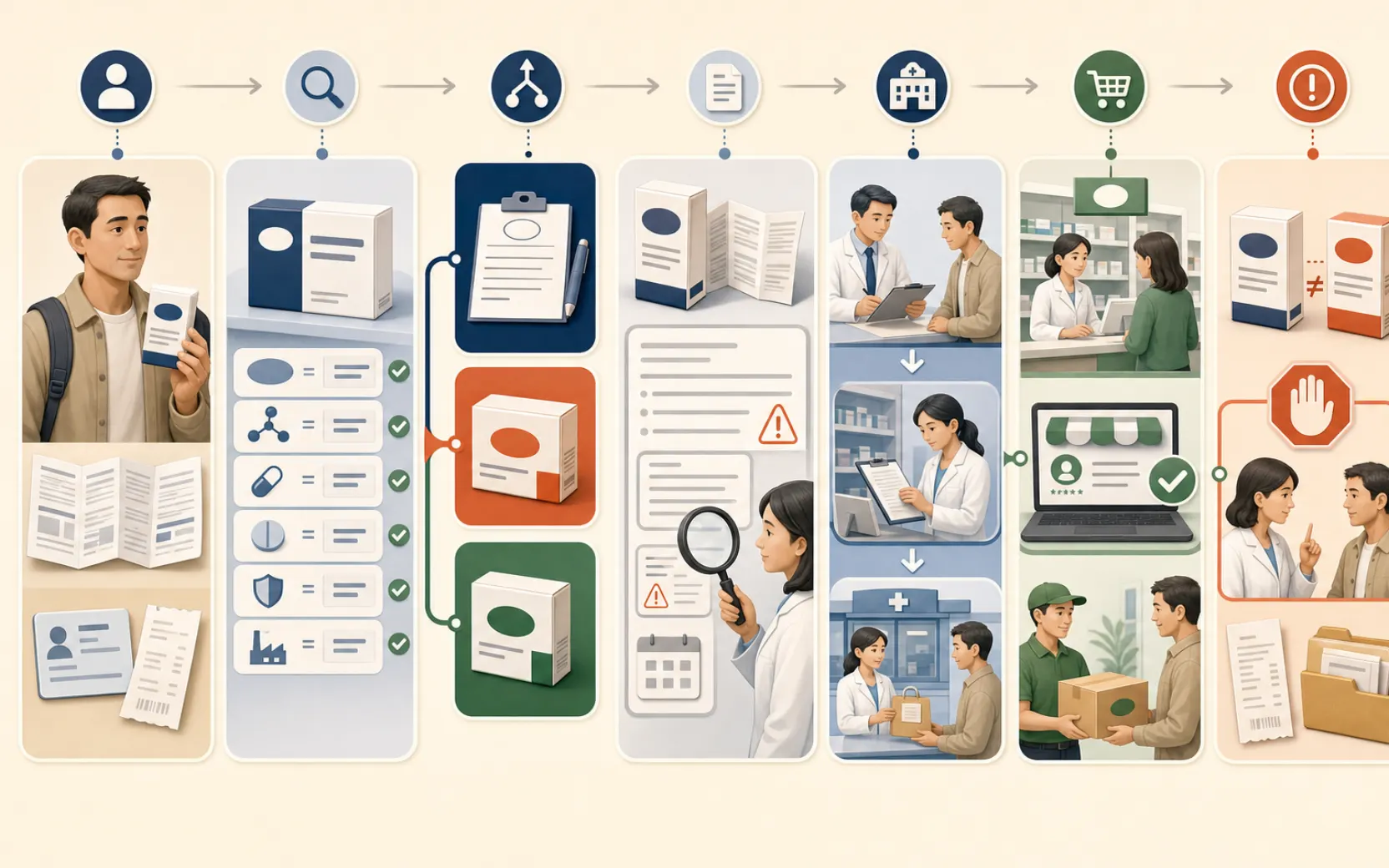
Prescription, Class A non-prescription and Class B non-prescription are regulatory states attached to an approved medicine presentation in China—not three levels of how strong, familiar or suitable a product looks. Classification can depend on the product, specification, approved indication, dose and route of administration, so a foreign brand name, active ingredient, box colour, app listing or previous purchase cannot settle the category by itself. A useful check connects the exact Chinese package and insert, OTC mark where present, generic name, strength and dosage form, approval number, lawful seller, prescription or pharmacist-review state, sales record and responsible service for questions. This guide explains that administrative route only; it never chooses a medicine, interprets symptoms, compares treatment, recommends a substitute or supplies a dose.
Use this as a practical starting point
Provider procedures can change, so confirm time-sensitive details with the hospital, insurer or service. A licensed professional must make clinical decisions for an individual patient.
At a glance
Key points
- Classify the exact China-approved product and presentation; an ingredient or overseas brand can exist in more than one regulatory state.
- A prescription medicine requires the lawful prescription and pharmacist-review route rather than open-shelf selection or a copied previous order.
- Approved non-prescription packages use the oval OTC mark: orange-red for Class A and dark green for Class B under the official mark explanation.
- OTC identifies the purchase category, not that a product is risk-free, suitable for every person or interchangeable with a similar-looking package.
- Read the complete approved Chinese label and insert; when another language appears, the Chinese text remains the controlling label under the national rules.
- Hospital, retail and online routes have different identity, prescription, pharmacist, stock, payment and record checks even when the product category is known.
- Keep the package, insert, prescription or consultation record, sales proof and seller details so a mismatch or question can be returned to the responsible professional.
Define the exact product before classifying it
Start with the physical package or the complete official product record, not a symptom, translated brand, search result or photograph of another box. Record the Chinese generic name, every active ingredient, dosage form, strength or specification, manufacturer, approval number and the seller or medical institution that supplied it. Keep combination products together while listing every ingredient shown in the insert.
Confirm that the object is presented as a medicine in China before applying prescription-versus-OTC rules. A food, health food, medical device, cosmetic, traditional medicine product, imported personal medicine or unverified online listing can follow a different approval and label route. This page does not determine that category from appearance; ask the lawful seller or pharmacist to identify the exact record when the package is unclear.
- Chinese generic name
- All active ingredients
- Dosage form and strength or specification
- Manufacturer and approval number
- Physical seller, hospital or online legal seller
- Unaltered package and insert
Match the category to the exact approved presentation
The national classification measures state that prescription or non-prescription management can differ according to the medicine variety, specification, indication, dose and route of administration. That means the same familiar ingredient or brand family is not a reliable category shortcut. Match the exact package and presentation rather than assuming that a tablet, liquid, topical product, adult product or child product follows the same route as another version.
For a prescription medicine, the classification rule requires a prescription issued by an authorized prescriber for dispensing, purchase and use. For an approved non-prescription medicine, the package and insert use the designated OTC identification and the product is assigned to Class A or Class B. Neither category answers whether the medicine is appropriate for the person holding it.
Do not convert a product into OTC status because it was easy to buy, was available overseas without a prescription or appears under an online search result.
Read the OTC mark and class without over-interpreting it
The official OTC mark is an oval symbol. The regulator explanation uses an orange-red background for Class A non-prescription medicines and a dark-green background for Class B. The national classification measures connect the classes to different safety-management and retail conditions: businesses selling prescription medicines or Class A OTC medicines need the relevant drug-distribution licence, while approved other commercial businesses may sell Class B OTC medicines under the applicable route.
Colour identifies the approved class only when it is the real OTC mark on the matching package or insert. It does not measure effectiveness, prove authenticity, indicate a dose, permit use by every age or health state, or authorize combining products. A missing, damaged, monochrome or unfamiliar mark is a reason to verify the complete package and source—not enough to declare the medicine illegal, prescription-only or safe.
- Oval OTC mark on the matching package
- Orange-red: Class A OTC
- Dark green: Class B OTC
- Class wording if the approved material is monochrome
- No category conclusion from colour elsewhere on the box
OTC means the approved purchase route does not require a prescriber's prescription. It never means risk-free, suitable for everyone or safe to combine.
Match the full Chinese label and insert
Use the outer label and the insert together. National rules require the outer label to cover the generic name, ingredients, characteristics, approved indication or function, specification, directions, adverse reactions, contraindications, precautions, storage, production date, batch, expiry, approval number and manufacturer, with abbreviated fields directing the reader to the insert when space is limited. The generic name, specification, batch and expiry remain essential even on a small inner label.
The rules require standardized Chinese and state that Chinese controls when another language is added. Keep the original text and mark any translation as a separate aid; do not paste a new label, edit a warning, translate a brand into a guessed local equivalent or let an app replace the approved insert. Ask a pharmacist or prescriber to explain medicine-specific wording that affects a real decision.
- Generic name and all ingredients
- Dosage form, strength or specification
- Approved indication or function
- Contraindications, precautions and adverse reactions
- Storage, batch and expiry
- Approval number and manufacturer
- Insert revision or source when shown
Use the prescription and pharmacist-review route
When the exact product is prescription-only, begin with the responsible clinician and a current lawful prescription. Then confirm whether dispensing occurs through the hospital pharmacy, an external retail pharmacy or a supported electronic route. A visit summary, foreign prescription, medicine photograph, old package, payment page or previous order is not automatically the prescription record the receiving pharmacy can use.
The retail quality framework assigns prescription review and medicine-use guidance to qualified pharmacy professionals and does not allow prescription medicines to be displayed or sold for open-shelf self-selection. Hospital examples make the handoff concrete: PUMCH International Medical Services describes pharmacy consultation and patient education, while Shanghai United Family describes prescription filling, medicine-profile and interaction checks, labels carrying the doctor's instructions and printed information on request. Those are provider examples, not nationwide stock or service promises.
- Current prescription and issuing provider
- Patient identity required by the route
- Hospital, retail or electronic dispensing destination
- Pharmacist review status
- Exact product and stock confirmation
- Payment, label and collection record
Verify the OTC seller and online route separately
For an OTC product, confirm that the seller is allowed to sell that class and that the package, insert and sales record identify the same product. Class A and Class B are not interchangeable store permissions. Even where Class B may be sold through an approved commercial business, an ordinary shelf, delivery rider or marketplace name does not prove that the legal seller and actual product are compliant.
Online sellers must display the responsible business licence information and pharmacy-professional information, distinguish prescription from non-prescription listings and preserve traceable sales records. Prescription-product pages have additional display and review restrictions before purchase. Save the legal seller, product page, order, sales proof and delivery record; use the separate online-medicine guide for the complete transaction workflow.
- Legal seller shown for the transaction
- Class the seller is allowed to supply
- Package and product-page match
- Displayed pharmacy-professional information
- Prescription review where required
- Sales proof, order and delivery record
Stop and hand off a mismatch instead of guessing
Pause when the category, OTC mark, Chinese name, ingredient, strength, dosage form, approval number, batch, expiry, package seal, insert, seller or prescription state does not match. Ask the dispensing pharmacist or responsible seller to identify the discrepancy and record the outcome. Send a prescription correction or product change back to the issuing clinician; do not alter a label, reuse an old prescription or accept an informal substitute.
Keep the package, insert, prescription or consultation record, pharmacy label, sales proof, payment record, online order and the name of the service that answered the question. For a suspected quality problem, wrong product, missing record or unresolved seller issue, use the seller's official complaint route and the dedicated problem-resolution guide. This administrative evidence supports investigation but does not decide whether a medicine should be started, stopped or changed.
Avoidable problems
Common mistakes
- Treating OTC as a claim that a medicine is harmless, mild or suitable for every person
- Matching only the active ingredient while ignoring specification, indication, dose or route of administration
- Using a foreign brand, box colour, photo or old purchase to decide the Chinese category
- Assuming every red or green element on a package is the official OTC class mark
- Declaring a package illegal or prescription-only merely because the OTC mark is missing or unfamiliar
- Letting an automatic translation replace the approved Chinese label or insert
- Treating a foreign prescription, visit summary or previous order as a current Chinese dispensing prescription
- Choosing a prescription product from an open shelf or asking a seller to bypass pharmacist review
- Assuming a marketplace or delivery app name proves the legal seller and class-specific permission
- Accepting a different ingredient, strength, form or package as an informal substitute
- Discarding the package, insert, sales proof or online record before a question is resolved
- Using this classification guide to select a product, dose, combination or treatment duration
Common questions
Frequently asked questions
What does OTC mean on a medicine package in China?
It marks an approved non-prescription medicine presentation. The oval mark is orange-red for Class A and dark green for Class B under the regulator explanation. It identifies the regulatory purchase class, not whether the medicine is suitable, risk-free or equivalent to another product.
What is the difference between Class A and Class B OTC medicines?
The national framework separates them by safety-management level and retail route. Businesses selling Class A OTC medicines need the relevant drug-distribution licence, while approved other commercial businesses may sell Class B OTC medicines. The class does not tell a patient which product to choose.
Is a medicine without an OTC mark always prescription-only?
No safe conclusion follows from the missing mark alone. It may be prescription-only, another product type, an outside or older package, damaged, incomplete or unverified. Keep the complete package and ask a lawful pharmacist or seller to match the actual Chinese product record.
Can the same ingredient be prescription-only in one package and OTC in another?
Do not classify from the ingredient alone. The national measures state that classification can depend on the medicine variety, specification, indication, dose and route of administration. Match the exact approved presentation and label.
Does an overseas prescription let me buy a prescription medicine in China?
Not automatically. It can support the treatment history, but the intended Chinese provider and pharmacy decide the lawful local assessment, prescription and dispensing route. A photograph, translation or old package is not automatically a usable Chinese prescription.
Can I buy Class A or Class B OTC medicine online?
The transaction still needs a lawful seller, class-appropriate permission, accurate product display, traceable sales record and suitable delivery. Online retailers must distinguish prescription and non-prescription products. Use the dedicated online-medicine guide to verify the full route.
Which language controls if the package has Chinese and English?
The national label rules require standardized Chinese and state that Chinese controls when another language is added. Keep the original wording and use a separate translation aid; ask a pharmacist or prescriber to explain medicine-specific instructions.
Can China Care Desk recommend an OTC medicine, substitute or dose?
No. This page explains classification, labels, lawful sellers and records only. A qualified clinician or pharmacist must address suitability, interactions, substitutions, directions and treatment decisions for the actual person and product.
Evidence
Sources consulted for this guide
National rules are separated from city and provider examples. Access dates show when a source was collected; source pages and procedures can change afterward.