
Medicines & pharmacies
Pharmacy receipts and insurance claims in China
Match the payer, patient, prescription and medicine, then keep sales proof, tax invoice, payment and settlement records separate for the correct claim route.
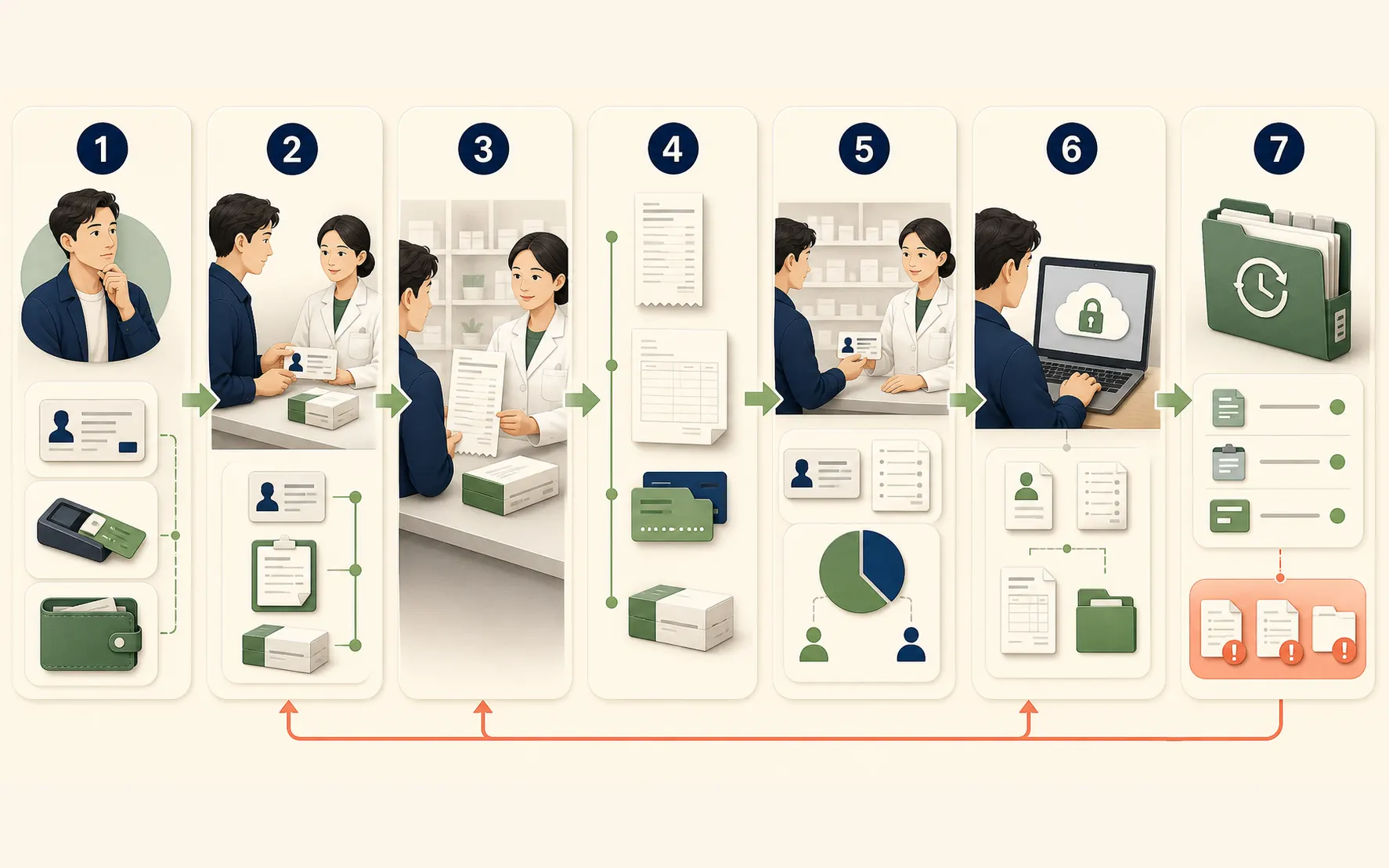
A pharmacy purchase creates several records, not one universal insurance receipt. The medicine package, prescription, pharmacy sales proof, tax invoice, payment proof, basic-medical-insurance settlement record and commercial-insurance claim file each answer a different question. Decide the payer route before purchase, keep the patient and exact medicine matched across the evidence, and follow the current policy or local settlement instructions. This guide organizes the handoff; it does not decide coverage or guarantee reimbursement.
Use this as a practical starting point
Provider procedures can change, so confirm time-sensitive details with the hospital, insurer or service. A licensed professional must make clinical decisions for an individual patient.
At a glance
Key points
- Choose the intended route before purchase: basic-medical-insurance direct settlement, a confirmed commercial direct-billing arrangement or self-pay followed by a possible claim.
- Keep the patient or member identity, prescription or clinical record, pharmacy seller and exact medicine presentation as one matched transaction set.
- Retail pharmacy sales proof should identify the medicine name, manufacturer, quantity, price, batch and specification under the national quality framework.
- Online sales proof may be electronic, so preserve a readable copy outside the seller app or account while the transaction and any claim remain open.
- Pharmacy sales proof, a tax invoice, payment proof and the original medicine package are different objects; one should not be renamed or substituted for another.
- A designated-pharmacy direct-settlement record and signed purchase list belong to the basic-medical-insurance route, not automatically to a commercial claim.
- Commercial insurers control their own invoice, prescription, diagnosis, translation, original-document, submission and deadline rules; complete documents still do not prove coverage.
Name the payment and claim route before purchase
Start with one intended administrative route: basic-medical-insurance direct settlement at a designated retail pharmacy; a commercial insurer arrangement that the insurer and pharmacy have both confirmed for this transaction; or patient payment followed by a possible reimbursement claim. A member card, directory listing or prior successful purchase does not by itself settle which route applies today.
Match the current patient or member identity, policy or enrolment dates, exact pharmacy outlet, prescription route and medicine request before money changes hands. Ask the relevant payer whether a network rule, prior approval, original document or claim deadline applies. Record an answer as confirmed only when it comes from the pharmacy, insurer or authenticated member route responsible for it.
- Basic-medical-insurance direct settlement
- Confirmed commercial-insurance direct billing
- Self-pay followed by a possible commercial claim
- Patient or member identity and active dates
- Exact outlet, prescription route and pre-purchase condition
Do not write an expected reimbursement amount as confirmed coverage. A payer route can still leave a deductible, co-payment, non-covered item or full patient payment.
Match the patient, prescription and exact medicine
Build one linked set around the person and the exact product supplied. Keep the patient name and identity used at the pharmacy, the insurance member or policy reference where relevant, the prescription or lawful electronic record for a prescription medicine, the pharmacy seller and outlet, and the medicine name, manufacturer, specification, batch and quantity shown on the package and sales evidence.
These records do different jobs. A prescription or clinical record supports the clinical and dispensing route; the package identifies the presentation in hand; the pharmacy sales proof records what the seller sold; and the payer record identifies who may assess or settle the cost. If names, dates, product fields or references conflict, preserve the original versions and ask the issuing organization to correct its own record instead of editing a scan or copying a field across documents.
- Patient identity used for the purchase
- Member, policy or basic-insurance identity when applicable
- Prescription, electronic-prescription or clinical reference
- Legal pharmacy seller and exact outlet
- Medicine name, manufacturer, specification, batch and quantity
A familiar English brand, package colour or translated nickname is not a safe cross-document identifier. Reconcile the exact presentation printed in the transaction records.
Collect the pharmacy sales proof before the handoff closes
The national retail quality framework requires a pharmacy selling medicine to issue sales proof that includes the medicine name, manufacturer, quantity, price, batch and specification and to maintain sales records. Treat the seller name, outlet, sale date and transaction reference as practical reconciliation fields when the pharmacy system provides them; do not present those extra fields as if Article 168 listed every one of them.
Check the proof while the pharmacy or online order remains accessible. Compare the medicine and amount with the package, prescription and payment. For an online sale, the proof may be electronic and the retailer must retain the minimum-sales-unit record for traceability. Download or export a readable copy outside the seller app, preserve the original file and record how to retrieve the order without publishing account credentials.
- Medicine name and manufacturer
- Specification and batch
- Quantity and price
- Seller, outlet, date and transaction reference when shown
- Original electronic file or complete paper document
Ask the pharmacy about a missing or incorrect sales record before discarding the package or closing the seller account. Reissue and correction practice belongs to that seller and system.
Separate sales proof, tax invoice, payment proof and package
Keep four objects in separate labelled files. Pharmacy sales proof itemizes the medicine transaction; a tax invoice is a tax document issued through the applicable route; payment proof records the transfer of money; and the original medicine package identifies the physical presentation received. A bank-card slip or wallet screenshot does not add the missing medicine fields, and a package photograph does not prove who paid or whether a payer accepted the charge.
The commercial insurer decides which invoice, original, translation, certification and upload format its policy requires. Allianz's current claim guidance is one insurer-specific example that requests a China tax invoice for its relevant claims and a prescription for specified medication benefits. Cigna's published process is a separate example using an invoice and claim information. These examples show why the pharmacy sales proof should be preserved alongside—not renamed as—the insurer's requested invoice.
- Pharmacy sales proof: what the seller recorded
- Tax invoice: the tax document the applicable claim route requests
- Payment proof: who transferred money, when and how much
- Original package: the exact presentation supplied
- Prescription or clinical record: the clinical and dispensing context
Do not alter document titles, totals, dates or names to make files appear consistent. Ask the issuer for a corrected record and retain the original plus the correction trail.
Reconcile a basic-insurance direct settlement
For China's basic-medical-insurance route, verify that the exact retail-pharmacy outlet is designated for the relevant local arrangement and that the patient's current identity and prescription route can be used. The national framework requires a designated pharmacy to check the insured person's identity, upload the medicine item, specification, price and cost information, provide the direct-settlement document and related material, and obtain confirmation on the purchase list.
Preserve the purchase list and settlement result showing the transaction amount and any patient-versus-fund allocation available in the local system. Under the cited national framework, medicine expenses incurred at a non-designated retail pharmacy are not paid by the basic-medical-insurance fund. Even at a designated outlet, product eligibility, local benefit rules and the prescription route remain separate questions. Do not present the basic-insurance settlement record as proof that a commercial insurer will reimburse the patient share.
- Exact designated outlet and local arrangement
- Insured-person identity match
- Prescription or electronic external-prescription route if required
- Medicine item, specification, price and cost record
- Direct-settlement document and confirmed purchase list
- Patient share and fund share kept as separate amounts
A pharmacy chain name is not enough. Designated status and local settlement capability must match the exact outlet, patient, date, medicine and route.
Build and submit the commercial-insurance claim file
Use the current policy, benefit guide and authenticated claim instructions as the controlling checklist. A pharmacy medicine claim may ask for member or policy identity, pharmacy sales proof, a tax invoice, prescription, diagnosis or treatment information, payment proof, a claim form, translation or original documents. Record which rule applies to this person, policy, medicine purchase and submission date; do not turn an insurer example into a China-wide requirement.
Submit through the insurer's verified channel and preserve the exact files, submission timestamp, claim or case number and status. Allianz's China app is one current example that accepts key details and invoice photographs and exposes claim status and policy documents. Cigna describes a secure customer-area route as one option in its own process. A successful upload proves transmission, not completeness, coverage, acceptance of every file or reimbursement.
- Member or policy identity and active policy record
- Current claim checklist or benefit-guide edition
- Sales proof, requested invoice and payment proof
- Prescription and requested clinical support
- Original, copy and translation rules
- Verified submission channel and deadline
- Submission confirmation, claim number and status
Keep unredacted identity and medical records inside the insurer's authenticated route or another channel it has verified. Do not place claim documents in public links or send them to an address copied from an unrelated page.
Correct the owner’s record and close every case
Separate pharmacy-document correction from insurer claim handling. A wrong patient, seller, medicine, date, quantity or amount on pharmacy evidence goes back to the issuing pharmacy or platform. A request for another prescription, diagnosis record, translation or original belongs to the insurer claim case. Preserve the original, the issuer's corrected record, the request for more information and the resubmission confirmation as distinct events.
Close the transaction only when the sales evidence, any basic-insurance settlement and any commercial claim each has its own final status. Record the claim or settlement reference, decision date, patient and payer amounts, payment destination and unresolved issue. A claim denial does not by itself prove the pharmacy document is wrong; move coverage or complaint questions to the separate denied-claim workflow without altering the underlying sale record.
- Pharmacy correction or reissue case
- Insurer request for more information
- Resubmission confirmation and status
- Approved, partly paid, denied or withdrawn outcome
- Patient amount, payer amount and payment destination
- Final archive containing originals and the correction trail
Complete evidence improves the handoff but never guarantees reimbursement. Coverage, eligibility, exclusions, limits, network rules and deadlines remain payer decisions.
Avoidable problems
Common mistakes
- Choosing the claim route only after discarding purchase evidence
- Treating a designated or network pharmacy listing as proof of coverage
- Leaving a transliteration or member-name mismatch unresolved
- Treating a bank-card slip as complete pharmacy sales proof
- Renaming pharmacy sales proof as a tax invoice
- Using a package photograph as proof of payment
- Deleting electronic sales proof when an app or seller account closes
- Combining different patients, policies, conditions or purchases without the insurer's instruction
- Editing a scan instead of asking the issuing organization for a correction
- Sending originals without retaining readable copies and a delivery trail
- Uploading sensitive claim files to a public link or unverified address
- Assuming direct settlement or direct billing means zero patient share
- Assuming a complete document file guarantees reimbursement
Common questions
Frequently asked questions
What should a retail pharmacy sales document show?
The cited national retail quality framework lists the medicine name, manufacturer, quantity, price, batch and specification in the sales proof and requires sales records. Preserve every field the issuing pharmacy actually provides, but do not claim that the rule lists an insurer's full claim checklist.
Is pharmacy sales proof the same as a fapiao?
Do not assume so. The pharmacy sales proof records the medicine sale, while a fapiao is a tax invoice issued through the applicable tax-document route. An insurer may request one or both. Ask the pharmacy what it can issue and the insurer what its current policy accepts.
Can online pharmacy sales proof be electronic?
Yes. The cited online-drug-sales rules allow required sales proof to be issued electronically and require retention of the minimum-sales-unit sales record. Insurer acceptance, upload format and original-document rules remain policy-specific, so save the original electronic file outside the seller app.
Is a bank-card or mobile-wallet slip enough?
Usually it proves only part of the payment event. It may not identify the medicine, manufacturer, specification, batch and quantity. Keep payment proof separately and obtain the pharmacy sales proof and any tax invoice the applicable claim route requests.
Is a basic-insurance settlement record a commercial-insurance claim file?
No. The designated-pharmacy direct-settlement document and purchase list belong to the basic-medical-insurance transaction. A commercial insurer may use some of the same underlying evidence, but its policy controls the separate claim file and accepted documents.
Does designated-pharmacy status mean my medicine will be paid?
No. It is one condition in the basic-medical-insurance route. The exact outlet, patient enrolment, prescription route, medicine eligibility and local benefit rules still matter, and the patient may retain a payable share.
What if the patient name or medicine details are wrong?
Keep the original evidence and ask the organization that issued the incorrect record to correct or reissue it. Do not edit the scan yourself. Preserve the correction request, revised document and any resubmission confirmation.
Must pharmacy documents be translated?
There is no universal answer. Confirm the accepted language, translator, certification, original and upload format with the applicable insurer before paying for translation. Keep the untranslated original and translated file separate.
Do complete pharmacy documents guarantee reimbursement?
No. Coverage, eligibility, exclusions, limits, network rules, prescription requirements, patient share and deadlines still determine the result. The document file supports assessment; it does not decide the claim.
Evidence
Sources consulted for this guide
National rules are separated from city and provider examples. Access dates show when a source was collected; source pages and procedures can change afterward.