
Living in China
Useful Chinese phrases at a hospital in China
Copy Chinese hospital phrases for appointments, passport registration, directions, language help, payment, pharmacy, reports and follow-up.
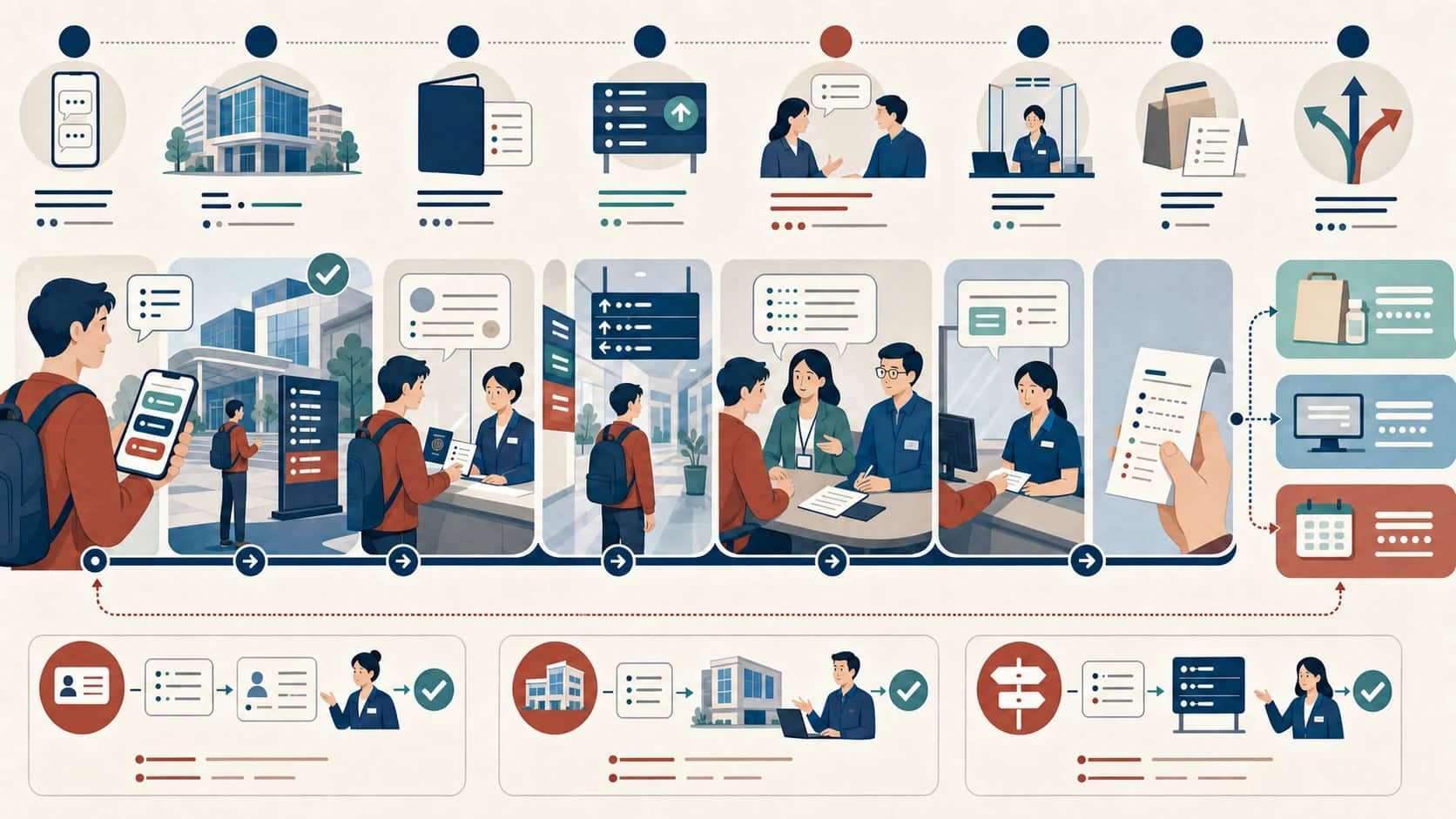
This page is a hospital-navigation phrase deck for mainland China. It helps an international patient show a verified appointment, register a passport, locate a desk or campus, request language assistance, ask for payment records, find a pharmacy or report route and arrange administrative follow-up. It deliberately does not translate symptoms, medical history, diagnoses, allergies, consent, medicine doses, test findings, treatment choices or emergency instructions. Those conversations need the responsible clinical team and qualified language support. Provider examples below demonstrate why the exact hospital route matters; they do not create one national script or guarantee that a phrase, document, language, payment method or service will be accepted at every institution.
Use this as a practical starting point
Provider procedures can change, so confirm time-sensitive details with the hospital, insurer or service. A licensed professional must make clinical decisions for an individual patient.
At a glance
Key points
- Show the Chinese characters; do not rely on pinyin pronunciation when the exact campus, identity, number or document matters.
- Build one offline trip card with the hospital, campus, department, appointment, passport spelling and a trusted contact route.
- Use the phrases to ask a question or locate the responsible desk, never to assert that a booking, document, insurance benefit or clinical decision is confirmed.
- Ask for language support before consent, diagnosis, medicines, allergies, test interpretation or other care-changing communication.
- Request important numbers, dates, units, amounts and destination details in writing, then compare them with the provider-issued record.
- Share only the minimum phrase and transaction reference needed; do not paste a full passport, report or insurance file into an unverified translation channel.
1. Keep the phrase deck inside a safe boundary
A phrase on this page can ask where to register, whether the hospital can arrange an interpreter or which office owns a document. It cannot establish the correct department, explain a symptom, obtain valid consent, identify a medicine, interpret a result or tell a patient what to do clinically. When a conversation could change care, stop using the deck as the communication method and ask the provider to arrange its qualified language-support route.
Provider arrangements differ. Beijing United Family publishes multilingual staff and telephone interpretation for its own Beijing services, while Jiahui states that interpreter assistance is used in its own patient-communication process. Those are useful examples of questions to ask—not proof that another hospital, campus, department or shift provides the same service. Ask who interprets, whether the support is on site or remote, which stages it covers, when it is available and whether a fee applies.
- Navigation question: a phrase card can help
- Clinical history or symptom: use the responsible clinical team and qualified interpretation
- Consent or refusal: identify the form and arrange language support before signing
- Medicine, allergy, dose or result: ask the doctor or pharmacist to explain with qualified support
- Emergency: use the local emergency route and dispatcher's instructions, not this page as a script
The copy button copies only the Chinese phrase shown. It does not verify that the phrase fits an individual situation or replace a clinician, pharmacist or interpreter.
2. Build one verified hospital trip card before leaving
Copy the exact Chinese hospital name, campus, address, department and appointment details from the provider's current official confirmation. Keep the original confirmation beside a short bilingual card rather than manually recreating every field. Peking Union Medical College Hospital, for example, publishes distinct campuses and general and international routes; its own instructions show that registration, check-in, payment, test scheduling, pharmacy and reports are separate steps. Another provider may organize them differently.
Put only the information needed for the trip on the card: hospital and campus, department or clinic already confirmed by the provider, appointment date and arrival window, patient name exactly as registered, last four characters or a masked version of any reference when possible, and the provider's verified contact route. Keep the full passport number, insurance policy, reports and medical history in a separate protected record. Download the card or take a screenshot so it remains available when mobile data, Wi-Fi, an app login or a QR code fails.
- Official Chinese hospital and campus name
- Chinese address and entrance or building if confirmed
- Department and service route already assigned by the provider
- Appointment date, time window and booking reference
- Passport spelling used for the booking
- Existing patient number or card where applicable
- Verified hospital contact and arranged interpreter contact
3. Separate appointment, registration, check-in and queue status
A booked appointment does not necessarily mean that the patient record exists, passport identity has been accepted, arrival has been checked in or a queue number is active. Show the original booking first, then ask which transaction is still open. Use the phrase deck to locate the official registration window, check-in route, guidance desk or waiting area; do not use it to declare that the patient is registered or entitled to a service.
PUMCH's current outpatient notice is one provider example: it separates first-visit record creation, registration, arrival check-in, payment and destination instructions and identifies staffed windows alongside digital routes. If an app or machine rejects a passport, do not enter a false resident-identity number or create a second profile. Ask the provider for a staffed foreign-document route and keep the same passport spelling across the appointment, patient record, payment and later documents.
- Appointment exists
- Patient identity or record exists
- Registration for the selected service is complete
- Arrival or check-in is recorded
- Queue or waiting-area instruction is current
- Payment and next-destination instruction are separate
4. Match the passport identity without exposing it unnecessarily
Show the original identity document only through the hospital's accepted route. Ask staff to use the same registered spelling, document type, date of birth and existing patient number that appear in the confirmed appointment or earlier records. PUMCH explicitly lists a passport among original identity documents for its own first-visit record-creation process; that provider example does not prove that every hospital app, kiosk, campus or service accepts the same document in the same way.
If the hospital cannot locate the record, ask staff to search the existing profile before opening another one. A renewed passport, different name order, missing space or former document number can create a mismatch. Use the short correction phrase to flag the problem, then follow the institution's formal registration or medical-record correction route. Do not edit a downloaded report or type a guessed identity number merely to make a digital form continue.
A phrase asking whether a passport can be used is a question, not a guarantee of acceptance. The exact provider and service control the current identity route.
5. Navigate the exact campus, building, floor and waiting area
Keep the Chinese campus name and address visible for transport and arrival. Hospital groups can operate multiple campuses, and a translated department name may refer to different clinics or buildings. At the entrance, show the original appointment and ask the guidance desk to mark the department and route on the hospital's own map or written instruction. A map listing, ride-hailing result or old social post is not a current service confirmation.
After payment or registration, read the provider-issued destination instruction before following a phrase from this page. PUMCH's outpatient notice directs patients to a guidance sheet for pharmacy, examination and treatment locations and documents provider-specific report routes. The practical lesson is to ask the responsible desk to write the next destination; it is not to copy PUMCH's building names, floors or workflow to another institution.
- Hospital group and exact campus
- General, special-demand or international route
- Outpatient, emergency, inpatient or test entrance
- Building, floor, zone and waiting area
- Provider-issued next destination after payment
6. Ask for language support and close the communication loop
Use the language-help phrases early—during appointment planning or registration—not only after a complex conversation has started. State which stage needs interpretation: registration, consultation, consent, pharmacy explanation, result discussion, discharge or another named interaction. Ask whether the person is hospital staff or an external service, whether the interpretation is in person, video or telephone, whether advance booking is required and how confidentiality is handled.
For an important number, date, amount, unit, building, department or document name, ask staff to write it down and compare it with the provider-issued record. Then repeat the administrative meaning as a question: for example, 'Is this the correct campus?' or 'Is this the amount I pay now?' Do not repeat a diagnosis, dose or treatment instruction through this deck; ask the clinician or pharmacist and interpreter to verify that information directly.
- Name the exact interaction that needs interpretation
- Confirm who provides the language support
- Confirm format, time, fee and privacy route
- Ask for critical administrative details in writing
- Use a question rather than asserting that the meaning is confirmed
7. Keep payment, insurance and document requests separate
Use the payment phrases to locate an official cashier or ask for an amount before paying. A registration charge, deposit, test payment, pharmacy charge and final settlement can be separate transactions. Ask for the provider's official medical fee receipt and itemized charge statement when needed. A mobile-payment screenshot may prove a transfer but is not automatically the hospital document an insurer, employer or other recipient requires.
Use insurance language only to locate the responsible desk and request a written answer. Do not translate an insurer logo into a coverage promise. Hospital acceptance, insurer network status, benefit eligibility, authorization, direct billing and the patient's final balance are separate decisions. Jiahui's international office publishes provider-specific estimate and third-party payment assistance; that is not a national guarantee or evidence that one patient's plan will pay.
Ask the hospital to write the amount due now and the document it issues. Ask the insurer separately what it covers and accepts.
8. Hand off pharmacy, reports and follow-up without clinical translation
After a consultation, ask where provider-issued prescriptions are paid and where medicine is collected. Request the printed medicine name and arrange language support for every use instruction you do not fully understand. A phrase can locate the pharmacy or request a printed name; it cannot identify an equivalent product, confirm an allergy, change a dose or decide whether a medicine should be taken.
Ask separately where laboratory reports, imaging reports, original image files and medical-record copies become available. Keep complete provider files and filenames without changing wording, values or units. Then ask how to book the follow-up department specified by the responsible team. PUMCH's published route and Jiahui's report assistance are provider examples; the issuing institution controls the actual release, correction and follow-up process.
- Prescription issued, paid and dispensed are different states
- Medicine name and medicine-use explanation are different requests
- Laboratory report, imaging report and original image data are different records
- Report release and clinician review are different states
- Follow-up department and booking completion are different states
9. Do not turn an emergency into a phrase-sheet exercise
This R1 page deliberately contains no symptom list, self-triage rule, first-aid instruction or clinical emergency script. If a medical emergency may be occurring in mainland China, use the local emergency route and follow the dispatcher's or responsible professional's instructions. Do not delay an urgent call while trying to construct a perfect translation, and do not use an administrative phrase to decide that a person can travel, wait or use routine registration.
If language is a barrier during an emergency interaction, ask for a Chinese speaker or interpreter as soon as possible without delaying the emergency route. Keep the verified Chinese address available, but let the dispatcher and emergency team control the questions and instructions. The separate 120 guide explains the public dispatch handoff and remains outside this navigation deck's scope.
For a possible medical emergency in mainland China, call 120. This page cannot decide urgency or replace dispatcher instructions.
10. Save an offline copy and protect the information you show
Save the page or screenshots before travelling, but record the review date because provider routes and terminology can change. Copy one Chinese phrase at a time and send it only to the hospital, interpreter or trusted helper who needs it. Keep the phrase separate from the full passport, insurance card, report or medical history unless the recipient and secure route have been verified.
After the visit, keep the provider-issued Chinese record as the source document and label any translation separately. Note which phrase or interpreter route was used for an unresolved handoff, then confirm the final answer with the responsible hospital, pharmacy, insurer or record holder. Delete temporary screenshots from shared devices and chats when they are no longer needed, subject to any legitimate record-keeping requirement.
Useful language
Navigation phrases
Show the Chinese characters when pronunciation is uncertain. Use the copy button to send one phrase through a trusted channel without retyping it.
Before you leave
Appointment and registration
Finding the right place
Language assistance
Payment and documents
Pharmacy, reports and follow-up
Avoidable problems
Common mistakes
- Showing only an English hospital-group name without the Chinese campus
- Treating an appointment as completed registration or check-in
- Entering a false resident identity number when an app rejects a passport
- Opening a second patient profile before staff searches the existing record
- Using pinyin when staff need exact Chinese characters
- Guessing a department from a translated symptom
- Assuming an English website proves interpretation is available at every step
- Asking for language help only after a consent or medicine conversation has begun
- Using a family member, colleague or app as the sole interpreter for care-changing information
- Copying a diagnosis, allergy, dose or result from an unverified translation
- Failing to confirm a number, date, amount or unit in writing
- Treating an insurer logo or translated phrase as coverage approval
- Saving only a payment screenshot instead of provider-issued billing records
- Confusing a report download with clinician review or completed follow-up
- Sending a full passport or medical record through a public translation chat
- Delaying an emergency route while searching for a perfect phrase
Common questions
Frequently asked questions
Are these phrases medical translations?
No. They are administrative navigation questions for mainland China. They do not translate symptoms, diagnoses, allergies, consent, medicines, doses, test findings, treatment or emergency instructions. Ask the responsible clinician or pharmacist to explain those matters with qualified language support.
Should I show Chinese characters or read the pinyin?
Show the Chinese characters whenever the exact hospital, campus, department, number or document matters. Pinyin is a pronunciation aid, not a substitute for the written phrase or the provider's own record.
Can I use a translation app at a hospital?
It may help with a low-risk navigation question, but do not rely on it alone for consent, diagnosis, allergies, medicines, doses, results, clinical instructions or emergencies. Request qualified language support and verify important administrative details in writing.
Can a friend or family member interpret?
A trusted companion may help with simple navigation, but ability, privacy, role and institutional rules matter. Ask the hospital how qualified language support will be provided for care-changing communication; a companion is not automatically an authorized representative or clinical interpreter.
Does an English hospital website mean English is available throughout the visit?
No. An English booking page or international office does not prove that every clinician, cashier, laboratory, pharmacy, ward or shift has the same language support. Confirm the exact appointment, campus, stage and date.
Does the passport phrase guarantee that a hospital will accept my passport?
No. It asks the provider a question. PUMCH publishes a passport route for its own first-visit record creation, but every hospital, campus, machine and service controls its current identity process.
What should I do if an app accepts only a mainland resident identity card?
Do not enter a false number. Use the hospital's official support or staffed registration route, show the accepted passport and appointment evidence, and ask staff to search for an existing patient record before creating another profile.
Can I copy a Chinese phrase from this page?
Yes. The copy button copies only that Chinese phrase. Review it before sending and use a verified hospital, interpreter or trusted contact channel. Copying a phrase does not confirm that it fits the situation or that the recipient has accepted the request.
Can I save screenshots for offline use?
Yes. Keep the hospital's original confirmation as the source record, save only the phrases needed and note this page's review date. Provider routes and terminology can change, so reconfirm time-sensitive details.
Can I use a phrase here to report an allergy or ask about a dose?
No. Allergy, medicine, dose, route, timing, interaction and substitution communication can change care. Ask the doctor or pharmacist to explain directly with qualified language support.
Can this page tell me which department to choose?
No. It can help you ask the provider to write down a department already assigned through its clinical or registration process. It does not translate symptoms into a specialty or assess urgency.
What should I do in a medical emergency?
For a possible medical emergency in mainland China, call 120 and follow the dispatcher or responsible professional. Do not delay the emergency route while using this page, and do not use it to decide that a person can wait or travel.
How do I protect my passport and medical information while using the phrases?
Keep full identity, insurance and health records outside the phrase card. Share the minimum needed through a verified route, avoid public translation chats, and remove temporary copies from shared devices when they are no longer needed.
Do these phrases apply in Hong Kong, Macao or Taiwan?
This page is scoped to mainland China. Terminology, emergency systems, hospital administration and language usage can differ elsewhere, so use a locally verified guide for those jurisdictions.
Evidence
Sources consulted for this guide
National rules are separated from city and provider examples. Access dates show when a source was collected; source pages and procedures can change afterward.