
Medical Chinese
Chinese phrases for hospital payment, receipts and insurance bills
Copy Chinese phrases for cashier payment, deposits, official medical receipts, itemized charges, final settlement and insurance claim records in China.
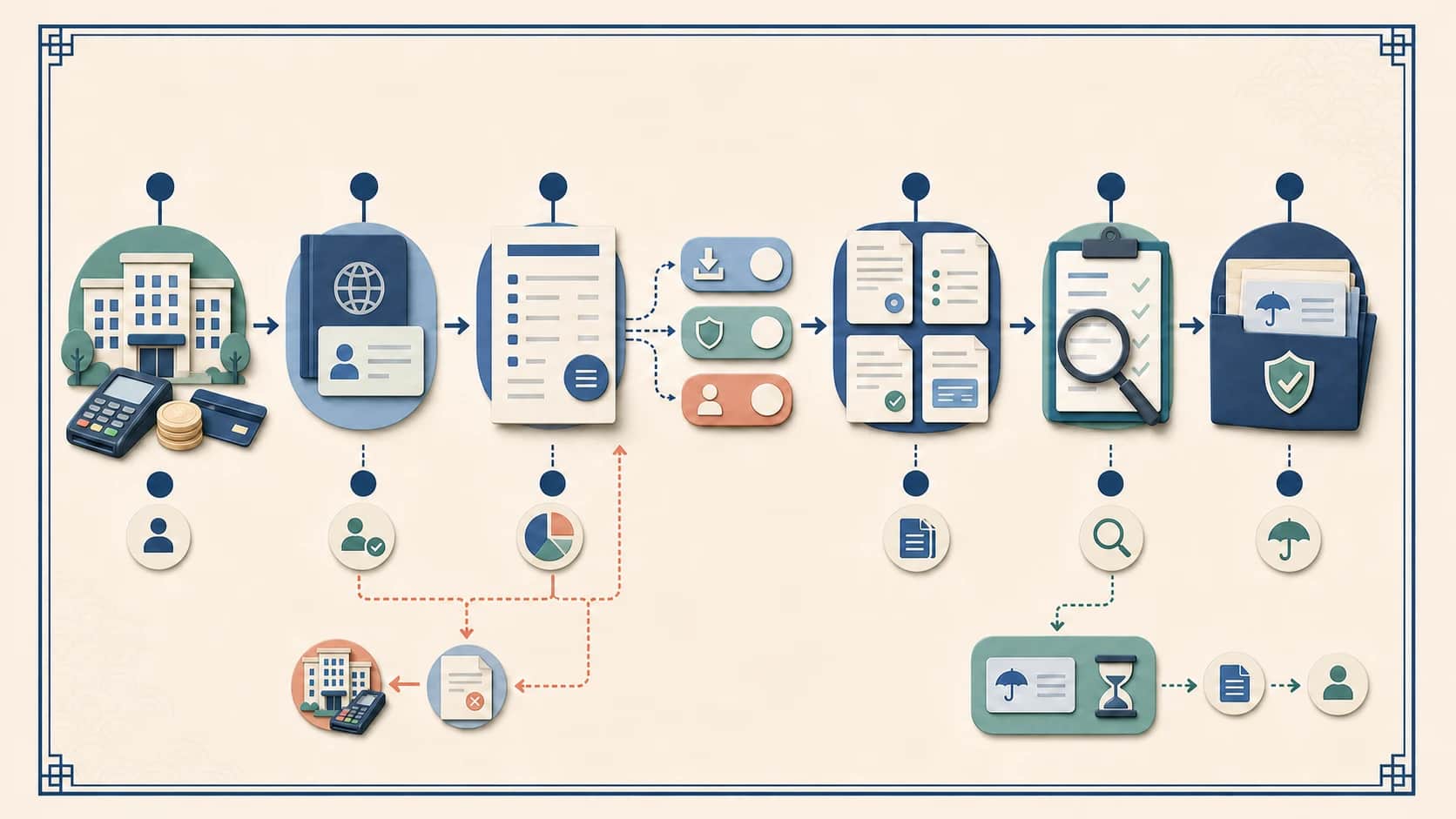
This copy-ready administrative phrase deck follows the financial handoff from a hospital order or deposit through cashier payment, public or commercial insurance allocation, official receipt, itemized charges, final settlement and a claim-ready record pack. It helps a patient ask the issuing provider what a document is, where it comes from and which amount remains payable. It does not decide whether a charge is clinically necessary, promise coverage, interpret a policy, replace an issuer's receipt or make one hospital's payment channel universal. Keep the provider-issued Chinese records unchanged, obtain the exact insurer checklist for the actual plan and move to qualified language support when billing questions reveal clinical information that must be understood accurately.
Use this as a practical starting point
Provider procedures can change, so confirm time-sensitive details with the hospital, insurer or service. A licensed professional must make clinical decisions for an individual patient.
At a glance
Key points
- A price estimate, deposit, payment transaction, official medical fee receipt, itemized charges, insurance settlement statement and refund record are different documents.
- Confirm the legal provider, campus, patient identity, visit number, payable amount and official payment route before transferring money.
- Ask the cashier to separate the gross charge, public-insurance payment, commercial direct billing, deductible or co-payment, deposit applied and amount still due.
- Collect both financial evidence and any insurer-requested clinical records, but keep those files separate and disclose only through verified channels.
- Direct billing can be partial, pending or declined; obtain a written status and a patient-paid receipt for every amount you actually pay.
- Route missing or incorrect receipts to the dedicated recovery guide; this page focuses on collecting and reconciling the correct documents during settlement.
1. Keep the conversation inside the payment-and-document boundary
Use this page to locate the cashier or insurance desk, confirm which amount is due, identify an official provider-controlled payment channel and request the records created by that transaction. The phrases can also ask whether a direct-billing decision is complete, whether a deposit has been applied and which document the hospital calls a medical fee receipt, itemized charge list or settlement statement. They cannot determine whether a service should have been ordered, whether the diagnosis is correct, whether an insurer must cover it or whether a disputed charge is legally enforceable.
Billing records can expose diagnoses, medicines, tests and other sensitive clinical details. If staff must explain why a clinical item was ordered, what a procedure includes, whether an alternative is medically appropriate or how a diagnosis affects coverage, ask for qualified language support and the responsible clinician or insurer. Do not use a generic phrase, a companion's guess or a public chat translation to make a treatment decision. In a medical emergency, call 120 or use the hospital's emergency route; a payment disagreement must not delay emergency assessment and stabilization.
- Administrative payment route and document name: this deck can help
- Clinical reason for a charge or treatment choice: ask the responsible clinician
- Policy coverage, deductible or authorization decision: ask the actual insurer
- Receipt issuance and charge content: ask the issuing hospital
- Urgent symptoms or deterioration: use the emergency route, not the cashier workflow
A copied Chinese phrase is a question, not proof. Preserve the provider's written answer, active receipt and payment confirmation.
2. Identify the legal payee and official payment route
Start with the exact hospital or clinic, campus, service and patient visit shown on the provider's record. A hospital group may use different cashiers, accounts, apps, mini programs, self-service machines or third-party payment processors at different campuses. Ask staff to show the current route from an official screen or written notice. Check the displayed legal payee before scanning a code or making a transfer. A familiar logo, search advertisement, personal account or message from someone claiming to be an agent is not enough.
Payment channels are provider-specific. Peking Union Medical College Hospital currently describes staffed windows, self-service equipment and its hospital app for its own outpatient workflow, with separate public-insurance credential requirements. United Family providers publish different accepted methods for particular facilities or packages. Those examples prove variation, not a national list. If a card, foreign mobile wallet or cash is rejected, ask for a provider-published alternative rather than splitting payment across unverified accounts.
- Exact provider and campus
- Patient name and visit, admission or order number
- Official cashier, machine, app or account
- Legal payee shown before confirmation
- Amount and currency
- Transaction reference returned after payment
Pause if the payee, campus, patient or amount does not match. Ask the staffed cashier to explain the mismatch before paying.
3. Confirm the amount and separate the payer allocation
Ask for the current gross charge before payment and then ask how it is divided. A patient may face full self-pay, public medical-insurance settlement, commercial direct billing, a guarantee-of-payment arrangement or a mixture. Even when the hospital bills an insurer directly, the patient may still owe a deductible, co-payment, excluded item, benefit-limit excess or amount pending approval. A direct-billing logo or provider-network listing does not confirm the decision for one policy and one visit.
Jiahui distinguishes public medical-insurance settlement from commercial direct billing in its own service information. United Family explains that its direct-billing patients may still pay plan-specific out-of-pocket amounts. Cigna likewise separates insurer payment from deductibles and cost shares in its member claim workflow. Ask the hospital and insurer to write the status, covered or provisionally approved amount, patient share and unresolved amount. Do not let the same expense appear simultaneously as fully direct-billed and fully patient-paid.
- Total or gross hospital charge
- Public medical-insurance payment, if actually settled
- Commercial insurer amount approved or pending
- Deductible, co-payment or excluded amount
- Deposit or advance payment applied
- Final patient amount paid and remaining balance
4. Track deposits, top-ups and final settlement as a lifecycle
A deposit or advance payment is money held before all charges are finalized; it is not automatically the final bill or the official receipt for every service. Record the patient, admission or visit number, payer, amount, date, channel and hospital reference each time money is added. If another person, employer or assistance company pays, ask the hospital how that payer is recorded. Keep every deposit and top-up record until the account shows how each amount was applied.
At discharge or completion of care, ask for a final settlement that reconciles charges, insurer contributions, deposit applied, patient payment, refund due and any open item. Do not calculate a refund from the last deposit alone. A package, estimated length of stay or guarantee of payment can change when care or coverage changes. Shenzhen New Frontier United Family's surgery-package page, for example, publishes package-specific deposit and adjustment conditions; that is useful evidence that terms can be service-specific, not a rule for another hospital.
- Every deposit and top-up record retained
- Payer and patient correctly linked
- Deposit applied to the final account
- Unapplied balance identified
- Refund amount, route and expected processing record confirmed
- No open hospital or insurer amount left unexplained
A refund promise is not a completed refund. Keep the hospital's refund reference and later match it to the original payment account.
5. Ask for each document by purpose, not by the word ‘invoice’
At the counter, describe what the recipient needs and ask staff for the provider's exact Chinese document name. The official medical fee receipt records the issuer's charge collection in the applicable receipt system. The itemized charge statement expands services, medicines, materials, quantities and amounts. A deposit record tracks advance money. A card slip, bank transfer or mobile-payment entry shows the payment channel. A public-insurance settlement statement explains that payer allocation. A commercial insurer may ask for its own claim form, invoice terminology, medical report or discharge record. These documents support different facts and are not interchangeable.
Do not assume the broad English words receipt, invoice or bill map to one universal Chinese document. Some institutions issue fiscal medical fee receipts while another provider type or payer may use different billing records. Show the insurer's written checklist to the hospital and ask which local record corresponds to each requirement. If the insurer requires an English version, ask whether the provider can issue one; otherwise keep the original Chinese file intact and make any translation a separate, clearly labelled document.
- 医疗收费票据 — the provider's official medical fee receipt where applicable
- 费用明细清单 — itemized charge statement
- 预交金凭证 — deposit or advance-payment record
- 支付记录 — transaction evidence from the payment channel
- 医保结算单 — public medical-insurance settlement record where applicable
- 出院结算单 — inpatient final-settlement record where provided
- 退款记录 — refund record linked to the original transaction
- 理赔材料清单 — the actual insurer's claim-document checklist
6. Reconcile patient identity, dates, amounts and document links
Before leaving, compare the patient name and identity reference with the hospital record and insurance membership. Check the legal provider and campus, outpatient or inpatient type, service dates, visit or admission number, issue date, receipt code and number where shown, total, payment allocation and transaction reference. Then add the itemized lines and compare their total with the relevant bill or settlement record. An estimate can differ from a final account, but the difference should be explained rather than silently overwritten.
Ask staff to identify rounding, discounts, package components, refunded items, insurer adjustments and separate physician or facility charges when they affect reconciliation. Do not edit a PDF, crop away a mismatch or rewrite a name to make documents align. Ask the issuing unit to correct its own record. This page does not reproduce the full recovery and red-letter workflow; use the dedicated lost-or-incorrect-receipt guide if a ticket is missing, inactive, red-lettered or requires formal reissue.
- Passport spelling or registered patient identity
- Hospital, campus and issuing unit
- Visit, admission and service dates
- Receipt, bill and transaction references
- Itemized total, gross total and patient-paid amount
- Insurer and deposit allocations
- Refunds, reversals or corrected records
7. Retrieve the active electronic receipt through the issuer
Ask which provider-controlled app, mini program, message, email, self-service device or counter exposes the electronic receipt for this visit. Confirm which patient account it is linked to, when it becomes available, how to download the native file and whether printing creates only a copy or changes the provider's active-document status. Save the native file rather than only a screenshot of a preview. Keep the ticket identifiers and the official access route with the claim folder.
PUMCH publishes hospital-specific retrieval and printing routes. China-Japan Friendship Hospital publishes its own distinctions among electronic retrieval, paper conversion and visible printed or red-lettered status. Their details should not be combined into a fictional national workflow. Ask the actual issuer what ‘printed’, ‘converted’, ‘void’ or ‘red-lettered’ means in its system and which document is active. If the active receipt cannot be retrieved or contains an error, stop here and use the recovery-and-correction guide rather than requesting several apparent originals.
Printing a file twice does not create two expenses. Preserve one active master record and label working copies.
8. Build an insurer handoff from the insurer's current checklist
Ask the insurer whether the case is direct billing, pay-first reimbursement or a hybrid. Obtain the current plan-specific checklist, case or authorization number, submission channel, deadline, file format, translation rule and requirement for originals before disclosing records. A hospital can provide documents but cannot promise that a payer will accept them. United Family's Shenzhen provider example states that it can supply an itemized medical bill and relevant documents when a patient pays first; Cigna and Allianz publish their own differing claim processes. Those examples show why a generic claim bundle is unsafe.
Build a folder that preserves the hospital's financial records separately from clinical records. Include only what the verified recipient requires: active receipt or invoice record, itemized charges, proof of the amount the patient paid, insurer form or case reference, and requested medical support. Retain originals and complete copies. Allianz advises its members to keep original supporting records and notes that proof of payment or more information may be requested. Cigna distinguishes provider-direct payment from reimbursement and may request claim documentation. The exact policy terms always control.
- Policy and member identity matched to the patient
- Claim, authorization or guarantee-of-payment reference
- Active provider receipt or invoice record
- Complete itemized charges
- Proof of the exact patient-paid amount
- Requested clinical record kept separate
- Secure upload or submission confirmation
- Originals retained until the payer's stated retention period ends
9. Protect payment, identity and clinical data
A receipt or statement can reveal a name, passport or insurance reference, visit date, hospital, diagnosis-linked service, medicine, amount, QR code, check code and payment allocation. Use the hospital, insurer and payment provider's verified routes. Do not post a full receipt to a public forum, send it to an unverified translation account or disclose a one-time verification code to someone who contacted you first. Open portals from the provider or insurer's own website, not from a search advertisement or forwarded link.
Keep one unedited master set in secure storage. Create a separate working copy only when the recipient allows redaction, and do not hide fields the recipient needs to authenticate the document. Record who received which file, by which channel and for what purpose. A claim request for medical details should be checked against the policy, authorization and minimum information the verified payer needs. Ask for qualified language support before consenting to a broad release you do not understand.
10. Escalate to the organization that controls the unresolved step
The hospital cashier or finance office controls its charge and receipt records. The hospital insurance desk can explain what it submitted and what its system currently shows. The insurer controls coverage, direct-billing approval, reimbursement evidence and claim decisions. The bank or payment provider controls its transaction record. Ask the first desk to name the responsible unit and write the unresolved item, reference and next action rather than sending the patient between counters with only a verbal explanation.
Jiahui's published patient information says its patients may question bill and physician-charge accuracy, request a charge summary and seek clarification. That supports asking the provider to explain its own account; it does not guarantee cancellation or reimbursement. If the issue involves a wrong or missing receipt, use the dedicated correction route. If it involves a denied claim, obtain the insurer's reason and appeal route. If it involves a clinical decision, return to the responsible clinician with qualified interpretation.
- Hospital cashier or finance: charge, payee, receipt and refund records
- Hospital insurance desk: provider-side direct-billing or submission status
- Insurer: coverage, authorization, deductible, evidence and appeal
- Bank or payment service: transaction status
- Clinician: clinical reason for care, not receipt legality
- Patient service: documented routing when responsibility is unclear
11. Complete a counter-to-claim handoff before leaving
Read the final account from left to right: correct patient and visit, legal provider, total charges, itemized detail, public or commercial payer allocation, deposit applied, amount the patient paid, refund or remaining balance and active receipt. Download the native electronic document while access works, or ask where and when it will appear. Photographing the cashier screen can support a query, but it does not replace the issuer's document.
Then record the next owner. A patient-paid case moves to the insurer's verified claim route with the required records. A pending direct-billing case keeps the authorization and hospital reference until resolved. A refund case keeps the original payment and refund reference. A document mismatch moves to issuer correction. Do not leave the account in several contradictory states. The goal is a traceable handoff, not a thick folder of unrelated screenshots.
Before leaving, ask: Which amount is final, which document is active, who owns the next action and what reference proves it?
Useful language
Navigation phrases
Show the Chinese characters when pronunciation is uncertain. Use the copy button to send one phrase through a trusted channel without retyping it.
Payee and payment route
Amount and payer allocation
Deposits and final settlement
Receipts and itemized records
Electronic receipt access
Insurance claim handoff
Avoidable problems
Common mistakes
- Paying a personal account or unverified QR code because its display name resembles the hospital
- Assuming one hospital group's payment methods apply at every campus
- Saving only a mobile-payment screenshot and not collecting the provider record
- Calling every financial document an invoice or fapiao
- Treating an itemized charge statement as the official receipt
- Treating a deposit record as the final settlement
- Discarding top-up records before the final account is reconciled
- Assuming direct billing means the patient owes nothing
- Submitting the gross bill after an insurer or deposit already paid part of it
- Assuming a network logo proves eligibility for the exact policy and service
- Leaving before checking patient identity, dates, provider and totals
- Editing a PDF or rewriting a name to make records match
- Printing several copies and treating them as separate expenses
- Sending a receipt QR code, check code or verification code to an unverified agent
- Combining financial and clinical documents without checking minimum disclosure
- Assuming the hospital can guarantee an insurer's reimbursement decision
- Using another insurer's checklist for the current policy
- Starting a payment dispute while urgent clinical deterioration is unresolved
Common questions
Frequently asked questions
Is a mobile-payment screenshot an official hospital receipt?
Do not assume so. It can help identify a transaction, but ask the issuing provider for its active official medical fee receipt or billing record and the separate itemized statement required for the intended purpose.
Are a medical fee receipt and an itemized bill the same document?
No. The receipt records charge collection in the provider's applicable system, while the itemized record explains the underlying services and amounts. A payer may require both.
Does an inpatient deposit prove that the hospital bill is fully paid?
No. Keep the deposit record and obtain the final settlement showing how the deposit was applied, whether a balance remains and whether a refund is due.
Does direct billing mean I will pay nothing?
Not necessarily. Eligibility and approval are plan-specific, and a deductible, co-payment, excluded service, benefit-limit excess or pending amount may remain payable by the patient.
Can the hospital promise that my insurer will reimburse the receipt?
No. The hospital controls its own documents and may support a claim, but the insurer controls coverage, evidence and claim decisions under the actual policy.
Should I ask for a fapiao?
Describe the recipient's purpose and ask the provider for the exact Chinese name of the document it issues. Do not assume the broad term fapiao is interchangeable with a medical fee receipt, itemized charges or settlement statement.
Can I use another insurer's document checklist?
No. Obtain the current checklist, deadline, file format and original-document rule from the verified insurer for the exact policy and claim.
Should I translate the hospital receipt by editing its PDF?
No. Preserve the original file unchanged. Ask whether the provider can issue an English record; otherwise keep any accepted translation as a separate, clearly labelled document.
What if the patient name or amount differs between the receipt and bill?
Do not rewrite either document. Ask the issuing provider to reconcile and formally correct its records, and use the dedicated lost-or-incorrect-receipt guide when a receipt must be recovered, red-lettered or reissued.
Does printing an electronic receipt create another original expense record?
No. Ask the issuer whether printing is only a copy or changes its active-document status. Multiple printouts do not create multiple expenses or claims.
Which office should explain a disputed hospital charge?
Start with the hospital cashier or finance unit that issued the account. Use the insurance desk for provider-side billing status, the insurer for coverage and the clinician for the clinical reason behind care.
How should I protect documents sent for a claim?
Use verified provider and insurer channels, retain an unedited master set, disclose only the required records and never share receipt QR codes, check codes, passport data or one-time verification codes with an unverified account.
Evidence
Sources consulted for this guide
National rules are separated from city and provider examples. Access dates show when a source was collected; source pages and procedures can change afterward.