
Medical Chinese
Chinese phrases for hospital appointments and registration
Copy Chinese phrases for booking, passport registration, check-in, queue numbers, campus confirmation and appointment corrections in China.
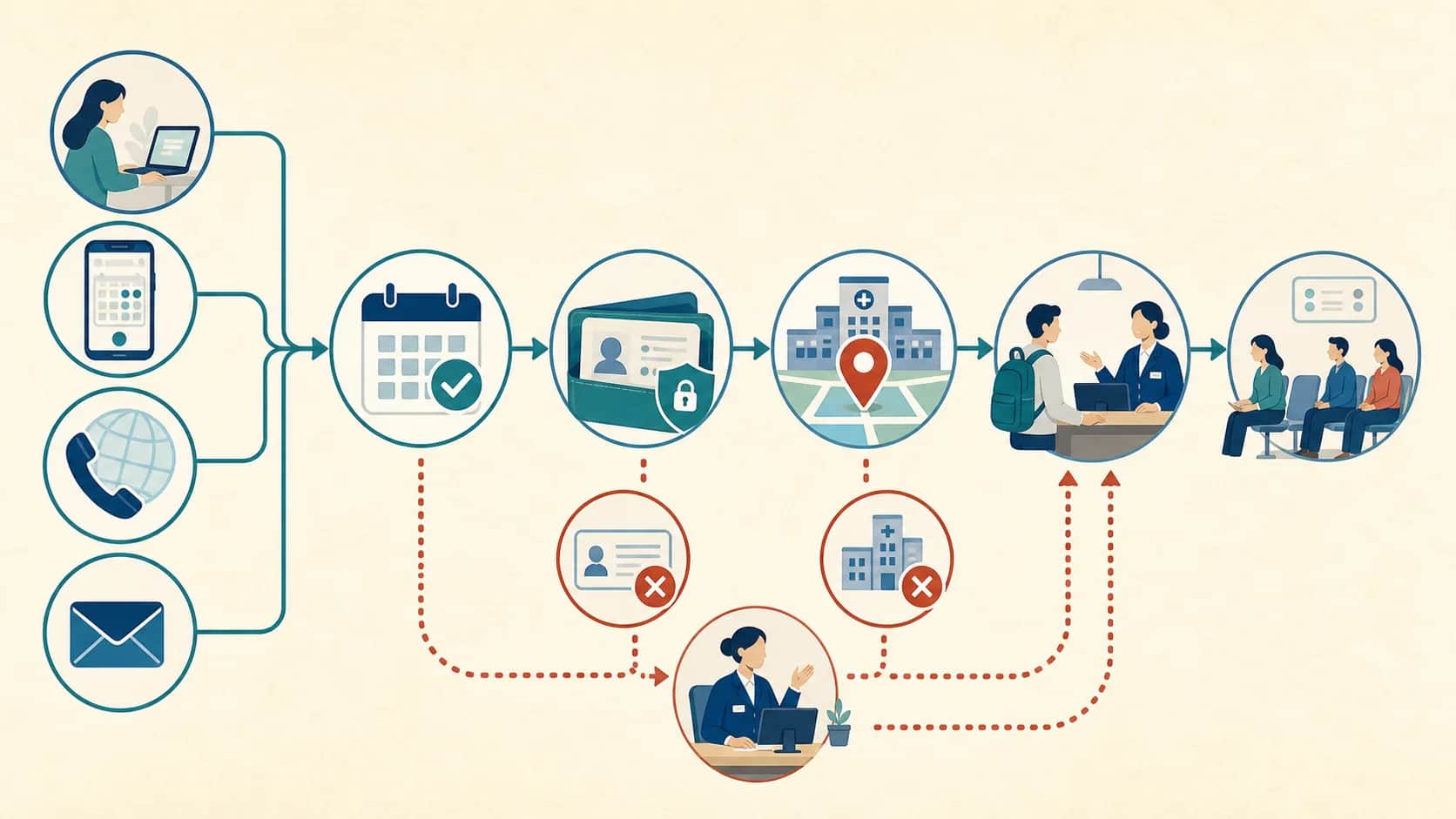
This is a copy-ready phrase deck for the administrative handoff between choosing a hospital's current appointment route, creating or finding the correct patient record, showing a passport through the provider's accepted process, confirming the campus and service, checking in and locating the current queue or waiting area. It does not select a department, describe symptoms, decide urgency, confirm that a request became a booking or prove that one hospital accepts a passport through every app, kiosk, campus or service. Provider examples below show why the exact institution and route matter. Use the Chinese text as a question, keep the provider-issued confirmation as the source record and move to qualified language support whenever the conversation becomes clinical.
Use this as a practical starting point
Provider procedures can change, so confirm time-sensitive details with the hospital, insurer or service. A licensed professional must make clinical decisions for an individual patient.
At a glance
Key points
- A request, appointment confirmation, patient record, registration, arrival check-in and queue status are different states; ask which one is still incomplete.
- Start from the exact provider and campus, then use only the appointment channels that provider currently publishes.
- Keep one passport spelling, document type, date of birth, contact route and existing patient number from booking through registration.
- If a digital route rejects a foreign document, stop and ask for the provider's staffed or international-service fallback instead of inventing identity data.
- Show the original appointment confirmation and ask staff to write the campus, service, time, building and current waiting instruction.
- Use these phrases for navigation only; department choice, symptoms, urgency, consent and treatment communication require the hospital's responsible clinical and language-support routes.
1. Keep the page inside its appointment-and-registration boundary
The phrases here can ask whether an appointment is confirmed, which campus owns it, what identity route the provider accepts, where to create or retrieve a patient record, whether arrival check-in is complete and where the current waiting area is. They cannot decide which specialty fits a medical problem, describe a symptom safely, assess urgency, explain consent, identify a medicine or interpret a result. If staff begin asking about the reason for care, allergies, medicines, pregnancy, a test or a treatment choice, state that language assistance is needed and move out of the phrase-deck workflow.
A provider example is evidence about that provider only. Peking Union Medical College Hospital publishes English-web and bilingual-app booking for its International Medical Services, Beijing United Family publishes several appointment channels, and Jiahui exposes online-request and international-patient contact routes. Those pages demonstrate that channel design varies. They do not make one app, telephone number, email, passport rule or arrival process universal across mainland China.
- Administrative question about a known appointment: this deck can help
- Choosing a department for symptoms: use the hospital's guidance or clinical triage route
- Possible emergency: use the emergency route immediately, not a routine appointment script
- Clinical history, consent, medicine or result: arrange qualified language support
- Provider or campus rule: confirm with that exact institution
Copying a phrase does not confirm the answer. Preserve the hospital's written response or provider-issued booking record.
2. Identify the exact provider, campus and service before booking
Record the hospital's current official Chinese name, the hospital group if relevant, the exact campus and whether the intended route is ordinary outpatient, special-demand, international, emergency, inpatient or another provider-defined service. A hospital group can publish different booking channels, identity categories, addresses and desk locations for different campuses or service lines. Do not assume an English brand name, map result or previous visit identifies the current route.
Use the provider's own location and appointment pages as the starting point. PUMCH lists two campuses on its international page and separates international services from its general outpatient notice. United Family's booking page publishes location-specific contacts. Jiahui's site exposes several facilities and an online appointment request. The practical rule is to bind the booking to one legal provider, campus and service before sharing identity information or travelling.
- Official hospital name in Chinese and English
- Exact campus and address
- Provider-defined service route
- Department or clinic already confirmed by the provider
- Current appointment channel shown on the provider's site
- Language-support need stated before the booking is finalized
3. Separate a request from a confirmed appointment
An online form submission, email, chat message, telephone enquiry or request for a preferred date may begin an appointment process without creating a booked slot. Ask whether the request has been accepted and obtain the provider's confirmation in the form it uses: an app entry, message, email, booking number or other official record. If a person or account only says that it will 'arrange' a visit, independently verify the result through a provider-published route before paying or sending a full identity document.
Read the confirmation as a transaction record. Check the patient name, hospital and campus, service or department, clinician if named, date, arrival window, building or entrance, booking reference, registration requirement and change route. Keep it offline. A confirmed consultation does not automatically confirm an interpreter, insurance authorization, test slot, admission bed or final price; those are separate handoffs.
Ask 'Is this appointment confirmed?' and 'What is the booking reference?' A sent request or payment screenshot is not enough by itself.
4. Build one passport-safe patient identity
Prepare the patient's name exactly as shown on the identity document the provider says it accepts, document type and number, date of birth, current contact route and any existing hospital patient number. Keep the same order, spaces, hyphens and spelling from the appointment request into registration. If the provider stores a Chinese alias or older passport, ask staff to link it to the same patient record rather than silently creating a second profile.
Provider evidence shows why a passport question must remain provider-specific. PUMCH's current outpatient notice lists a passport among original identity documents for its own first-visit record-creation route. Beijing United Family Rehabilitation Hospital tells first-time patients to bring a Chinese identity card or passport for its new-patient registration. Jiahui's patient responsibilities ask for photo identification, including a passport, at initial registration. These examples do not prove that every digital form, kiosk, department or hospital accepts the same document in the same way.
- Passport spelling and order
- Document type and number
- Date of birth
- Reliable telephone or email contact
- Existing patient number, card or app profile
- Former passport or prior spelling only when a record mismatch must be resolved
If a system offers only a resident identity-card field, do not choose it and invent digits. Ask for the provider's staffed foreign-document route.
5. Use a provider-published fallback when the digital route fails
Move sideways within the same provider rather than sending passport details to a random agent. A fallback can be the provider's staffed telephone, email, official WeChat, international-patient office, service desk or on-site registration route where that provider publishes it. State the exact failure: no passport document type, invalid name length, duplicate record, verification message not received, prior patient number not found or campus mismatch. Ask the staffed route to preserve the existing identity and booking rather than starting again without checking.
PUMCH publishes English-web, bilingual-app and international-service contact routes for international patients. United Family publishes official email, WeChat, telephone and online channels for its network. Jiahui exposes a call center, appointment request and international-patient contact. Those examples support using a provider-verified alternative, not copying a contact detail into another hospital's workflow or treating a social-media account as official because its name looks familiar.
6. Distinguish record creation, registration, arrival check-in and queue status
A hospital can treat these as separate transactions. First-visit record creation establishes or retrieves the patient identity. Registration attaches the patient to a service or visit. Arrival check-in records that the patient has arrived for the current slot. A queue number or waiting instruction identifies the next administrative state. Payment may occur before or after one of these steps. Ask which state remains open instead of saying only 'I registered.'
PUMCH's outpatient notice is a useful provider example because it separates record creation, registration, arrival check-in, payment and the destination shown on a guidance record. Its current process includes staffed windows as well as digital and self-service routes. Another hospital can use different names or combine steps. The phrase deck therefore asks staff to identify the incomplete transaction and show the current destination in writing.
- Patient record exists or has been retrieved
- The current visit or service is registered
- Arrival has been checked in
- The queue or waiting-area instruction is active
- Required payment status is known
- The next building, floor or desk is written down
7. Correct the record without losing the appointment
Before leaving a staffed desk or digital screen, compare the displayed name, document type, masked document number, date of birth, contact, patient number, hospital, campus, service and appointment time with the source documents. If something is wrong, point to the exact field and ask which office owns the correction. Record whether the appointment can remain active while the identity or campus problem is repaired.
Do not edit a screenshot, reuse another person's profile or create a new patient record before staff check for the existing one. A renewed passport, different transliteration, missing middle name, changed telephone or earlier hospital number can make a record appear absent. Ask staff to search by the provider's accepted identifiers and preserve a correction receipt, request reference or updated confirmation. Registration-profile corrections, medical-record corrections, insurance identity and an appointment change can be separate workflows.
Use one correction phrase at a time: identify the wrong field, request the responsible desk and obtain a written result.
8. Reconfirm arrival instructions and change the appointment through the provider
Recheck the appointment before a long journey, holiday period or time-sensitive visit. Confirm the campus, date, arrival window, record or document needed, check-in route and the provider's current change channel. If the patient will be late, ask whether the slot remains valid; do not assume a queue will wait or that a payment preserves the appointment.
For cancellation or rescheduling, use the provider's stated route and retain the completion notice. Jiahui's patient responsibilities, for example, ask patients to keep scheduled appointments and give advance notice for changes. That is a Jiahui provider rule rather than a national deadline. A cancellation request is not complete until the provider confirms the status, and any refund is a separate payment transaction.
9. Limit the identity information sent through appointment channels
Share only the fields the verified provider route needs for the current transaction. A booking may require name, document type and number, date of birth and contact, but that does not justify sending a complete passport scan, medical history, insurance file, verification code or payment credential to every person involved. Confirm the recipient through the provider's current site and separate appointment data from clinical records whenever possible.
Save the provider-issued booking and correction records in a protected place and keep an offline copy needed for the visit. Remove temporary copies from shared devices and group chats after the handoff, subject to legitimate record-keeping needs. If an interpreter or companion helps, define the exact task and avoid giving access to unrelated records or accounts.
10. Do not use routine booking phrases during a possible emergency
This page contains no symptom list, self-triage rule, first-aid instruction or promise that a routine appointment is safe to wait for. If a possible medical emergency is occurring in mainland China, use the local emergency route and follow the dispatcher's or responsible professional's instructions. Do not delay while trying to select a clinic, obtain a routine queue number or perfect a translation.
If the problem is not an emergency but the correct department is unknown, ask the hospital's guidance or clinical triage route to assign the service. The appointment phrases can then confirm the administrative result. They must not be used to decide urgency or to translate the clinical reason for care.
For a possible medical emergency in mainland China, call 120. This page cannot decide urgency or replace dispatcher instructions.
Useful language
Navigation phrases
Show the Chinese characters when pronunciation is uncertain. Use the copy button to send one phrase through a trusted channel without retyping it.
Provider and campus
Booking status
Passport and patient record
Digital-route fallback
Arrival, check-in and queue
Changes and corrections
Avoidable problems
Common mistakes
- Treating an appointment request as a confirmed slot
- Starting from a map listing or agent instead of the provider's current site
- Booking the hospital group without confirming the campus
- Assuming every service line uses the same appointment channel
- Entering a false resident identity number when a form rejects a passport
- Creating a second patient profile without searching the existing record
- Changing the passport name order or spacing between booking and registration
- Sending a full passport scan or verification code to an unverified account
- Treating record creation, registration, check-in and queue status as one step
- Assuming an appointment confirms an interpreter, insurance authorization or price
- Leaving without a written campus, time and waiting instruction
- Editing a screenshot instead of asking the provider to correct the source record
- Assuming a cancellation or reschedule request succeeded without confirmation
- Using a routine appointment phrase to decide a clinical department or emergency urgency
- Using machine translation for symptoms, consent, medicines or results after check-in
Common questions
Frequently asked questions
Does submitting an appointment form mean I have a confirmed booking?
Not necessarily. Ask whether the request was accepted and obtain the provider's written confirmation or booking reference before treating the slot as confirmed.
Can these phrases tell me which department to book?
No. Ask the hospital's guidance or clinical triage route. The page can confirm the department after the provider assigns it, but it cannot choose one from symptoms.
Is a passport accepted by every hospital registration system?
No. PUMCH, one United Family facility and Jiahui publish passport examples for their own routes, but the exact hospital, service, campus and channel control acceptance.
What should I do if an app only accepts a Chinese resident identity card?
Stop rather than selecting the wrong document type or inventing digits. Ask the provider which staffed, international-service, telephone or on-site route can register the passport correctly.
Should I create a new patient profile if the old one cannot be found?
Ask staff to search the existing record first. A renewed passport, different name order, prior telephone or older patient number can cause a mismatch that should be resolved through the provider's correction route.
What is the difference between registration and check-in?
Registration attaches the patient to a visit or service; arrival check-in records that the patient has arrived. Providers can name or combine steps differently, so ask which transaction remains incomplete.
Does a queue number prove I booked the correct department?
No. It identifies an administrative queue. Keep the provider-issued department and campus confirmation, and use the hospital's guidance route if the service is uncertain.
Does an appointment confirm English service or an interpreter?
No. Request language support separately, name the interaction that needs it and confirm provider, timing, format and any fee.
Can I use the phrases to explain why I need the appointment?
Not for symptoms, diagnoses or other care-changing information. Ask for qualified language support and communicate with the responsible clinical team.
What if I am late?
Contact the provider through its current appointment route and ask whether the slot remains valid. Do not assume a payment or booking reference holds the queue indefinitely.
Is a cancellation request complete when I send it?
Not automatically. Retain the provider's confirmation of cancellation or rescheduling. Any payment refund follows a separate transaction.
Should I pronounce every phrase?
Showing the Chinese characters is usually more reliable. Pinyin is a pronunciation aid, not proof of meaning and not a substitute for language support.
Evidence
Sources consulted for this guide
National rules are separated from city and provider examples. Access dates show when a source was collected; source pages and procedures can change afterward.