
Mental health & psychiatric care
Psychiatric prescriptions and controlled medicines in China
Use a licensed prescriber, accountable institution, pharmacist review and lawful dispensing route without treating a foreign prescription as a China refill.
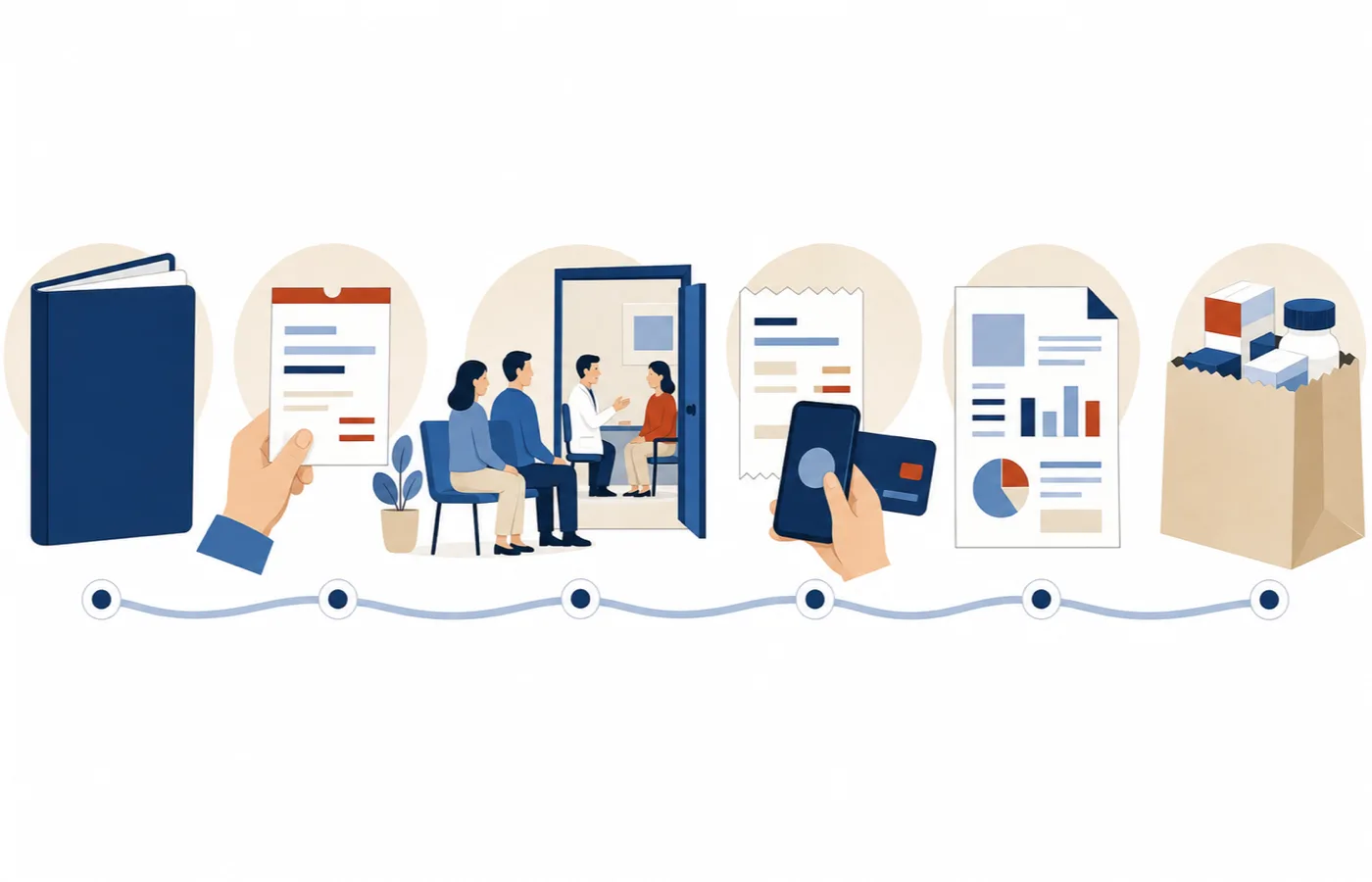
A psychiatric appointment, clinical decision, prescription, pharmacist review, dispensing event and insurance settlement are separate steps in China. Some medicines are subject to additional national controls, and current internet-diagnosis rules prohibit online prescribing of narcotic drugs, psychotropic drugs and other specially managed high-risk medicines. A foreign prescription, overseas package, translated medicine list or earlier Chinese prescription can inform a clinician but does not itself authorize dispensing. This guide explains the administrative evidence chain only. It gives no medicine name, classification decision, dose, quantity, refill interval, substitution, tapering, stopping, importing or emergency-use advice; those decisions belong to authorized professionals and authorities.
Use this as a practical starting point
Provider procedures can change, so confirm time-sensitive details with the hospital, insurer or service. A licensed professional must make clinical decisions for an individual patient.
At a glance
Key points
- Use a licensed medical institution and registered physician for psychiatric diagnosis, treatment and any prescription decision.
- A prescription is a medical document issued after a responsible clinical process and reviewed by qualified pharmacy personnel before dispensing.
- Do not infer whether a product is specially controlled from an English brand, foreign package, appearance or online listing.
- Controlled-medicine rules can affect prescriber authority, prescription form, quantity, dispensing location, record keeping and replacement.
- Current national rules prohibit internet diagnosis from prescribing narcotic drugs, psychotropic drugs and other specified high-risk medicines.
- A foreign prescription or prior record is clinical background, not a Chinese dispensing authorization or automatic refill right.
- Keep the prescription, dispensing record, medicine package, receipt and follow-up record separate and unaltered.
- If a prescription cannot be issued or dispensed, return to the accountable clinician or pharmacy instead of changing, sharing or buying a substitute yourself.
Start with the accountable institution and prescriber
Confirm the Chinese legal name of the medical institution, exact campus and department and the named physician handling the encounter. Use the official institution and physician queries as identity safeguards, then verify the live appointment through the institution. A platform profile, counsellor biography, overseas qualification, white coat or translated title does not establish Chinese medical prescribing authority.
National prescription rules treat the prescription as a medical document issued by a registered physician within the authorized practice route and reviewed and dispensed by qualified pharmacy personnel. Booking, payment or a prior diagnosis does not require the physician to prescribe. This page cannot tell the physician what to issue or tell the patient that a requested medicine is appropriate, equivalent, available or legally dispensable.
- Chinese legal institution name
- Campus and psychiatric department
- Physician's Chinese name and registration
- Patient identity and hospital number
- Clinical encounter and record reference
- Official pharmacy or named dispensing route
A prescription request is not a prescription entitlement. The responsible clinician and pharmacist must complete their separate professional checks.
Treat controlled status as an official classification question
China's regulations impose additional controls on classified narcotic and psychotropic drugs across production, distribution, prescribing, dispensing, storage and supervision. Those controls are attached to the legally classified medicine and route, not to a website's informal label. Ask the responsible physician or pharmacist whether special controls apply and what institution-issued process follows; do not classify a foreign brand or package yourself.
Special controls may mean that an ordinary long-term-prescription, replacement, delivery or retail-pharmacy route is unavailable. A hospital that provides psychiatry does not necessarily hold every authorization or stock every product, and a pharmacy that dispenses ordinary prescriptions may not be able to dispense a specially controlled item. This guide cannot interpret a list, predict the permitted quantity or tell a patient how to obtain an exception.
- Official generic name recorded by the clinician
- Whether special management applies
- Authorized prescriber and institution route
- Required prescription and identity controls
- Named dispensing location
- Collection and record requirements
Do not rely on an online refill or delivery promise
Current national guidance requires a treating physician's electronic signature and pharmacist review for internet prescriptions and expressly prohibits internet diagnosis from prescribing narcotic drugs, psychotropic drugs and other high-risk or specially managed medicines. An app's appointment, chat, payment page or medicine-search result therefore cannot be treated as proof that a requested psychiatric prescription can be issued online.
For an ordinary medicine that is not within the prohibited categories, online care still depends on the internet hospital's lawful scope, patient identity, prior diagnosis and records, clinician assessment, prescription review, pharmacy and local implementation. This page does not classify the medicine or promise that an online route qualifies. When the institution says physical care is required, record the exact campus, department and handoff rather than seeking an unofficial seller.
- Accountable internet hospital and physical institution
- Patient real-name registration
- Prior diagnosis and record accepted
- Physician's decision on online eligibility
- Electronic prescription and pharmacist review
- Physical-care fallback
No psychiatric medicine, refill or delivery route should be selected from this page. Controlled categories cannot be prescribed through internet diagnosis.
Use foreign and earlier prescriptions as source-labelled records
Bring the original overseas or earlier Chinese prescription, dispensing label, medical summary and relevant reports in their original form. Add a clearly labelled translation if the receiving institution requests one, but do not replace the original, convert a dose, rewrite a product name or claim equivalence. The receiving clinician decides what information is reliable and what assessment is required under the Chinese medical record.
An overseas prescription does not compel a Chinese physician or pharmacy to issue or dispense the same product, and a prior Chinese prescription does not create unlimited future access. Long-term prescriptions are available only within defined clinician-assessed, locally implemented routes and do not override special controls. Ask the receiving provider to document the current plan and next follow-up without treating silence or refusal as permission to self-adjust.
- Original prescription and date
- Original labelled package or clear photographs
- Prescribing institution and clinician
- Dispensing history
- Medical summary and relevant records
- Source-labelled translation
- Current patient identity details
Preserve prescription, dispensing and payment evidence
Keep the clinical record, prescription, pharmacist-reviewed dispensing record, package, receipt and payment record as separate evidence. Check that the patient identity and official generic name can be connected across the documents without editing them. Ask the pharmacy how a collection by another person, where permitted, must be authorized; family relationship or possession of a screenshot is not automatic collection authority.
If insurance is involved, distinguish the clinical prescription from the payer's benefit decision. A medicine may be lawfully prescribed but not covered, covered but unavailable at that location, or subject to a designated provider or pharmacy route. Preserve the settlement statement and ask the responsible payer about the exact transaction. Do not share prescription images containing sensitive information through a public chat to locate stock.
- Medical record and encounter number
- Unaltered prescription
- Pharmacist review or dispensing record
- Package and labelled instructions
- Official receipt or invoice
- Insurance settlement statement
- Collection authorization where applicable
Resolve rejection, loss or mismatch through the responsible route
If the physician does not issue the requested prescription or the pharmacy cannot dispense it, ask for a neutral administrative explanation: no current prescription, clinical reassessment required, controlled category, authorization limit, prescription problem, stock issue, identity mismatch, insurance issue or another stated reason. Do not demand a substitute, edit the prescription, divide a package, share another person's medicine or move to an unverified seller.
For a lost prescription, lost medicine, damaged package or identity mismatch, contact the original institution and pharmacy promptly and follow their documented process. Special controls may prevent replacement or require a new in-person clinical review. Use the institution's complaint channel for an unresolved process, privacy, record or staff-identity concern, but do not treat a complaint as a way to compel a medicine, dose, refill, substitution or refund.
- Patient and encounter identifiers
- Prescriber and institution
- Prescription and dispensing references
- Exact rejection or mismatch stage
- Unaltered supporting documents
- Responsible desk and contact
- Written next step or complaint reference
Useful language
Navigation phrases
Show the Chinese characters when pronunciation is uncertain. Use the copy button to send one phrase through a trusted channel without retyping it.
Avoidable problems
Common mistakes
- Treating a foreign prescription as valid dispensing authority in China
- Inferring controlled status from a brand name or package
- Assuming a psychiatrist must issue the requested prescription
- Assuming a prior prescription creates an automatic refill
- Trying to obtain a psychotropic or other prohibited controlled prescription online
- Editing or translating medicine instructions without preserving the original
- Using another person's prescription or medicine
- Buying from an unverified personal seller after a pharmacy rejection
- Treating stock availability as proof of lawful prescribing or suitability
- Using a complaint to demand a medicine, quantity, substitution or clinical decision
Common questions
Frequently asked questions
Can a Chinese pharmacy fill my foreign psychiatric prescription?
Do not assume so. Give the original documents to a licensed Chinese medical institution; the responsible clinician and pharmacy decide the lawful local route.
Can this guide tell me whether my medicine is controlled?
No. Do not infer classification from a brand, translation or package. Ask the responsible physician or pharmacist to apply the official classification and rules.
Can an internet hospital prescribe psychotropic medicines?
Current national rules prohibit internet diagnosis from prescribing psychotropic drugs, narcotic drugs and other specified high-risk or specially managed medicines.
Does a stable condition guarantee a long-term prescription?
No. The clinician must assess eligibility, and local disease, medicine, follow-up and dispensing rules apply. Special controls are not overridden.
Can a family member collect the prescription or medicine?
Only through the institution or pharmacy's permitted authorization and identity process. Relationship alone does not create automatic authority.
What should I do if the pharmacy rejects the prescription?
Ask for the exact administrative reason and return to the accountable prescriber or pharmacy route. Do not alter the prescription or self-select a substitute.
Evidence
Sources consulted for this guide
National rules are separated from city and provider examples. Access dates show when a source was collected; source pages and procedures can change afterward.