
Tests, medicines & records
Medical certificates and sick notes from hospitals in China
Use the issuing hospital's authorised route, match passport identity and dates, correct errors formally and keep originals separate from translations.
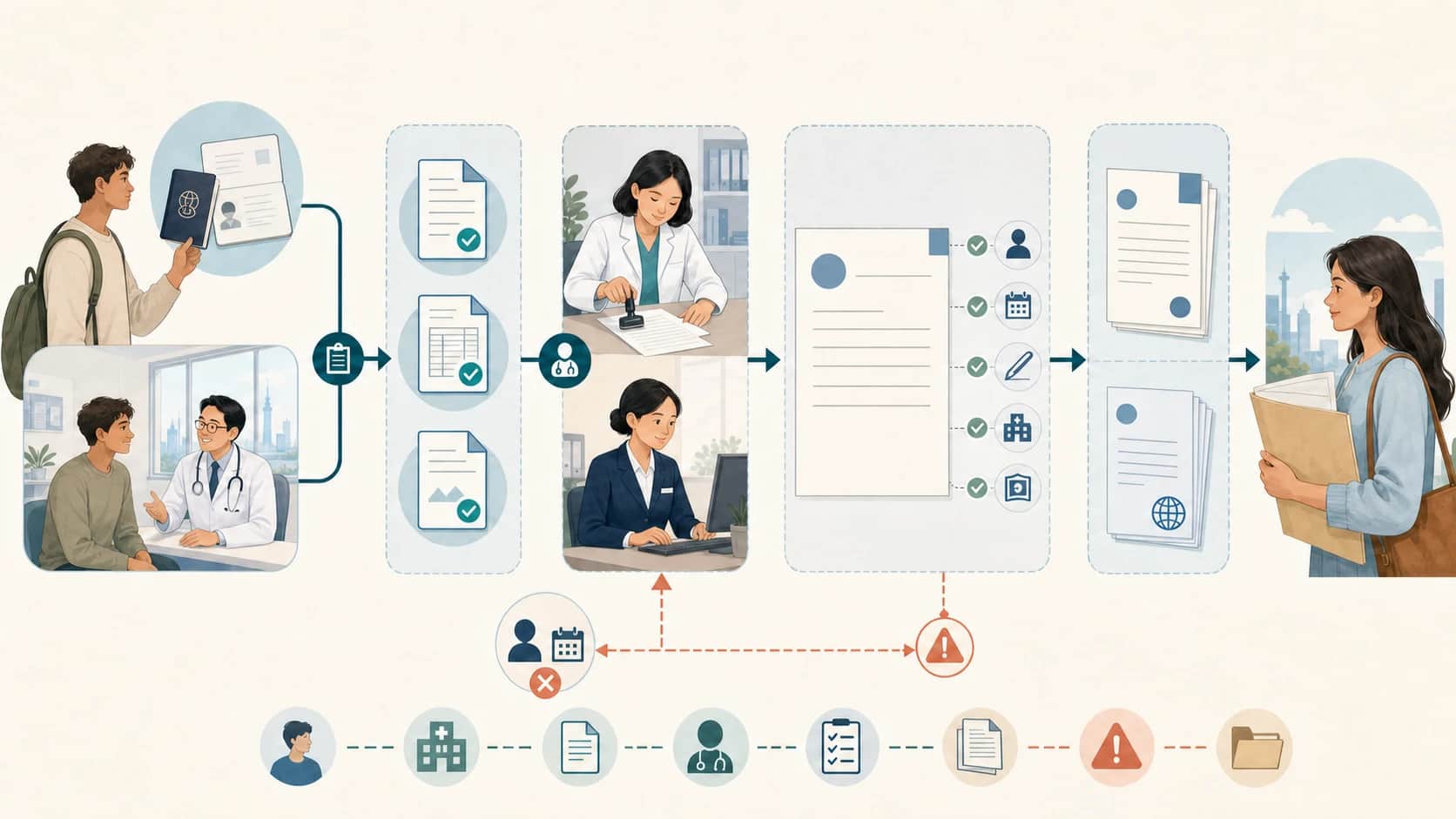
A China hospital medical certificate is not a generic note that can be ordered independently of care. It is a provider-controlled document tied to an actual encounter, supporting medical records, an authorised issuer and the institution's own form, review and validation process. A diagnosis certificate, sick-rest recommendation, attendance confirmation, discharge record, test report, receipt and insurance form answer different questions. The hospital decides what it can truthfully issue; the employer, school, insurer, airline, embassy or other recipient separately decides what it requires and whether it accepts the submitted evidence. This guide gives international patients an issuance-first workflow: define the document task, attend the responsible provider, identify the authorised route, verify passport identity and dates, obtain formal correction when needed, preserve the original and translation separately and hand over only the necessary information. It does not diagnose illness, create a certificate, authenticate a scan remotely, guarantee leave or reimbursement, or replace advice from the responsible provider or a qualified legal professional.
Use this as a practical starting point
Provider procedures can change, so confirm time-sensitive details with the hospital, insurer or service. A licensed professional must make clinical decisions for an individual patient.
At a glance
Key points
- There is no single national ordinary sick-note template or document name that replaces the issuing institution's current catalogue and process.
- A physician signing medical proof must have personally examined or investigated the patient, and the institution must not issue it for a person who did not attend there.
- Choose the task first: diagnosis proof, recommended rest, attendance, discharge, record copy, report, fitness form and claim form are not interchangeable.
- Treat the clinician's statement, institutional review, authorised validation mark, document number and retained provider record as separate controls.
- Match the certificate to the passport and hospital patient record before leaving; never correct a name, date, diagnosis, signature or validation mark yourself.
- A replacement, supplementary issue or correction must come from the responsible provider's formal route and may not be available retrospectively.
- Keep the complete Chinese original unchanged and label any translation as a separate translation; a translation cannot repair the source document.
- Provider issuance and recipient acceptance are separate decisions, so obtain the recipient's current requirements without asking the clinician to decide an employment, school, insurance or legal question.
1. Define the certificate task before asking the hospital
Write one sentence describing what the document must prove and to whom. Examples include that the patient attended a hospital on a date, that an authorised clinician recorded a diagnosis, that the treating team recommended a period of rest, that inpatient care ended on a date, or that a recipient-specific form needs clinical completion. Do not begin with the English phrase “sick note” and assume it maps to one Chinese document. The National Health Commission's 2024 framework requires each institution to maintain a catalogue and process, while the official explanation recognises that many ordinary medical proof documents do not have one nationally standardised form.
Ask the recipient for its current requirement before the encounter when practical. Request the document purpose, accepted issuer, required fields, date range, original-or-copy rule, validation requirement, language, translation standard, deadline and submission channel. Ask whether a form supplied by the recipient must be completed. A recipient may use familiar English wording that the hospital does not use, so keep the request functional: what fact must be documented, for which period and for which administrative decision?
Keep the recipient's requirement outside the clinical conclusion. An employer may need evidence for absence, a school may need attendance or return-to-study information, an insurer may request a diagnosis and itemised claim records, and a public authority may use a defined form. None of those recipients should ask a hospital to certify a fact it cannot know, and a clinician should not be asked to approve leave policy, insurance coverage, visa status or a legal result. The provider records clinical facts or recommendations within its authorised scope.
If the recipient cannot name the document, ask it to state the minimum fact and evidence it will evaluate rather than sending the entire chart. Preserve that answer. You can then show the hospital a neutral description of the purpose and ask which document in its catalogue fits. If no hospital document fits exactly, obtain the provider's answer and return it to the recipient instead of improvising a new form or asking staff to sign a blank page.
- Fact or recommendation the document must evidence
- Recipient and administrative purpose
- Required dates, original or copy and validation method
- Language or translation standard
- Deadline and authorised submission channel
There is no single ordinary China sick-note template. Start with the task, then use the issuing provider's current catalogue and controlled route.
2. Anchor the request to a real encounter and responsible institution
The request begins with actual care, not paperwork. Under the Physicians Law, a physician signing a medical certificate document must personally examine or investigate the patient and complete the associated medical documentation as required. The medical-institution regulation also prohibits a medical institution from issuing disease diagnosis or health proof without the patient's personal examination by a physician. A booking confirmation, payment screenshot, medicine request or description relayed by another person is not the encounter required for issuance.
Use the institution where the relevant encounter occurred and ask which clinician or department owns the source record. A hospital cannot normally certify another provider's examination as its own. If care involved several providers, identify which fact belongs to which encounter: the emergency department may document emergency attendance, an inpatient team may issue discharge material, and a later outpatient clinician may document a follow-up assessment. Do not ask one clinician to copy a conclusion from an unrelated hospital without conducting the assessment the clinician considers necessary.
Bring the identity document used for the patient record and the materials the hospital says it needs. For an international patient, that usually means the actual passport or other accepted identity document, the hospital patient number or app account, and the encounter information. A foreign insurance card, employee badge or school card may explain the purpose but does not replace the identity and medical-record matching process. Do not enter another person's resident identity number to bypass a passport limitation.
Emergency care comes first. A person with severe or rapidly worsening symptoms should call 120 or use an appropriate emergency route instead of delaying care to obtain a preferred certificate. Once the patient is stable, ask the emergency or subsequent treating team what record or certificate it can issue from the real encounter. Administrative timing cannot justify creating a visit that did not occur, backdating a note, leaving fields blank for later completion or changing clinical content to fit a payroll deadline.
Never buy, request or use a certificate for a visit that did not occur. For immediate danger call 120; paperwork follows the real encounter.
3. Choose among certificate, rest, attendance, discharge and record documents
A disease or diagnosis certificate records a provider-supported clinical conclusion within the issuing scope. A sick-rest or leave recommendation records the clinician's medical recommendation for a period, where the institution offers that document or field. An attendance confirmation may state that a person presented for care without reproducing a diagnosis. A discharge certificate or discharge summary records an inpatient episode and handover. A return-to-work, return-to-school, fitness, disability, occupational-disease or other special-purpose document may require a different examination, qualified institution, form or authority.
Keep records and certificates separate. A medical record documents the care over time; a laboratory or imaging report records a test result; a prescription records a medication order; an itemised bill and receipt record financial events; an appointment message records a booking; an insurance claim form supports a payer process. Peking Union Medical College Hospital's current outpatient guide, for example, separates outpatient-record printing, inpatient-record copying and report printing into different routes. That provider example illustrates the categories but does not identify every certificate another hospital issues.
Shanghai's retained-certificate catalogue gives one local example in which sick-leave proof and disease-diagnosis documents are separate retained matters. The catalogue also shows why a recipient should not invent unnecessary proof tasks. Ask the issuing provider whether the requested fact belongs in a diagnosis certificate, a sick-rest document, an attendance record, a discharge record or a recipient's own form. If the provider says the document does not exist or falls outside its competence, record that answer instead of renaming another document.
Do not turn an ordinary diagnosis certificate into a job-fitness determination, statutory occupational-disease certificate, disability assessment, work-injury recognition, aviation fitness statement or legal capacity opinion. Those tasks can involve different qualifications and procedures. Likewise, a discharge summary may support a request but does not automatically state that a person cannot work or study for a specific period. Keep each conclusion with the person and institution authorised to make it.
- Disease or diagnosis certificate
- Sick-rest or leave recommendation
- Attendance or encounter confirmation
- Discharge certificate or discharge summary
- Medical-record copy and separate test reports
- Recipient-supplied fitness, claim or special-purpose form
4. Find the authorised clinician, review desk and validation route
Issuance can involve more than one person. The treating clinician determines what can be supported clinically and signs or completes the appropriate provider-controlled document. A medical administration, outpatient service, ward, records, cashier or other designated desk may then compare the document with the encounter, check the issuer's authority, register or number it and apply the institution's controlled validation. The National Health Commission's 2024 notice specifically requires institutions to define responsible departments and authorised personnel and to separate document issuance from seal control.
Do not equate a clinician's handwritten recommendation with a completed institutional certificate unless the provider says that is the final form. Conversely, do not assume every provider uses a visible ink seal. Ask what makes the paper or electronic document final under that institution's process: clinician signature, name stamp, dedicated certificate validation, unique number, verification code, electronic signature, service-desk record or a combination. Record the answer without trying to reproduce the feature yourself.
Provider routes differ. Guangdong Provincial People's Hospital publishes a provider-controlled outpatient diagnosis-certificate process. Shandong Provincial Hospital separates outpatient and inpatient handling and describes internal comparison before validation. Beijing Ditan Hospital's published rules distinguish treating-clinician completion from service-centre review, and Lu'an Hospital of Traditional Chinese Medicine links outpatient proof to the hospital's supporting record and prompt validation. These examples prove variation, not a national counter or timeline.
Ask one closed operational question: “For this encounter and purpose, which clinician completes the document, which desk reviews it, what identity and source records are required, what marks show final issuance, and when must I collect it?” Save the hospital's answer. If a desk refuses validation, ask for the missing field or process step rather than seeking an unofficial stamp, another department with no connection to the care, or a blank form signed in advance.
A clinician's clinical statement and the institution's final validation are separate controls. Never copy, paste or recreate a signature, seal, number or verification mark.
5. Match passport identity to the hospital patient record
Before the document is created, show the hospital the same passport or accepted identity document linked to the encounter. Compare the full name, order of names, passport number, date of birth, sex or gender field where used, nationality and hospital patient number. International patient records may contain spaces, hyphens, transliteration choices, truncated names or an earlier passport number. The objective is not to make every system visually identical; it is to let the provider record the correct patient and formally explain or correct a mismatch.
If the passport was renewed, keep the old and new passports or copies and ask which desk updates the patient identity. Do not create a second patient account merely to obtain the preferred spelling unless the provider instructs you to do so. A duplicate account can separate the certificate from the encounter, reports or payment record. Ask the hospital to preserve the link between the old identifier, new identity document and existing medical record through its authorised process.
Check the document while still at the responsible desk. Read every identity field against the passport and the encounter record. Confirm the institution, campus, department, encounter date, issue date and document number. A recipient may reject a document because the passport name or number does not match even when the clinical content is genuine. The answer is provider correction or a factual identity-link record, not editing the scan, using image software or writing over the original.
Representative authority is separate from identity. National record-copy rules describe a route for a patient or authorised agent to obtain specified record materials, while a certificate office can use a different rule. Shanghai Mental Health Center's current specialty guide, for example, requires a tightly documented patient, guardian or representative route because the information is particularly private. Ask the exact provider what the representative may request, collect or receive; family relationship alone does not automatically grant every certificate or record.
- Passport name and number used for the encounter
- Old-to-new passport link where applicable
- Hospital patient number and campus
- Representative identity and task-specific authority
- Correction owner when a field does not match
6. Follow the outpatient, emergency or inpatient issuance route
For outpatient care, ask the treating clinician during or immediately after the encounter whether the provider issues the requested document and where final review occurs. Bring the outpatient record, patient identity and any recipient form the hospital agreed to review. Some providers require prompt service-desk validation. Do not assume an app consultation message, test-only visit or pharmacy pickup creates an outpatient certificate route; the responsible clinician and institution must support the document from the actual care.
For emergency care, stabilisation and treatment come first. Once appropriate, ask the emergency team whether it can issue a dedicated certificate or whether the available evidence will be the emergency record, triage record, test report, admission material or discharge record. A provider may restrict what emergency staff can certify or for how long; one hospital's stated limit must never be copied to another. Notify a recipient that evidence is pending instead of asking staff to change the encounter date or extend a recommendation without reassessment.
For inpatient care, ask the ward or discharge team which document is produced at discharge and whether a separate diagnosis or rest certificate is available. Keep the discharge summary, certificate, itemised bill and receipt distinct. Shandong Provincial Hospital's published guide is one example of different outpatient and inpatient validation points, while Lu'an's provider rules illustrate a discharge-stage route. The actual hospital's current instructions control the case.
If the request is made later, ask whether the institution permits supplementary issuance or replacement from retained records, which department reviews it and how the later issue date is shown. Quannan's local service guide describes one controlled replacement example using original encounter records and replacement notation. That is evidence that a formal route can exist, not a national right to backdating or reissue. Another institution may require review, may issue a different record or may be unable to recreate the requested document.
Do not rely on another hospital's stated time limit or reissue rule. Ask the responsible provider what it can issue from the actual outpatient, emergency or inpatient record.
7. Check content, dates and purpose without changing clinical truth
Check the document as an administrative record, not as an editor. Confirm the patient's identity, issuing institution and campus, department, encounter date, issue date, clinician identity, supported diagnosis or medical statement, rest or review recommendation where the provider includes one, signature or authorised completion, final institutional validation and document or verification number. Not every provider uses every field, so ask what its controlled form requires instead of adding a missing-looking field yourself.
Dates answer different questions. The encounter date records when care occurred; the issue date records when the document was issued; an admission and discharge period records inpatient care; a recommended rest interval records the clinician's recommendation; a submission deadline belongs to the recipient. Keep them separate. Do not ask a clinician to change the encounter date to match an absence, and do not infer that a recommendation begins or ends on a date the document does not state.
Read the document purpose literally. A certificate can report a diagnosis without recommending rest. A rest recommendation can cover a period without deciding wage treatment or attendance coding. A discharge record can confirm inpatient dates without declaring fitness for a particular job or flight. If the recipient wants a stronger conclusion, return the written requirement to the responsible provider and ask whether the provider can assess and issue it through an authorised route. Do not strengthen the wording in translation.
Reject unsafe shortcuts. Do not accept a blank signed sheet, a document obtained through an online seller, a cropped page that hides issuer details, an image with pasted validation, an unofficial bilingual overlay, an altered rest period or a certificate for an absent person. Provider rules from Beijing Ditan, Shandong Provincial Hospital and Lu'an all illustrate the importance of supporting records, complete fields, authorised clinicians and controlled review. The national notice makes those controls institution-wide rather than decorative.
- Patient identity and patient number
- Institution, campus, department and clinician
- Encounter, issue, admission, discharge and recommendation dates
- Clinical statement within the issuer's scope
- Authorised final validation and document number
- No blank fields, alteration, cropping or pasted elements
8. Correct or replace the document only through the issuer
Stop before submission when an identity field, date, department, page, signature area, validation mark or clinical statement appears wrong or incomplete. Photograph or scan the complete document for the correction record, but do not annotate the only original. Contact the issuing clinician or designated provider desk and identify the exact field. Ask whether the institution will correct the source record, cancel and reissue the certificate, add a formal explanatory record or decline because the requested change is not supported.
Bring the original certificate, identity document, patient number, encounter record and evidence of the mismatch. For a renewed passport, bring both document numbers. For a recipient complaint, bring the recipient's written reason without asking the hospital to adopt the recipient's preferred conclusion. The provider should decide whether its original record is inaccurate, whether new assessment is needed and what traceable correction is permitted. A later issue date should remain visible when that is how the institution records the correction.
Do not use image editing, white-out, overwriting, a copied signature, a remade QR code, a translated replacement page or a separate stamp obtained outside the provider's process. The personal-information law gives people a route to request correction of inaccurate or incomplete personal information, but the provider must verify and implement the correction. Quannan's local service example also shows how a supplementary issue can be visibly tied to the original encounter rather than disguised as an original same-day document.
Keep the superseded version, corrected version, provider receipt or explanation and submission update together. Mark the old version “superseded” in your own index without writing on the provider's original. If correction is refused, ask for the reason and responsible escalation route. A disagreement about clinical content may require a provider review or complaint process; a recipient's acceptance dispute may require its own employment, education, insurance or legal route. Do not collapse them into document editing.
Only the responsible provider can correct or reissue its document. A translation, scan editor, employer or agent cannot repair the source certificate.
9. Preserve original, copy, record and electronic verification separately
Create a simple evidence inventory. Label the provider-issued certificate, the medical-record copy, the discharge record, each test report, the itemised bill, the receipt, the appointment record and the translation as different files. Use the hospital's document number or date in your private filename without changing the document image. A certificate may refer to the encounter, but it is not the complete chart; a chart copy can support verification, but it is not automatically the certificate the recipient requested.
Keep the physical original flat and complete. Scan every side and page in colour, include attached continuation pages and do not crop the signature, validation area, document number or margins. If the hospital supplies an envelope or verification instruction, retain it. Do not hand over the only original without documenting custody and return. Ask the recipient whether a certified copy, ordinary scan or original inspection is sufficient before mailing irreplaceable evidence.
For electronic documents, use the provider's own app, portal, download or verification route. Record the URL or app route, download date, file name and any provider-issued verification code. Do not treat a screenshot of an app page as an official certificate unless the provider identifies it that way. The 2025 national electronic-record notice emphasises authorised, secure and traceable use, while provider examples such as PUMCH show that printing a report, copying a record and handling proof documents can remain separate even within one digital service environment.
If an authorised representative collects material, record exactly what was collected and under which authority. National medical-record rules set identity and authorisation requirements for specified record copies, but a certificate office may use another task-specific route. A representative who can collect a record is not automatically authorised to receive a diagnosis certificate, access a portal, translate the document, submit it to an employer or consent to care. Verify each task separately.
10. Translate the unchanged source and disclose only what is necessary
Ask the recipient whether it accepts the Chinese original, a provider-produced bilingual document, an ordinary translation, a certified translation or a translator with specified qualifications. Do not pay for a translation before the recipient states its rule. The translation should be a separate document that identifies the source, translator or translation method and date. Keep the complete Chinese original attached or linked according to the authorised submission route.
Translate faithfully. Preserve the patient name, institution, department, encounter and issue dates, diagnosis wording, rest or follow-up recommendation, signature description, validation description, document number and uncertainty. Do not translate a recommendation to rest as a legal finding of incapacity, convert a diagnosis certificate into a fit-to-fly statement, expand an abbreviation without marking uncertainty or replace the passport spelling with a preferred English name. Ask the provider to correct the source when a source field is wrong.
Medical and health information is sensitive personal information. Give the recipient only the document and fields necessary for the stated purpose through an authorised channel. An employer may need accepted absence dates without the full chart; a school may need attendance or a defined recommendation; an insurer may need claim evidence listed in its request. Do not upload the certificate to a public link, send it to an unofficial translation account or share portal credentials merely because someone offers quick bilingual processing.
When another person assists, separate interpreting, translating, collecting, submitting and receiving future updates. Shanghai Mental Health Center's current specialty route demonstrates why particularly private information can require tightly controlled patient, guardian or representative authority. That specialty process is not universal, but the lesson is: confirm who may access which document, for what purpose and for how long. Keep a delivery receipt and remove unnecessary working copies when the task is complete under the applicable retention arrangement.
A translation explains an unchanged source. It does not become the hospital original, create missing clinical content or guarantee acceptance.
11. Hand over a complete evidence pack and record the recipient decision
Build one final pack with an index. Include the recipient's requirement, complete provider-issued original or accepted copy, separate translation if required, identity-link note where a passport changed, provider verification instruction, supporting record or report only when requested, submission cover note and delivery receipt. State the purpose and dates requested without rewriting the clinical conclusion. Keep irreplaceable originals and unrelated health information out of the pack unless the recipient has explained why they are necessary.
Run a consistency check before submission. The patient identity must match the passport or documented identity link; the provider, campus and encounter must match; every page must be present; dates must not conflict; the clinician and institutional validation must follow the provider's route; and the translation must remain separate and faithful. If the recipient supplied a form, confirm it was completed by the authorised provider rather than by the patient or translator. Resolve a mismatch before the deadline where possible and record any evidence-pending notice.
Ask the recipient to record its decision separately from provider issuance: received, under verification, accepted for stated dates, partly accepted, further evidence requested or rejected with a reason. A genuine provider-issued certificate does not automatically approve employer sick leave, school absence, insurance reimbursement, travel, immigration or another legal result. Likewise, recipient rejection does not prove the document is false. Identify whether the dispute concerns authenticity, purpose, dates, translation, policy or a separate eligibility rule.
For employer sick leave, continue to the separate China Care Desk guide on submitting a medical certificate to an employer; that page covers HR receipt, verification, attendance, privacy, pay and medical-period boundaries. This page ends at provider issuance and an accurate handoff. Preserve the provider record, correction history, translation, recipient response and final status so that a later question can be traced without resending the entire chart or trying to reconstruct the document from memory.
- Recipient requirement and purpose
- Complete original or accepted provider copy
- Separate faithful translation when required
- Passport identity link or correction record
- Provider verification instruction
- Minimum necessary supporting material
- Submission receipt and separate recipient decision
Useful language
Navigation phrases
Show the Chinese characters when pronunciation is uncertain. Use the copy button to send one phrase through a trusted channel without retyping it.
Avoidable problems
Common mistakes
- Asking for a generic sick note without defining the fact and recipient
- Assuming every hospital uses one national form or document name
- Buying or requesting a certificate for an encounter that did not occur
- Treating an appointment, receipt or medicine pickup as a clinical encounter
- Asking one hospital to certify another provider's care as its own
- Using a duplicate patient account to hide a passport mismatch
- Confusing diagnosis proof with a rest recommendation or attendance record
- Treating a discharge summary, report, bill or receipt as the requested certificate
- Assuming a clinician's note is final without the provider's required review
- Copying a signature, validation mark, number or verification code
- Editing a name, date, diagnosis or rest period in a scan
- Asking for backdating instead of using a formal supplementary route
- Applying one provider's time limit or no-reissue rule nationwide
- Cropping pages or hiding the issuer and validation area
- Letting a translation strengthen or repair the Chinese source
- Sending the complete chart when the recipient needs one limited document
- Giving an unofficial translator or agent the hospital portal password
- Assuming family relationship authorises every record and certificate task
- Treating a genuine certificate as automatic leave, reimbursement or legal approval
- Calling recipient rejection proof that the provider document is false
Common questions
Frequently asked questions
Can a hospital issue a medical certificate without seeing me?
The national framework and Physicians Law tie issuance to the patient's actual attendance and the physician's personal examination or investigation. A booking, message, payment or another person's account is not a substitute. Ask the provider which encounter and review the requested document requires.
Is there one national sick-note form in China?
Not for ordinary sick notes. The 2024 national framework requires institutions to control their catalogues, forms and issuance processes where no national or local standard form exists. Ask the responsible hospital which document it issues for the stated purpose.
Is a diagnosis certificate the same as a sick-rest recommendation?
Not necessarily. A diagnosis certificate can record a clinical conclusion without recommending rest, while a provider may use a separate sick-rest document or field. Ask both the hospital and recipient which evidence is required for the dates at issue.
Can an appointment message or hospital receipt replace the certificate?
No. An appointment records a booking and a receipt records a financial event. They may support the timeline, but they do not automatically state a diagnosis, attendance, recommended rest or another medical fact.
Can I ask a different hospital to reissue the document?
A different provider cannot normally certify another institution's encounter as its own. It may conduct a new assessment and issue only what it can support from that assessment. Request correction or replacement from the original responsible provider first.
Can a hospital backdate a medical certificate?
Do not assume so or ask staff to disguise a later issue. Ask whether the provider has a formal supplementary or replacement route tied to retained encounter records and how the later issue date will be shown. Availability and rules are institution-specific.
What if my passport was renewed after the visit?
Bring the old and new passport details and ask the hospital which desk links or corrects the patient identity. Keep the provider's correction or identity-link record. Do not edit the certificate or create a second patient account unless instructed.
Can a family member collect the certificate?
Only if the provider permits that task and accepts the required patient and representative identity and authorisation evidence. Authority to collect a record, pay a bill or accompany the patient does not automatically authorise certificate collection or later disclosure.
What if a name, date or passport number is wrong?
Stop before submission and use the issuing provider's formal correction route. Bring the original, identity evidence and encounter details. Never overwrite, crop or digitally edit the provider document.
Is an app screenshot an official electronic certificate?
Only if the provider identifies that output as its official document and supplies the relevant download or verification route. Preserve the original file and provider instructions; a screenshot can omit metadata, pages or validation details.
Can I translate the certificate myself?
Ask the recipient what translation it accepts. An informal translation may be useful for understanding but may not satisfy the submission rule. Any translation must remain separate from the unchanged Chinese original and must not add or strengthen content.
Does an English translation guarantee acceptance?
No. The recipient may require the Chinese original, a specified translator, certification, verification or additional evidence. Obtain the requirement before relying on the translation.
Will an employer, school or insurer automatically accept a genuine certificate?
No. Provider issuance and recipient acceptance are different decisions. Ask the recipient to state whether it received and accepted the document, for which purpose and dates, and what separate eligibility or policy rule remains.
Can an ordinary diagnosis certificate prove fitness for work, flight or study?
Not automatically. Fitness is a task-specific conclusion that may require a new assessment, defined form or qualified provider. Ask the recipient and responsible healthcare provider what assessment and document are actually required.
Evidence
Sources consulted for this guide
National rules are separated from city and provider examples. Access dates show when a source was collected; source pages and procedures can change afterward.