
Eye & vision care
Book an eye doctor appointment in China as a foreigner
Confirm the legal provider, campus, booking purpose, passport record, language support, document intake and charging rules before finalizing an eye appointment.
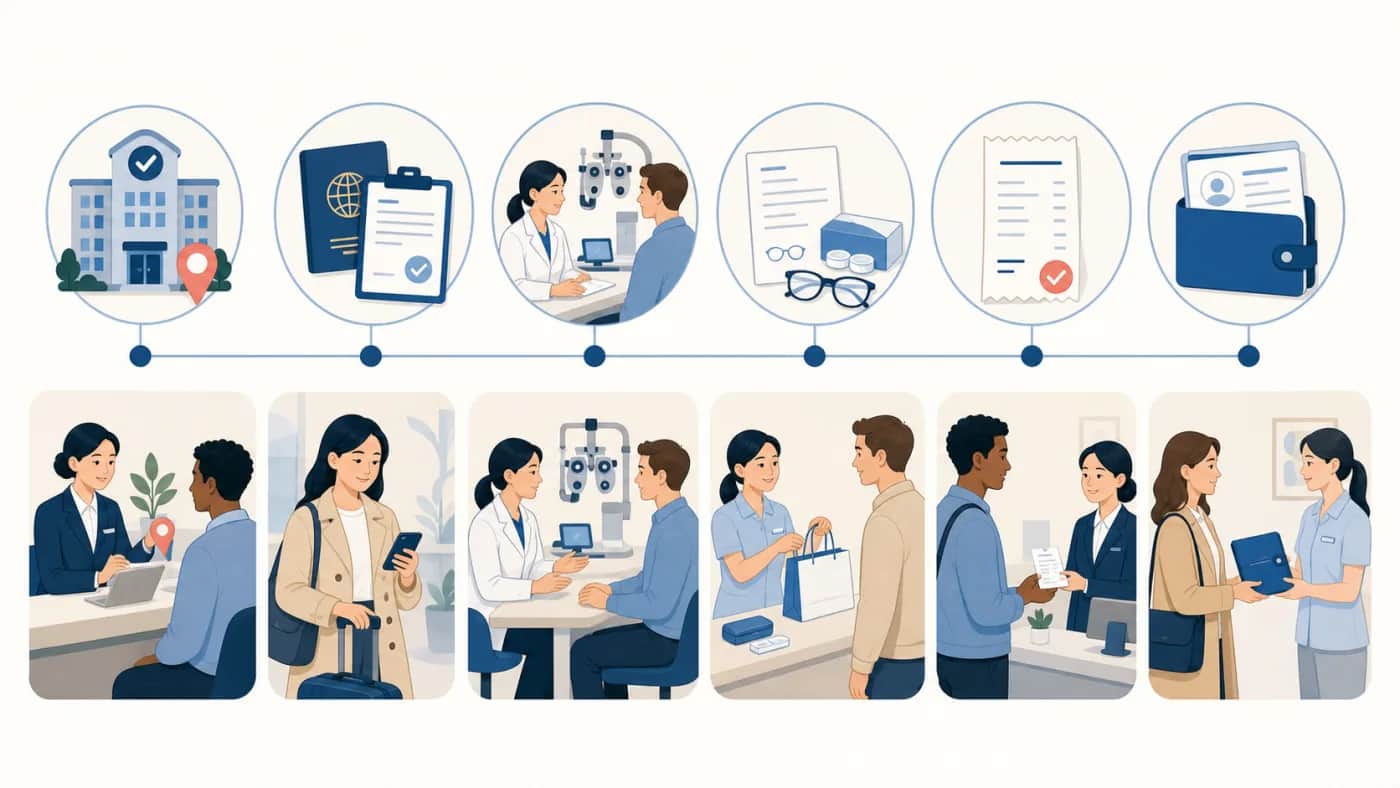
Booking an eye doctor in China is more than selecting a time. The confirmation should connect a foreign patient's identity to the correct legal institution, campus, provider-defined department and appointment purpose. It should also explain language support, record intake, charging and cancellation. This guide covers that administrative workflow only. It does not triage symptoms, choose an examination, interpret existing results, recommend a provider or product, or give preparation or aftercare instructions. The institution's qualified team must make all clinical decisions.
Use this as a practical starting point
Provider procedures can change, so confirm time-sensitive details with the hospital, insurer or service. A licensed professional must make clinical decisions for an individual patient.
At a glance
Key points
- Use an official channel published by the exact legal provider and campus.
- Ask whether the slot reserves a medical eye visit, programme screening, records review, refraction service or provider-directed follow-up.
- If a platform rejects a passport, use an official alternative rather than false identity data or another person's account.
- Link continuing care to the existing patient number and correct identity spelling.
- Verify a named physician separately and reconfirm the current campus appointment with the institution.
- Confirm language, interpreter, companion and secure document-intake arrangements for the actual encounter.
- Read the confirmation for identity, location, time, appointment purpose, charges and cancellation without treating it as approval of any clinical service.
Identify the exact provider, campus and official channel
Begin with the provider's Chinese legal name, exact campus or branch and official website, app, mini-program, telephone number or in-person desk. A group name or English directory entry may not identify the legal institution that will create the patient record. Use the national medical-institution query to compare the available licence information and registered scope, then confirm the live booking route with the institution.
For a general hospital, confirm that ophthalmology is connected to the selected campus rather than assuming every location uses the same departments. Do not pay or upload passport information through a personal account whose relationship to the institution cannot be verified. Save the official page or message that identifies the booking channel and the entity responsible for the encounter.
- Chinese legal provider name
- Exact campus or branch
- Registered ophthalmology scope where applicable
- Official booking channel
- Entity expected to create the medical record
Ask what the appointment slot actually reserves
Use neutral administrative language when asking about the slot. It may be recorded as a medical eye visit, programme screening, records review, refraction service or provider-directed follow-up. Ask staff to identify the official appointment category and department. If the purpose is unclear, describe the existing referral, provider instruction or document-review request without using an online symptom list to select examinations.
A confirmed slot does not prove that a named examination, prescription, product or procedure will be provided. Ask what written output the booked route normally creates and whether another appointment could be required after the qualified team reviews the case. That is a workflow question, not a prediction about clinical need.
- Provider-recorded appointment category
- Provider-defined department
- New visit, records review or provider-directed follow-up
- Expected administrative document or record route
- Limits of what the booking itself confirms
The appointment grants access to a route. It does not select or authorize clinical care.
Create or retrieve the correct foreign-patient record
Ask which passport or other foreign identity document the channel accepts and how the patient's name must be entered. If a platform requires an unsupported identity format, contact the provider through another published route. Do not invent a resident identity number, alter a birth date or use someone else's account to force the booking through.
When the patient has visited before, supply the existing patient number and ask staff to compare the name, document number and date of birth before creating a new record. A correction should be handled through the provider's official identity process. Keeping one correctly matched record supports traceable access to notes, reports, payments and authorized record copies.
- Accepted identity-document type
- Passport name order and spelling
- Existing patient number
- Contact number used for notices or account recovery
- Official correction route for a mismatch
Confirm the department and named physician evidence
Save the provider-defined department name in Chinese and the appointment category exactly as shown. If a physician is assigned, request the physician's Chinese name and check available registration information through the official physician route. Then confirm with the legal institution that the physician is currently connected to the stated campus and appointment.
A physician-query match does not prove schedule, language, professional title, experience for an individual case, independent authority for a named technology or outcome. Ask how the institution communicates a substitute and whether the appointment remains valid if the named physician changes. The institution and qualified treating team remain responsible for clinical assignment.
Use official records to verify identity, then use the institution to verify the live appointment.
Arrange language, consent and secure document intake
Confirm whether the professional conversation will be available in the requested language, whether the institution supplies an interpreter or whether an independent interpreter may attend. A bilingual booking interface does not prove that explanations, consent discussions or written records will be bilingual. Ask what authority a companion needs to register, receive information or request records.
If the provider asks for prior records, first obtain the official upload portal, institutional email or other verified channel and send only the requested material. Keep originals and translations separate, and identify the issuing institution and date. Electronic medical-record information should be handled through authorized, minimum-necessary and traceable systems; sending a file does not require the receiving provider to accept or interpret it in a particular way.
- Language for the actual professional conversation
- Institutional or independent interpreter process
- Companion authority requirements
- Requested record list and file format
- Verified minimum-necessary upload route
Read and preserve the final confirmation
Check the legal provider, campus, department, physician if assigned, date, time window, registration deadline, accepted identity document, patient number and appointment purpose. Confirm the cancellation or rescheduling channel and whether a missed deadline changes the booking. If any material field changes, ask the provider to issue an updated confirmation rather than relying on an informal message.
Ask which charge applies to the booked encounter, when an itemized estimate can be provided, which entity collects payment and which payment document will be issued. Price-management rules support transparent item information and enquiries, but they do not create one national ophthalmology price. Keep the confirmation, payment evidence, record-intake receipt and any complaint contact together.
- Legal provider and exact campus
- Department and physician if assigned
- Date, time window and registration deadline
- Accepted identity document and patient number
- Appointment purpose and language arrangement
- Charge, payment-document and cancellation information
Useful language
Navigation phrases
Show the Chinese characters when pronunciation is uncertain. Use the copy button to send one phrase through a trusted channel without retyping it.
Avoidable problems
Common mistakes
- Booking a group brand without confirming the legal provider and campus.
- Assuming every campus of a general hospital operates ophthalmology.
- Choosing examinations from a symptom list instead of asking the provider to assign the booking route.
- Treating a confirmed appointment as approval for a particular test, prescription or procedure.
- Entering invented identity data when an app rejects a passport.
- Creating a duplicate patient record with a different name spelling.
- Assuming an English booking page guarantees English professional communication.
- Uploading full records to an unverified personal account.
Common questions
Frequently asked questions
What if the eye-hospital booking app does not accept my passport?
Use another channel published by the exact provider, such as its official telephone line or in-person desk. Ask which foreign document and name format should be used. Do not enter invented identity data or use another person's account.
Which eye department should I book?
Describe the administrative purpose of the visit, any existing provider instruction and the documents you want reviewed to the institution's official booking desk. Ask staff to name the provider-defined route. This guide does not triage symptoms or select examinations or clinical services.
Does the appointment guarantee an eye examination?
It guarantees only what the provider states in the confirmation. Ask whether the slot is a medical visit, screening programme, records review, refraction service or provider-directed follow-up. Qualified professionals decide what clinical work is appropriate.
How do I verify the named eye doctor?
Request the Chinese name, check available official physician-registration information and then confirm the current campus appointment with the legal institution. The query is an identity safeguard, not a quality score or clinical recommendation.
Can I send previous eye records before the appointment?
Send only what the provider requests through a verified institutional channel. Keep the original and any translation separate. The receiving qualified team decides whether and how the information can be used; uploading it does not guarantee acceptance or prevent further provider decisions.
Does a booking price show the total cost?
Not necessarily. Ask what the booked charge covers, when an itemized estimate becomes available and which entity issues the payment document. Local implementation and separate components can vary, so no national total should be inferred from the appointment label.
Evidence
Sources consulted for this guide
National rules are separated from city and provider examples. Access dates show when a source was collected; source pages and procedures can change afterward.