
Eye & vision care
Eye exams, screening, refraction and prescriptions in China
Distinguish the responsible entity, service label, record, refraction document, eyeglass order, price item and receipt without interpreting results.
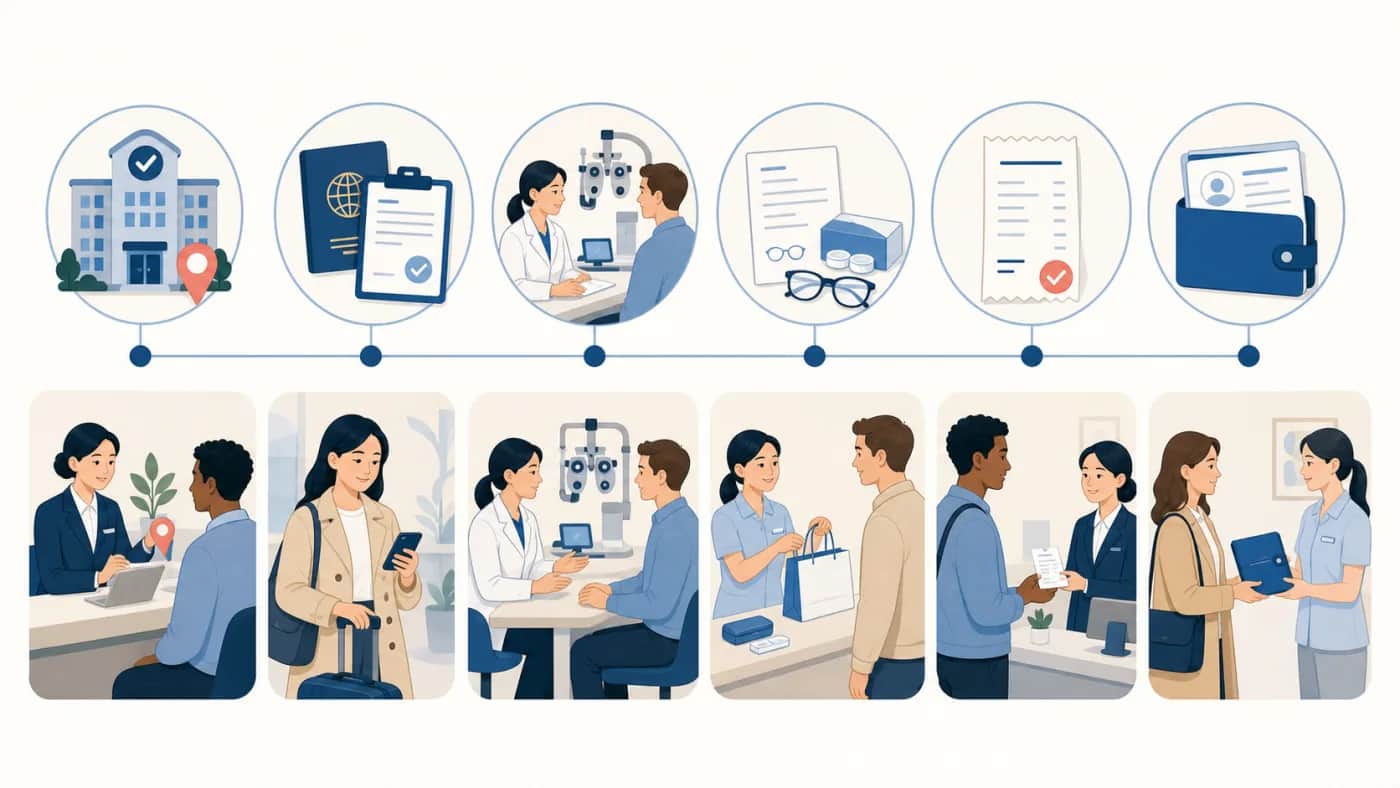
The English words eye exam, screening, refraction and prescription can describe different transactions and documents in China. The safest administrative approach is to identify the responsible legal entity, ask what the service is called in its own system, confirm what written output it produces and keep the original record separate from any translation. This guide does not select an examination, interpret measurements, decide whether a prescription is clinically valid for a person, or recommend a lens, product, provider or treatment. It also provides no preparation or aftercare instructions. Qualified professionals must make clinical decisions.
Use this as a practical starting point
Provider procedures can change, so confirm time-sensitive details with the hospital, insurer or service. A licensed professional must make clinical decisions for an individual patient.
At a glance
Key points
- Identify whether the service owner is a licensed medical institution, a programme operator or a consumer optical business.
- Ask for the provider's exact service name and expected written output instead of relying on an English label alone.
- Do not assume that a screening record, medical record, refraction document, eyeglass order and finished-product information are interchangeable.
- The national ophthalmic price framework organizes medical price items but does not select examinations or set one nationwide patient price.
- Keep original-language documents and translations separate and never rewrite numerical values into a clinical conclusion.
- For eyeglass transactions, retain the refraction document, order and invoice or receipt and compare delivered information with the order.
- Let the issuing and receiving qualified providers decide how a document can be used; this guide does not interpret or validate it.
Start with the responsible entity and service owner
Ask who is legally providing the service. A registered medical institution may create an ophthalmology medical record, while a consumer optical business may provide refraction and eyeglass fitting under market-regulation and metrology requirements. A screening programme may have its own operator and limited programme record. The public-facing location or shared brand does not by itself establish which entity owns the encounter or document.
Verify a medical institution through the official institution query and confirm its registered ophthalmology scope where applicable. For a consumer optical transaction, check the displayed business credentials and ask which business will issue the order and invoice or receipt. These checks identify responsibility; they do not recommend the provider, validate clinical suitability or rank service quality.
- Legal name of the service owner
- Medical-institution or consumer optical route
- Exact location or branch
- Entity named on the record or order
- Entity expected to issue the payment document
Identify who owns the service before deciding what any document means administratively.
Ask what the service label means in that system
Request the exact Chinese service name shown in the provider's booking, medical-record or retail-order system. Ask whether the encounter is recorded as a medical visit, programme screening, refraction service or eyeglass transaction. Do not choose a medical price item or examination name from a catalogue; the qualified provider decides what, if any, clinical services are appropriate.
Ask what written output is normally created and who signs, issues or stores it. An English translation such as exam or prescription may be used loosely in conversation, so rely on the original title, issuing entity and stated purpose. A booking description is not proof that a particular document will be clinically sufficient for another provider, school, employer, insurer or seller.
- Original Chinese service name
- Service category used by the issuer
- Expected record, form or order
- Named issuer and date
- Stated purpose of the document
Keep screening and medical-record status explicit
If a service is described as screening, ask who operates the programme, whether the encounter occurs within a licensed medical institution and whether the output becomes part of that institution's medical record. Do not infer the scope of the programme from the word screening alone. Ask for the programme's written description and the exact record it provides.
When a medical institution creates notes, reports or images, national medical-record rules govern custody, privacy and patient copying. Request the documents by their official names and follow the institution's identity and authorization process. The existence of a screening or medical record does not authorize this website to interpret findings or decide what another provider should do.
A programme label and a medical-record status are separate facts. Confirm both with the responsible entity.
Separate refraction, order and finished-product documents
For consumer optometry and eyeglass fitting, national guidance directs consumers to check lawful business credentials, verify that specified measuring instruments carry valid compulsory-verification status, and retain the refraction document, eyeglass order and invoice or receipt. Ask the operator to identify each document and the business entity responsible for it.
At collection, compare the delivered product information with the order information as the official consumer guidance describes. Keep labels, order details and transaction evidence together. Do not use this administrative comparison to interpret refraction values, alter an order, decide whether a product is appropriate or recommend one lens over another.
- Refraction document
- Eyeglass order
- Finished-product information
- Business invoice or receipt
- Business credential and instrument-verification evidence
Understand medical price items without choosing examinations
The national ophthalmic price guide consolidates technical-service descriptions into standardized price projects for provincial implementation. Its official explanation describes the charging structure, but neither source tells an individual which examination or service should be selected. Use price-item language only to understand an itemized quote supplied by the responsible medical institution.
Provincial authorities establish benchmarks and authorized local areas determine execution levels, so the national guide is not one nationwide patient tariff. Ask the provider for the current local item name, code where used, quantity, separately charged medicine or consumable and expected payment document. Obtain insurance information separately; a price item is not an insurance benefit decision.
A price catalogue organizes charges. It is not an examination menu, clinical recommendation or national total-price list.
Copy, translate, transfer and dispute documents carefully
Request medical-record copies through the institution's formal process and use authorized, minimum-necessary channels for electronic information. Preserve the original file, issuing entity, date and any certification. Put translations in a separate file and do not overwrite numbers, units, labels or issuer wording. A receiving qualified provider decides whether an outside document can be used or whether its own process is required.
For a medical-service record, fee or process concern, use the medical institution's published complaint route. For a consumer optical transaction, preserve the order, product information, invoice or receipt and communications for a consumer or market-regulation complaint. Each route has a defined administrative purpose and neither automatically determines clinical fault, product suitability, refund, compensation or the meaning of a result.
- Original document and unedited file
- Separate translation with source identified
- Formal medical-record copy request where applicable
- Itemized medical charge document or retail invoice
- Complaint evidence matched to the responsible entity
Useful language
Navigation phrases
Show the Chinese characters when pronunciation is uncertain. Use the copy button to send one phrase through a trusted channel without retyping it.
Avoidable problems
Common mistakes
- Assuming the English word exam identifies one standard transaction everywhere.
- Treating a screening record as automatically identical to a medical record.
- Treating a refraction document, eyeglass order and medical prescription as interchangeable.
- Interpreting numbers or rewriting labels while translating a document.
- Choosing examinations from the national price catalogue.
- Assuming a national price-item name creates one China-wide patient price.
- Discarding the retail order or invoice after receiving eyeglasses.
- Asking a consumer complaint channel to determine diagnosis or clinical fault.
Common questions
Frequently asked questions
Is an eye screening the same as an eye examination?
Do not decide from the English label alone. Ask who operates the service, the exact Chinese name, whether it occurs within a licensed medical institution, what record it creates and its stated purpose. Qualified professionals—not this guide—determine any clinical scope or next decision.
Is a refraction document a medical prescription?
Do not assume the documents are interchangeable. Check the original title, legal issuer, service setting and stated purpose. Keep the original and let the issuing or receiving qualified provider explain how it may be used without asking this website to interpret its values.
What should I keep after ordering eyeglasses?
Official consumer guidance says to retain the refraction document, eyeglass order and invoice or receipt and to compare the delivered product information with the order. This is transaction documentation, not advice about which product a person should use.
Can the national ophthalmic price guide tell me which exam to choose?
No. It organizes medical-service price items for local implementation. It does not establish clinical need or recommend an examination. The qualified provider decides clinical services, and the exact institution supplies the current itemized local quote.
Can I translate my eye record myself?
You may keep a separate translation for communication, but preserve the original file and do not overwrite numbers, units, labels or issuer wording. Ask the receiving institution what translation or certification it requires. It decides whether and how the document can be used.
Where do I raise a dispute about an eye-service document?
Use the medical institution's complaint channel for its medical service, record or fee process. For a consumer optical transaction, preserve the order, product information and invoice for the applicable consumer or market-regulation route. Neither route automatically interprets results or guarantees a refund, compensation or clinical finding.
Evidence
Sources consulted for this guide
National rules are separated from city and provider examples. Access dates show when a source was collected; source pages and procedures can change afterward.