
Eye & vision care
Understand eye-care prices and insurance in China
Separate ophthalmic price items, provider quotes, basic-insurance benefits, commercial payment arrangements and final receipts before an eye-care visit.
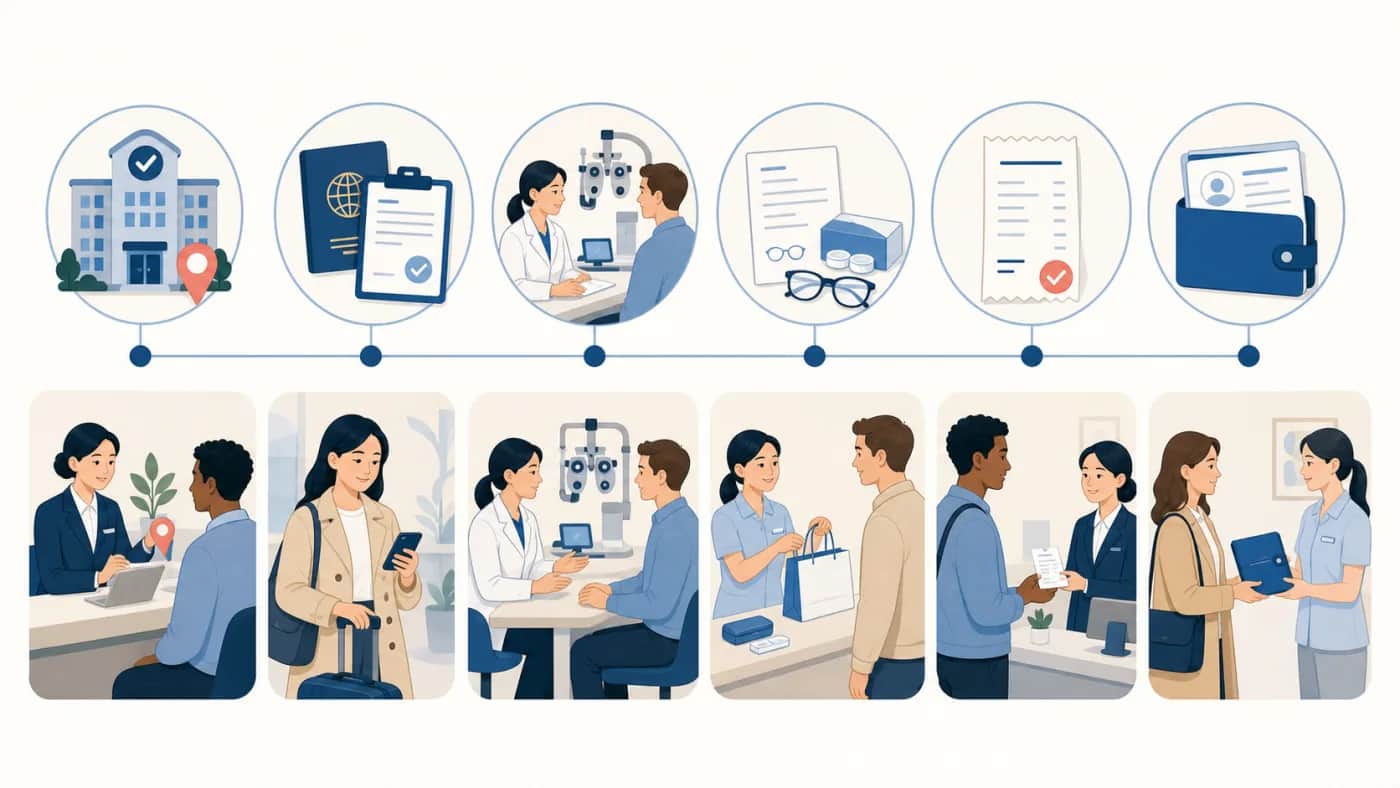
Eye-care cost questions often collapse four different decisions into one: whether a medical service has a recognized price item, what the exact provider currently charges, whether a person's live insurance record covers the coded transaction and whether the provider can settle directly with a payer. China's national ophthalmic price guide standardizes project language but leaves benchmark and execution prices to provincial and authorized local implementation. Insurance scope is also being unified gradually and remains transaction-specific. This guide helps build a written cost and payment evidence chain. It does not estimate a national price, recommend an examination or treatment, interpret insurance benefits, promise direct billing or reimbursement, or decide whether any item is clinically necessary.
Use this as a practical starting point
Provider procedures can change, so confirm time-sensitive details with the hospital, insurer or service. A licensed professional must make clinical decisions for an individual patient.
At a glance
Key points
- Keep the national ophthalmic price item, local provider price, insurance benefit and payment method as four separate checks.
- The national guide maps ophthalmic services into standardized projects but does not create one nationwide patient price or total package.
- Request a provider quote that separates medical services, medicines, consumables, devices or lenses and optional or later charges.
- Verify the insured place, entitlement, designated-provider status, coded item and required authorization in the live insurance route before relying on settlement.
- Eyeglasses are outside basic medical-insurance payment under the cited national response, while potentially payable clinical services still require current local verification.
- The 2026 personal-account retail-pharmacy rule expressly excludes contact lenses from provincial white lists; that narrow rule must not be generalized to every eye-care charge.
- A commercial-insurance card, provider logo or prior successful claim does not prove direct billing for a new visit; obtain current confirmation from both provider and payer.
- Collect the final itemized list, receipt and settlement evidence and reconcile them against the quote without interpreting clinical necessity.
Separate price projects, prices, benefits and settlement
A price project describes a billable medical-service output. A provider price is the amount the institution applies under the current local rules. An insurance benefit determines whether the live participant and coded transaction fall within payment scope. Settlement describes how the approved amount is paid at the cashier. These layers can produce different answers: a service may have a valid price item but be excluded from a person's benefits, or be covered in principle while direct settlement fails because identity, provider, authorization or system conditions are not met.
Start every enquiry with the exact Chinese legal institution, campus, department, intended service as named by the provider and intended payer route. Do not ask only, “How much is eye care?” or “Do you take insurance?” A hospital's international department, ordinary outpatient department, private clinic and retail optical shop can use different prices and payment documents.
- Price-item name and code
- Current local provider price
- Participant-level benefit decision
- Designated provider and authorization status
- Direct settlement or self-payment method
- Final receipt and settlement evidence
A recognized price item is neither a treatment recommendation nor an insurance guarantee.
Read the ophthalmic price guide correctly
The national ophthalmic price guide maps 563 prior technical-service items into 125 standardized projects and directs provinces to establish provincial benchmarks, with authorized pooling areas determining actual execution levels. Its official explanation groups eye care into examination, non-surgical treatment and surgical treatment and gives examples of how project language is organized. It does not quote one patient's visit.
Use the guide to ask a provider for the exact current project name, unit and price, not to calculate care from a national table. Local implementation timing and mapping can change the wording shown on a quote. A project can also exclude medicines, consumables, lenses, devices, anaesthesia, imaging or other services unless the provider's current rule states they are included.
- Exact local project name and code
- Charging unit and quantity
- Current effective price and date
- Included professional work
- Separately charged medicines and consumables
- Separately charged device, lens or product
- Possible additional services requiring a new order
Obtain a component-level provider estimate
Ask the medical institution to issue or record a current estimate through its price or patient-service route. National price-management rules support publication of common prices, itemized fee lists, price enquiries and price complaints at public medical institutions. Ask the provider to separate medical services, medicines, consumables and devices, and to identify which amounts are fixed, estimated or dependent on later qualified orders.
The estimate is not a clinical plan from this website and should not be used to choose or refuse care. Ask the treating professional to explain why an item is proposed and the price office or cashier to explain its billing code. If the plan changes, request an updated clinical explanation and revised estimate. Do not infer necessity from the price, or coverage from the presence of an insurance code.
- Provider and campus
- Estimate date and validity
- Medical-service project lines
- Medicine lines
- Consumable and device or lens lines
- Deposits and later balances
- Excluded or uncertain charges
- Contact for price changes
Clinical justification and billing explanation come from different responsible teams. Obtain both without asking administrative staff to make treatment decisions.
Verify basic medical insurance in the live transaction
National policy has historically left medical-service payment scope and levels to local catalogues while a national catalogue is developed in stages. The May 2026 official explanation says the first national medical-service catalogue is still being prepared and ophthalmology is not included as one complete first-batch category. Before a planned visit, verify the insured place, active entitlement, provider designation, service code, authorization or referral conditions and accepted credential through the responsible local insurance route.
Keep products and clinical services separate. The cited national response states that eyeglasses, dentures and prosthetic eyes were outside basic medical-insurance payment across provinces under the framework it describes. That does not prove that every eye examination, treatment, medicine or hospital-used device is excluded. Obtain a current local answer for the exact coded item and participant instead of relying on an old claim, another person's settlement or a provider's general “takes医保” label.
- Active insured place and entitlement dates
- Insurance category
- Designated-provider status
- Exact coded service or product
- Referral, prior authorization or other condition
- Expected pooling-fund, personal-account and self-pay treatment
- Identity fields matching the hospital record
Apply the 2026 personal-account contact-lens rule narrowly
A May 2026 national notice requires provinces to create white lists for employee basic medical-insurance personal-account purchases at designated retail pharmacies. It expressly says contact lenses may not be placed on those white lists. A personal-account purchase is not the same as pooled-fund reimbursement, and a designated retail pharmacy transaction is not the same as a hospital medical-service charge.
Do not extend that rule to eyeglass-shop payments, resident insurance, work-injury insurance, commercial insurance, a hospital examination or a device used during treatment. Ask the responsible payer and provider how the exact transaction is classified. If a cashier attempts a personal-account transaction, retain the result and do not ask staff to relabel an item to obtain payment.
- Employee personal account or another funding route
- Designated retail pharmacy or another seller
- Provincial white-list status
- Exact product category
- Transaction date and local implementation
- No relabelling or substitution to change payment treatment
Confirm direct billing and commercial payment separately
Direct billing is a current operational arrangement, not a quality mark and not proof that all charges are covered. For any commercial or third-party payer, ask the provider whether the exact legal institution, campus and department can submit a claim directly for the planned visit. Ask the payer separately whether the patient, policy, provider and intended service fit the arrangement and what written confirmation or authorization it requires.
Record whether the patient must pay a deposit, deductible, co-payment, excluded item or full amount if approval is unavailable. Do not treat a membership card, insurer logo, phone assurance, prior visit or employer benefit summary as a current guarantee. If confirmation is not available, ask what self-pay documents the provider can issue and ask the payer whether later reimbursement is possible before assuming it will be accepted.
- Payer and policy or case reference
- Exact legal provider and campus
- Department and planned visit type
- Written direct-settlement confirmation or authorization
- Deposit, deductible, co-payment and exclusions
- Fallback self-pay and reimbursement document list
- Contact if the provider and payer give different answers
Reconcile the final bill, receipt and complaint route
After payment, obtain the itemized fee list, medical charge receipt where applicable, insurance settlement statement or payer response and any deposit or refund evidence. Medical receipt rules distinguish final medical charges from advance payments and require truthful issuance for qualifying non-profit medical institutions. Compare provider, patient identity, project names, quantities and amounts with the latest estimate and documented changes.
For an unexplained medical-institution charge, start with the price enquiry or complaint contact and the institution's unified complaint route. For a retail optical or contact-lens transaction, use the seller and market-regulation route instead. Preserve records and ask the responsible team to explain a code; do not accuse staff based only on an English translation or use a complaint to reinterpret clinical necessity. These routes do not guarantee refund, liability, insurance reversal or compensation.
Call 120 for a possible medical emergency in the Chinese mainland. Do not delay urgent care while seeking a price estimate, insurer authorization or billing correction.
Useful language
Navigation phrases
Show the Chinese characters when pronunciation is uncertain. Use the copy button to send one phrase through a trusted channel without retyping it.
Avoidable problems
Common mistakes
- Treating a national price-item guide as a nationwide patient tariff.
- Assuming a provider's price item is automatically covered by insurance.
- Asking only whether a hospital “takes insurance” without naming the participant and transaction.
- Combining retail eyeglasses, contact lenses and hospital clinical services into one coverage assumption.
- Applying the employee personal-account contact-lens rule to every insurance category and eye-care charge.
- Treating an insurer logo or card as a guarantee of direct settlement.
- Paying a deposit without documenting the final-bill and refund process.
- Keeping only the receipt and discarding the itemized list and settlement statement.
- Using a billing complaint to decide whether a clinical service was necessary.
Common questions
Frequently asked questions
Does China have one national price for an eye examination?
No source cited here creates one nationwide patient price. The national ophthalmic guide standardizes price-item structure, while provinces and authorized pooling areas implement benchmark and execution levels. Ask the exact provider for its current local project name, unit and price and for any separately charged items.
If a service has an ophthalmic price code, will basic medical insurance pay?
Not automatically. Price recognition, benefit scope and live settlement are separate. Verify the participant's insured place and entitlement, provider designation, exact local code and any referral or authorization condition. The current national catalogue work does not make the ophthalmic price guide a complete insurance list.
Does basic medical insurance cover eyeglasses?
The cited NHSA response states that eyeglasses were not included in basic medical-insurance payment across provinces under the framework it describes. Confirm current local policy for the exact transaction, and do not extend that product rule to every clinical eye service, medicine or hospital-used device.
Can I use an employee medical-insurance personal account to buy contact lenses?
The 2026 national notice says contact lenses may not be included in provincial personal-account white lists for purchases at designated retail pharmacies. That is a narrow employee personal-account retail rule. It does not decide resident insurance, commercial insurance, an optical-shop transaction or hospital clinical-service payment.
Does an insurer card or hospital logo guarantee direct billing?
No. Ask the provider whether the exact legal institution, campus, department and visit can use the arrangement, and ask the payer whether the patient, policy and intended service qualify. Obtain the current reference or authorization and document deposits, co-payments, exclusions and the fallback if settlement fails.
What should I keep after paying an eye-care bill?
Keep the latest estimate, documented changes, itemized fee list, medical charge receipt where applicable, insurance settlement statement or payer response, deposit and refund evidence and the related medical record. Preserve Chinese originals and ask the recipient about translation or claim requirements rather than altering the documents.
Evidence
Sources consulted for this guide
National rules are separated from city and provider examples. Access dates show when a source was collected; source pages and procedures can change afterward.