
Eye & vision care
Verify an orthokeratology clinic and records in China
Verify the ophthalmology department, responsible doctor, registered device, consent and patient file without assessing candidacy or giving lens instructions.
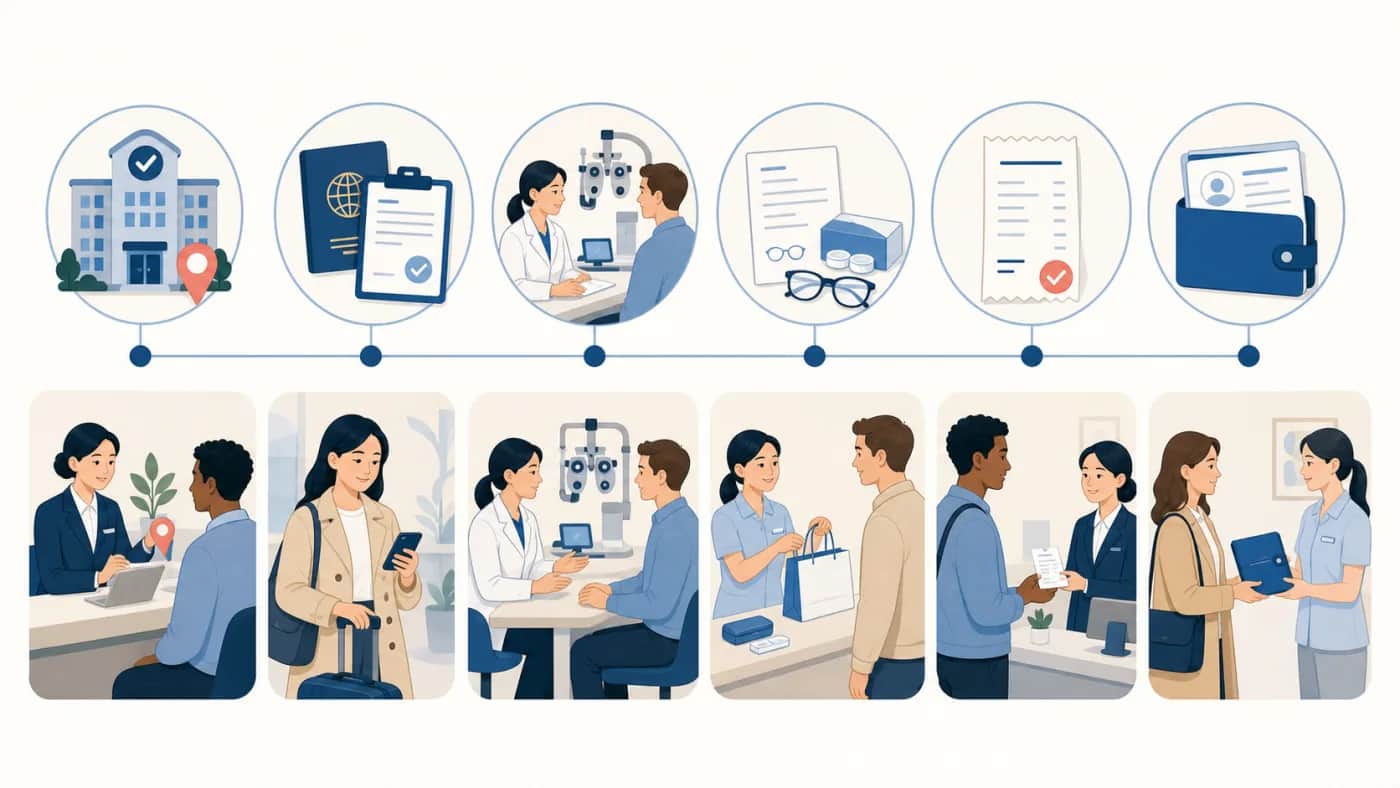
China's 2026 orthokeratology management standard treats orthokeratology fitting as a clinical technology performed through a medical institution with an approved or filed ophthalmology department. It assigns the full medical decision and quality-control process to a registered, trained ophthalmologist and places technical staff under that doctor's guidance and supervision. This guide explains how to verify the legal institution, responsible physician, device registration, consent, one-patient file and transfer record. It does not assess candidacy, interpret corneal, refraction, axial-length or other results, recommend a lens or provider, describe fitting or wearing steps, advise on cleaning or follow-up intervals, or decide whether treatment should start, continue, pause or stop.
Use this as a practical starting point
Provider procedures can change, so confirm time-sensitive details with the hospital, insurer or service. A licensed professional must make clinical decisions for an individual patient.
At a glance
Key points
- Verify the legal medical institution and its approved or filed ophthalmology department; a retail optical shop or brand showroom is not enough.
- Identify the registered ophthalmologist responsible for the entire clinical process, not only the technician or sales contact handling measurements and orders.
- The 2026 standard places assessment, consent, parameter and prescription decisions, follow-up and complication management under the responsible ophthalmologist.
- Check the exact orthokeratology product through official medical-device registration data, but do not treat registration as proof of individual suitability.
- Ask for the institution's consent, price, product, follow-up, referral and complaint documents before paying or transferring care.
- The institution must maintain one patient file for at least 15 years from the last visit under the 2026 standard; request copies through the formal record route.
- When moving or changing providers, confirm the receiving institution and handoff requirements before assuming that a prior lens, record or plan will be accepted.
Verify the legal institution and ophthalmology department
Use the official medical-institution query to match the Chinese legal name, licence information, address and registered diagnosis-and-treatment scope. The 2026 orthokeratology standard requires the institution to have an approved or filed ophthalmology department and specified rooms, equipment and hygiene conditions. Ask the institution to identify the exact campus where the service is provided because a hospital group name does not prove that every branch has the same registered scope or capability.
Do not use a brand logo, shopping-centre counter, optical-shop business licence, online advertisement or device distributor's authorization as a substitute for medical-institution verification. The national standard describes minimum institutional requirements, not a public ranking or guarantee of availability, language support, appointment capacity, clinical quality or outcome.
- Chinese legal institution name
- Exact campus and address
- Medical-institution registration result
- Approved or filed ophthalmology diagnosis-and-treatment subject
- Official appointment and patient-service contact
- Institution-level complaint route
Orthokeratology product sales and clinical fitting are different functions. The 2026 standard places fitting within an eligible medical institution.
Identify the responsible ophthalmologist and supervised team
Ask for the Chinese name of the ophthalmologist responsible for the complete fitting process and check the available physician-registration record. The 2026 standard states that the physician leads pre-fitting assessment, consent, lens-parameter selection and customization, the prescription, follow-up and management of complications. It also requires relevant registration, professional training and continuing education.
Technical personnel may assist with examinations, records, trial-lens handling, product receipt and parameter checking, distribution and patient education, and may assist with parameter selection and ordering under an ophthalmologist's guidance and supervision. Ask staff to state their role accurately. Do not ask a technician, sales representative or interpreter to make a clinical decision that belongs to the responsible physician.
- Responsible ophthalmologist's Chinese name
- Official physician-registration result
- Institution and practice location match
- Role of each technical staff member
- How the physician supervises assisted work
- Contact route for physician-led questions and follow-up
Prepare identity, guardian and language arrangements
Before the appointment, ask the institution which identity document it accepts for patient registration, whether a foreign passport can be used in its system and what guardian or authorization documents it requires when applicable. Keep the patient name consistent across the hospital record, consent form, device order, payment and later record request. A passport or guardian document establishes an administrative identity route only; it does not determine clinical eligibility.
Confirm language support for the physician's explanation and consent conversation, not only for reception. Ask whether the institution supplies an interpreter or permits an independent interpreter or companion, and what privacy authorization it requires. An interpreter communicates the exchange but must not select parameters, recommend a product or answer clinical questions for the physician.
- Patient name and accepted identity document
- Existing patient number, if any
- Guardian or representative documents where required
- Preferred spoken and written language
- Interpreter or companion authorization
- Official channel for advance record submission
Match consent, product registration and written quote
The 2026 standard requires objective explanation of benefits and risks and alternative vision-correction and myopia-control methods, adherence to indication and contraindication requirements and an informed-consent system. These are duties for the treating institution and ophthalmologist. This website does not reproduce those clinical criteria or compare options. Ask for the institution's own case-specific explanation and do not sign a blank or unexplained form.
Record the exact Chinese product name, registration number, registrant and model or specification shown on the institution's order, then check the appropriate NMPA registration database. Ask the institution to separate professional services, examinations, device or lens charges and later follow-up charges on the written quote. Product registration and a written quote do not establish clinical suitability or insurance payment.
- Patient and institution identity match
- Responsible physician is named
- Case-specific consent discussion occurs through an understood language route
- Exact registered product and registration number are written
- Professional service and product charges are separated
- Change, cancellation and refund process is documented
This checklist verifies who explains, what product is recorded and how the transaction is documented. It does not help choose the lens or decide whether orthokeratology is appropriate.
Request the one-patient file and available copies
The 2026 orthokeratology standard requires one fitting file per patient and retention for at least 15 years from the patient's last visit. Ask the institution what the file contains under its workflow and which department handles copies. National medical-record rules provide a formal route for patients or authorized agents to request available notes, examination reports, images and consent documents, subject to identity and authorization checks.
Request named records rather than demanding an undefined complete export. Useful administrative labels can include the initial assessment record, consent form, device order and registration information, examination reports made available by the institution, follow-up record, payment documents and any referral or transfer note. Preserve the Chinese originals and do not interpret measurements, images or changes yourself.
- Patient identity and unique record number
- Consent and physician explanation record
- Product order and registration identifiers
- Provider-issued examination reports and images available for copying
- Follow-up and communication records
- Referral, transfer or closure record
- Itemized charges and receipts
Plan continuity, transfer and problem resolution
Before moving, travelling for a long period or changing institutions, ask the current clinic which qualified institution owns pending follow-up and complication-management responsibility and what record pack it can provide. Ask the receiving institution what it needs and whether it will accept the prior product, records and plan. The national referral notice supports coordinated handoffs, but it does not compel another provider to accept a patient, lens or previous clinical decision.
For a missed document, unexplained fee, unavailable responsible physician, consent-process concern or record-request problem, use the institution's published complaint route and describe the exact administrative event. For a suspected product-registration or seller issue, use the market-regulation route separately. Neither complaint process replaces clinical care. If a possible medical emergency is occurring, call 120 in the Chinese mainland rather than waiting for a clinic message, record transfer or complaint response.
Continuity planning preserves responsible ownership and records. It does not authorize a patient or website to decide whether care can safely wait.
Useful language
Navigation phrases
Show the Chinese characters when pronunciation is uncertain. Use the copy button to send one phrase through a trusted channel without retyping it.
Avoidable problems
Common mistakes
- Treating an optical-shop business licence as proof of an eligible medical institution.
- Checking only the hospital group and not the exact campus and ophthalmology scope.
- Dealing only with a technician or salesperson without naming the responsible ophthalmologist.
- Assuming a physician-registration result proves orthokeratology training, schedule or suitability.
- Treating product registration as proof that the product is right for the patient.
- Signing a generic or untranslated form without a case-specific physician explanation.
- Keeping only screenshots of results instead of requesting provider-issued records.
- Changing cities without confirming which institution owns follow-up and handoff.
- Using a complaint channel instead of seeking timely qualified medical care.
Common questions
Frequently asked questions
Can a retail optical shop independently provide orthokeratology fitting?
The 2026 national standard places the clinical technology in a medical institution with an approved or filed ophthalmology department and assigns medical decisions and quality control to a qualified registered ophthalmologist. Verify the exact legal institution and campus; a retail business identity or product authorization alone is insufficient.
Can a technician choose the orthokeratology parameters and manage the case alone?
The standard allows trained technical personnel to assist and to work on specified tasks under an ophthalmologist's guidance and supervision. It assigns the overall assessment, consent, parameter and prescription decisions, follow-up and complication management to the responsible ophthalmologist. This guide does not interpret how those duties apply to a clinical case.
Does the clinic have to keep an orthokeratology fitting file?
Yes. The 2026 standard requires one patient, one file and retention for at least 15 years from the patient's last visit. Ask the institution which documents exist and use its formal copying route. The rule does not guarantee that every raw device output is available to the patient or that another clinic will accept every item.
Does an NMPA registration prove an orthokeratology lens is suitable?
No. It verifies the administrative registration record for the described product. Suitability, parameters, prescription, follow-up and any change require an individualized physician-led process. This website does not assess those clinical questions.
Can I transfer the same lens and plan to a clinic in another city?
Do not assume so. Ask the current institution for a named record pack and ask the receiving legal institution what it will accept and what assessment it requires. The referral framework supports coordination but does not force acceptance of a patient, product or prior plan.
Where should I report an orthokeratology clinic or record problem?
Use the medical institution's published complaint route for its clinical-service, consent, fee or record process. Use the market-regulation route for a suspected device-registration or seller issue. Neither route replaces qualified medical care, determines liability automatically or guarantees a refund. Call 120 for a possible medical emergency.
Evidence
Sources consulted for this guide
National rules are separated from city and provider examples. Access dates show when a source was collected; source pages and procedures can change afterward.