
Eye & vision care
Buy eyeglasses in China with a clear quote and receipt
Verify the optical shop, document the eyeglass order, compare pickup details, and preserve receipts and after-sales terms without choosing lenses.
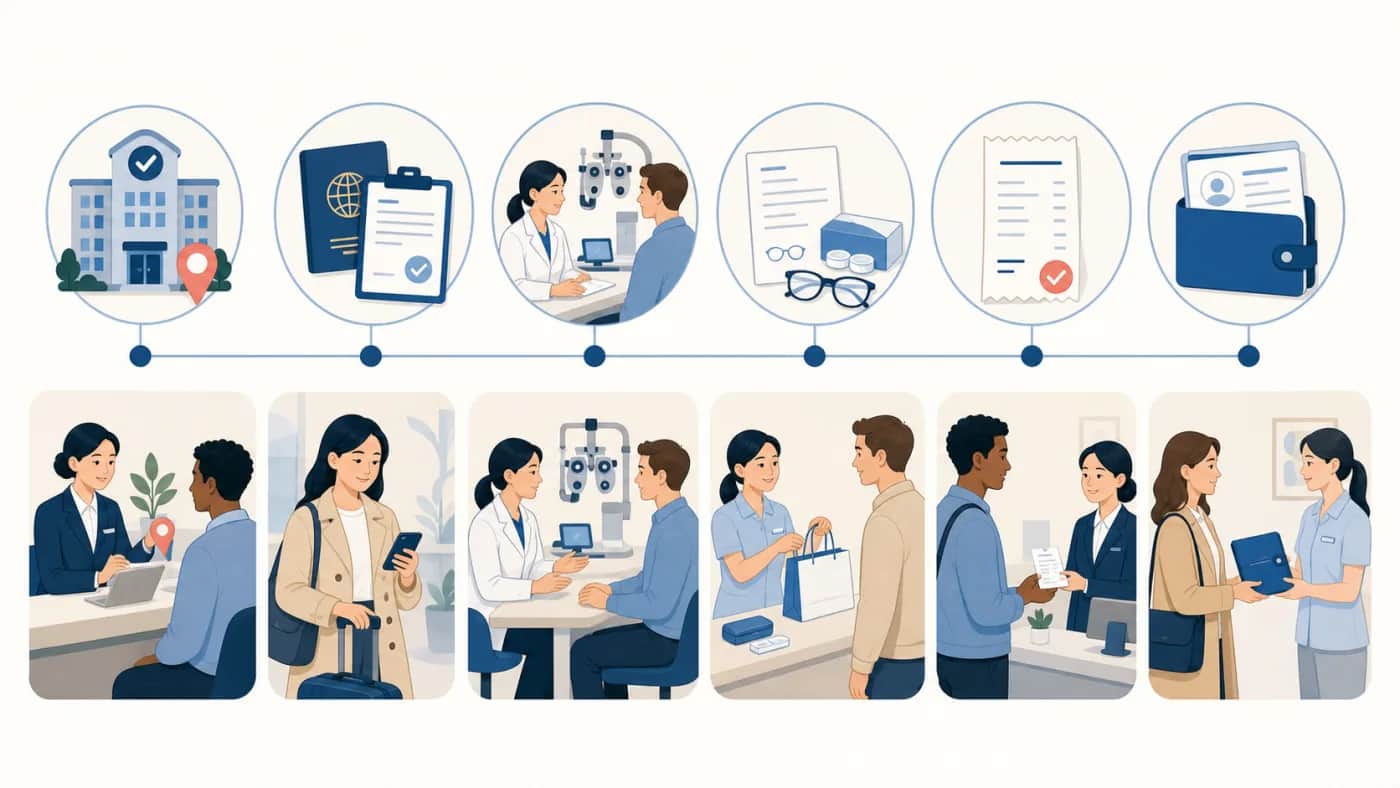
An eyeglass purchase in China can involve a retail optical shop, a hospital refraction service, a separate lens laboratory and several documents that use different names. The safest administrative approach is to identify the legal seller, keep the clinical prescription or provider-issued refraction record separate from the retail order, obtain a component-level quote and preserve the final receipt and written after-sales terms. This guide covers the transaction and evidence chain only. It does not interpret a refraction result, decide whether a new eye examination is needed, recommend a frame, lens material, index, coating, brand or visual correction, assess product quality from appearance, or tell anyone whether the completed glasses are clinically suitable. Those decisions require qualified eye-care professionals and the responsible seller.
Use this as a practical starting point
Provider procedures can change, so confirm time-sensitive details with the hospital, insurer or service. A licensed professional must make clinical decisions for an individual patient.
At a glance
Key points
- Identify whether each charge belongs to a medical institution or a retail optical seller; their price documents, receipts and complaint routes are not interchangeable.
- Check the shop's displayed legal business identity and the current verification status of the specified optometry instruments before placing an order.
- Keep the provider-issued refraction record, retail order, component quote, payment evidence and pickup confirmation as separate documents.
- Ask the seller to write the exact frame, lens and service identifiers it is promising instead of relying on an English marketing label or spoken description.
- At pickup, compare the delivered identifiers and visible condition with the written order without attempting to interpret the prescription or certify optical performance yourself.
- Obtain the correct invoice or receipt and written warranty, remake, adjustment, return and complaint terms before leaving.
- Use the seller's after-sales route and then the current 12315 process for an eligible consumer dispute; neither route determines clinical suitability.
Separate the medical service from the retail transaction
Start by identifying who performed any medical or clinical service and who is selling the finished eyeglasses. A hospital may issue a refraction-related medical record or charge under an ophthalmic medical-service price item, while a retail optical shop issues its own order and retail payment document. A hospital receipt does not prove what a separate shop promised, and a shop order is not a hospital medical record. If the same brand appears to operate both functions, ask for the Chinese legal entity and document issuer for each charge.
Do not ask retail staff or this page to decide whether an existing refraction record is clinically current or adequate. Ask the qualified eye-care provider what record it created and ask the seller what written data it needs to manufacture the ordered glasses. Preserve the original record exactly as issued. Do not rewrite numbers, convert notation or merge two prescriptions yourself.
- Medical institution and department that created the eye record
- Retail legal entity accepting the eyeglass order
- Document issued for the clinical service
- Document issued for the retail sale
- Payment recipient for each transaction
- Complaint contact for each legal entity
A retail eyeglass order and a medical eye record may refer to the same visit, but they remain different evidence with different issuers and responsibilities.
Check the shop identity and measurement controls
At a physical shop, compare the name on the displayed business credentials with the name that will appear on the order and payment document. The 2026 national optometry consumer guidance also directs consumers to look for current mandatory-verification marks on specified instruments such as the autorefractor, focimeter and trial lens set. Record the shop address and order contact, but do not treat a clean store, famous brand, training certificate or valid instrument mark as a clinical-quality score.
If the order is placed through an online account, identify the legal seller shown by the platform, the address and the after-sales channel before paying. Save the product page and order terms that actually apply to the transaction. A platform display name, influencer account or chat contact is not enough to identify the contracting seller. Do not send a passport or medical record to an unofficial personal account merely to obtain a promotional quote.
- Chinese legal seller name
- Physical or registered business address
- Order and after-sales contact
- Displayed business credentials
- Current verification marks on specified instruments
- Online platform order number, where applicable
Build a written component-level order and quote
Ask the seller to place every promised component on a written order before payment. Useful identifiers can include the frame brand and model, lens brand and product line, material or index, coating or treatment name, quantity, service charge, promised completion date and total price. These are transaction fields, not recommendations. The seller and qualified eye-care professionals remain responsible for explaining what a proposed product means and whether it is appropriate.
Ask which items are included in the total, which are optional, which may change after confirmation and what deposit or cancellation terms apply. Keep discounts and bundled gifts separate from the core product price so a later comparison is possible. National ophthalmic price guidance concerns medical-service projects and does not create a retail spectacle tariff; a quote must come from the actual seller.
- Frame brand, model, colour and quantity
- Lens brand, product line and written specifications promised
- Coating, treatment or additional service names
- Unit price, discount and total
- Deposit, balance and payment recipient
- Expected completion and collection route
- Written conditions for changes, remake or cancellation
Do not choose a lens from price, index, coating or brand language on this page. The purpose of the list is to document what the seller promises after an appropriate professional process.
Compare the pickup package with the written order
At collection, ask the seller to show how the frame and lens identifiers correspond to the order and to provide any packaging, card or parameter record it normally gives the customer. Check the customer name, order number, visible model and quantity and record any obvious physical damage before accepting the goods. The 2026 consumer guidance supports checking that ordered brand, refractive-index and coating information matches the agreement and allows the customer to discuss an on-site instrument check with the seller.
Do not interpret the instrument output, compare it with a prescription or declare that the completed glasses are clinically correct. If the customer has a vision or comfort concern, ask the responsible seller and qualified eye-care provider to use their normal assessment process and document the result. Keep the original order unchanged and avoid posting personal eye data publicly while seeking advice.
- Customer and order number match
- Frame model and visible condition match the order
- Lens identifiers and promised treatment names are documented
- Quantity and included accessories are complete
- Seller records any concern before collection is closed
- Customer receives the seller's normal product and order documents
Preserve payment, warranty and after-sales evidence
Request the invoice or receipt appropriate to the retail transaction and make sure the seller name, date, amount and product description can be connected to the order. Keep the payment-platform record as supporting evidence, not as a substitute for the seller's transaction document. A medical charge receipt is designed for qualifying non-profit medical-institution charges and should not be demanded from an unrelated retail optical shop.
Ask the seller to write the duration and scope of any warranty, free adjustment, remake, exchange or return promise, who decides whether the condition is met, what evidence is required and which costs remain the customer’s responsibility. Do not assume that a spoken promise, brand-wide advertisement or another branch's policy applies. This page cannot determine whether the law or contract requires a refund or remake in an individual dispute.
- Invoice or receipt issuer and amount
- Order number linked to the payment
- Warranty period and covered components
- Adjustment or repair route
- Remake, exchange or return conditions
- Evidence and deadline for an after-sales request
Use a documented dispute route
For a missing component, mismatched order, unexplained charge, unfulfilled written promise or product-quality concern, first send the legal seller a concise request containing the order number, date, promised term, evidence and requested resolution. Keep the clinical question separate. A retail seller can address its transaction and product obligations but should not be asked to rewrite a hospital record or substitute for an eye-care professional.
If the issue falls within consumer or market-regulation authority and the seller does not resolve it, the current national rules permit complaints or reports through the National 12315 Platform, 12315 hotline or another published market-regulator channel. Provide truthful identity, seller and factual information. The process can handle an eligible consumer dispute or suspected regulatory breach, but it does not establish clinical negligence, guarantee compensation or decide which optical correction is right.
For a possible medical emergency, use 120 in the Chinese mainland. Do not wait for a shop manager, warranty review or 12315 response.
Useful language
Navigation phrases
Show the Chinese characters when pronunciation is uncertain. Use the copy button to send one phrase through a trusted channel without retyping it.
Avoidable problems
Common mistakes
- Treating a retail optical-shop order as a medical record or prescription.
- Assuming a famous brand name identifies the legal seller and payment recipient.
- Accepting a single package price without written component identifiers.
- Choosing a lens or coating solely from marketing claims on a quote.
- Discarding the original order after receiving only a payment-app screenshot.
- Interpreting an instrument display or declaring the finished glasses clinically correct without a qualified professional.
- Relying on a spoken lifetime warranty without scope, branch and evidence terms.
- Demanding a medical charge receipt from an unrelated retail seller.
- Using 12315 to seek a clinical diagnosis or treatment recommendation.
Common questions
Frequently asked questions
Is an optical-shop refraction record the same as a hospital eye record?
Do not assume they are the same. Ask each issuer to name the document, legal entity and purpose. A hospital medical record follows medical-record rules, while a retail order records the seller's transaction. A qualified eye-care professional must decide what information is clinically adequate; this guide only keeps the documents distinct.
Does China have one national price for eyeglasses?
No source cited here creates one national retail spectacle price. National ophthalmic price guidance structures medical-service price items, while a retail seller must provide its own current quote. Compare written components and terms rather than treating a hospital service item or an online advertisement as a universal price.
Can I use the instrument verification mark to judge the shop's quality?
The 2026 guidance supports checking that specified instruments have a current mandatory-verification mark. That check concerns measurement control; it is not a provider ranking, diagnosis, guarantee of staff competence, product quality certificate or proof that the completed glasses suit an individual.
What documents should I keep after buying eyeglasses?
Keep the original eye record supplied by its issuer, the retail order, itemized quote, invoice or receipt, payment evidence, product identifiers, pickup record and written after-sales terms. Preserve the Chinese originals. The exact record an insurer or another provider accepts must be confirmed with that recipient.
Does a shop have to refund or remake eyeglasses if I complain?
This guide cannot decide that. The result depends on the facts, written terms, product and service issue and applicable law. Submit the exact order and evidence to the legal seller first. For an eligible consumer dispute or suspected market-regulation breach, use the current 12315 route without presenting it as a clinical appeal.
Can the 12315 platform tell me whether the prescription or lenses are clinically right?
No. Market-regulation complaint rules do not turn the platform into an eye-care provider. Use it for matters within consumer and market-regulation authority. Questions about examination findings, visual correction or clinical suitability belong to qualified eye-care professionals.
Evidence
Sources consulted for this guide
National rules are separated from city and provider examples. Access dates show when a source was collected; source pages and procedures can change afterward.