
Eye & vision care
Eye-test images, reports and record transfer in China
Request named ophthalmology reports and image data, protect the originals, and prepare a secure provider-to-provider handoff without interpreting results.
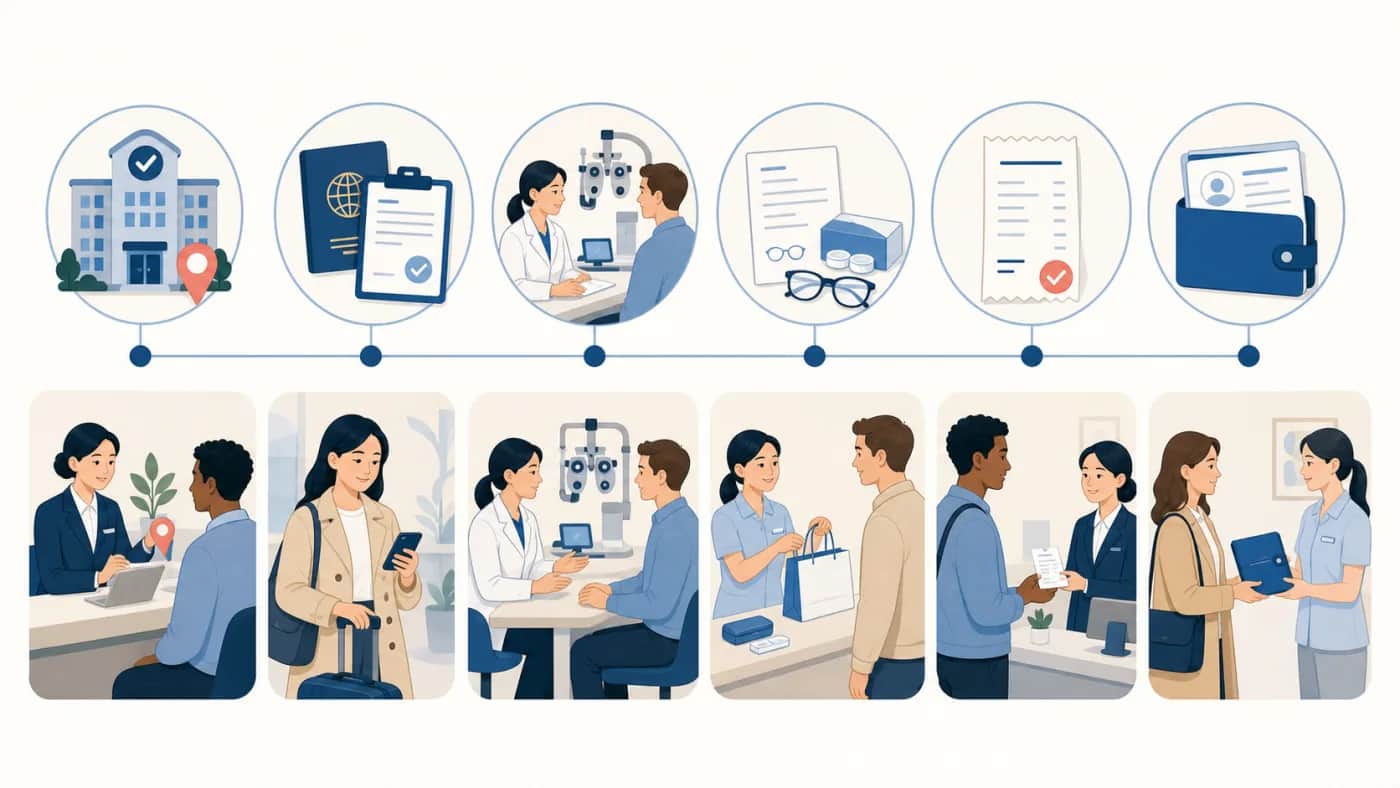
An eye-care handoff can involve a consultation note, provider-recorded diagnosis, examination report, prescription, image, device-generated output, procedure record, consent document, fee statement and follow-up note. These are not interchangeable, and the institution may store them in different systems. National medical-record rules support formal access to specified records and available reports or images, while current electronic-record rules emphasize authorized, minimum-necessary and traceable sharing. Neither framework creates one national patient portal or guarantees that every raw output exists, can be exported immediately or will be accepted by another provider. This guide explains the administrative record request and transfer process. It does not interpret a result, compare measurements, decide whether a test should be repeated, identify a diagnosis or recommend any examination, procedure, medicine, lens or follow-up interval.
Use this as a practical starting point
Provider procedures can change, so confirm time-sensitive details with the hospital, insurer or service. A licensed professional must make clinical decisions for an individual patient.
At a glance
Key points
- Ask for records by exact name, date, eye-care department and visit instead of requesting a vague complete file.
- A written report, a displayed image, original image data and a device worksheet can be separate outputs with different release routes.
- Keep the original Chinese records unchanged and attach translations as separate, clearly labelled documents.
- Use the institution's formal identity and authorization process; a companion or insurer does not automatically have record access.
- Ask the receiving provider which reports, image formats, viewers and transfer method it accepts before the originating visit closes.
- Only the receiving qualified team can interpret prior material, decide whether it is sufficient or determine whether anything must be repeated.
- For missing, delayed or inaccurate records, preserve the request trail and use the record, correction or complaint route that matches the issue.
Map the record set before making the request
Start with a visit-by-visit index. Record the patient's name and identity document used at registration, patient number, Chinese legal institution name, exact campus, ophthalmology department, visit date and any examination date. A hospital group may use separate patient numbers, archives or image systems at different campuses. Match each requested item to the legal institution that created or holds it rather than assuming an international desk, booking platform, optical shop or referring clinic owns every record.
List the output actually needed. Examples may include the outpatient note, provider-recorded diagnosis, examination order, formal report, image data, prescription, procedure note, consent record, discharge material, itemized fee list or receipt, but only where that item was created. Ask the receiving provider for its names and preferred formats before submitting the request. This checklist does not establish that every listed record should exist for every visit, and it does not tell a patient which examination is clinically necessary.
- Patient name, passport or other registered identity number and patient number
- Chinese legal institution name, campus and ophthalmology department
- Visit and examination dates
- Exact report or record name
- Image-data format or secure access method requested by the receiving provider
- Purpose and deadline for the transfer
A screenshot of a patient portal can help identify an item, but it is not automatically the formal report, original image data or certified record copy.
Separate reports, images and other test outputs
Ask the records office or ophthalmology department how it distinguishes a report from the underlying image or device output. A report is the provider's recorded document; an image may be viewable only inside a hospital system, supplied through a viewer, exported in a particular format or unavailable as a patient-facing raw file. A printed chart, photograph of a screen and original dataset are not equivalent. Record what the provider can release, what format it uses, whether viewing software or an access code is required and how long a link remains active.
Do not alter contrast, crop identifiers, overwrite files or convert formats before preserving a read-only original. If a translation is needed, keep it alongside rather than over the Chinese source. Label who prepared the translation and the date, and avoid translating a provider-recorded finding into a stronger clinical conclusion. The receiving eye-care team must determine whether a report and its available image data can be relied on, whether the identifiers match and whether further provider-led review is required.
- Formal report as issued
- Available original image or data export
- Viewer software, link, code or access-expiry information
- Visible patient, institution and examination identifiers
- Unmodified Chinese original
- Separate translation and transfer index
This site cannot read an eye image or explain a measurement. Preserve the material and ask the qualified receiving team to review it.
Use the formal identity, authority and privacy route
Medical institutions normally verify the patient or another eligible applicant before releasing records. Ask which original identity document, copy, application form and relationship or authorization evidence the institution requires. A parent, guardian, family member, interpreter, employer, school, insurer or travel companion does not gain blanket access merely by attending the visit or paying. If the patient used an old passport or a different transliteration, tell the records office before filing so it can locate the correct patient record without creating a second identity.
Choose a secure delivery channel offered or approved by the record holder. Avoid sending full records through an unknown personal account, public link or unverified intermediary. Current electronic-record policy emphasizes authorized, minimum-necessary and traceable access. Ask who will receive the material, what minimum set is needed, whether an access link expires and how the institution documents release. If a foreign provider, insurer or translator will receive the file, confirm its intake and privacy requirements separately; a release by the Chinese institution does not guarantee acceptance elsewhere.
Payment for care, family relationship or possession of a patient's phone does not automatically establish authority to obtain or forward the medical record.
Prepare a receiving-provider handoff
Contact the receiving legal medical institution before travel or before the old account is closed. Confirm the exact Chinese or foreign department, named upload route, accepted file formats, maximum sizes, translation expectations and whether the team wants a concise provider-issued summary. A national continuity policy supports coordinated referrals and information handoffs, but it does not guarantee that another institution will accept an appointment, adopt a prior conclusion, open an external image format or continue an unfinished plan.
Build a neutral transfer index that states the institution, date, document name, language, format and file name. Do not add a self-diagnosis or rank findings. Include the originating institution's record-contact channel and preserve proof of transmission. At the receiving appointment, ask staff to confirm which material was successfully attached to the new record. Only the receiving clinician can interpret the content, reconcile differences or decide whether prior information is sufficient for the provider's own process.
- Receiving legal institution and exact department
- Secure upload or provider-to-provider channel
- Accepted report and image formats
- Translation and certification requirements
- Neutral document index
- Confirmation of receipt and attachment to the new record
Resolve missing, delayed or inaccurate material without guessing
If an item is missing, first ask whether it was created, whether it is held by another department or system, whether the request name is correct and whether the copy is still being prepared. Keep the application, receipt, tracking number, staff office and promised response date. For an apparent demographic or factual record error, use the institution's correction process and state the exact field, source document and requested review. Do not edit the issued record yourself or demand that a provider replace a clinical judgment with the patient's preferred interpretation.
Escalate a process failure through the institution's records office, patient-service office or published complaint route. Describe dates, documents, identifiers and the remedy requested, such as locating a report, explaining non-release, correcting a passport number or providing a usable copy. Complaint rules create an institution-level channel; they do not prove clinical fault, compel a particular interpretation, guarantee release of every raw device output or establish compensation. Preserve the response for the receiving provider and any later administrative route.
A missing export does not tell you what an eye result means. Keep the record problem separate from clinical review.
Useful language
Navigation phrases
Show the Chinese characters when pronunciation is uncertain. Use the copy button to send one phrase through a trusted channel without retyping it.
Avoidable problems
Common mistakes
- Asking only for all eye tests without identifying dates, departments or document names.
- Treating a portal screenshot as the formal report and original image data.
- Changing, cropping or overwriting the only copy before preserving the original.
- Adding a self-interpretation to a translation or file name.
- Assuming a companion, employer, school or insurer automatically has access authority.
- Sending complete records to an unverified personal account or public link.
- Assuming another provider must accept the format or adopt the prior conclusion.
- Editing an issued record instead of using the institution's correction process.
- Using a complaint route to demand a clinical interpretation or a particular diagnosis.
Common questions
Frequently asked questions
Is an eye-test report the same as the original image data?
Not necessarily. A report, displayed image, original data export and device worksheet can be separate outputs. Ask the institution what was created, what it can release, the available format and whether a viewer or access code is needed. The receiving qualified team decides how the available material can be used.
Can this website explain my eye-test results?
No. This guide covers record identification, copying and transfer only. It does not interpret an image, number, graph, prescription or provider-recorded finding. Ask the qualified treating or receiving eye-care team to explain the result in the patient's context.
Can a family member collect my ophthalmology records?
Only through the record holder's applicable identity and authority process. Family relationship, payment or attendance does not automatically grant full access. Ask the institution which authorization, relationship evidence and identity documents it requires for the specific applicant.
Should I translate the records before sending them abroad?
Ask the receiving provider or authority what it requires. Preserve the Chinese originals and attach any translation separately, with the translator and date identified. Do not replace provider language with a self-diagnosis or stronger conclusion.
Must the new provider accept my previous eye images?
No guarantee exists. The receiving institution decides whether the identifiers, content, format, age and quality meet its process and whether it needs anything else. A complete handoff reduces ambiguity but does not require the team to adopt a prior conclusion or avoid further provider-led review.
What can I do if an eye report or image is not released?
Ask whether the item exists, which department holds it, whether the request name and identity match, and when a response is due. Preserve the request trail. If the process remains unresolved, use the institution's records, patient-service or published complaint route, stating the exact document and remedy requested.
Evidence
Sources consulted for this guide
National rules are separated from city and provider examples. Access dates show when a source was collected; source pages and procedures can change afterward.