
Eye & vision care
How to continue eye care after moving in China
Transfer ophthalmology records, verify the receiving provider, rebuild appointments and payment arrangements, and keep all clinical decisions provider-led.
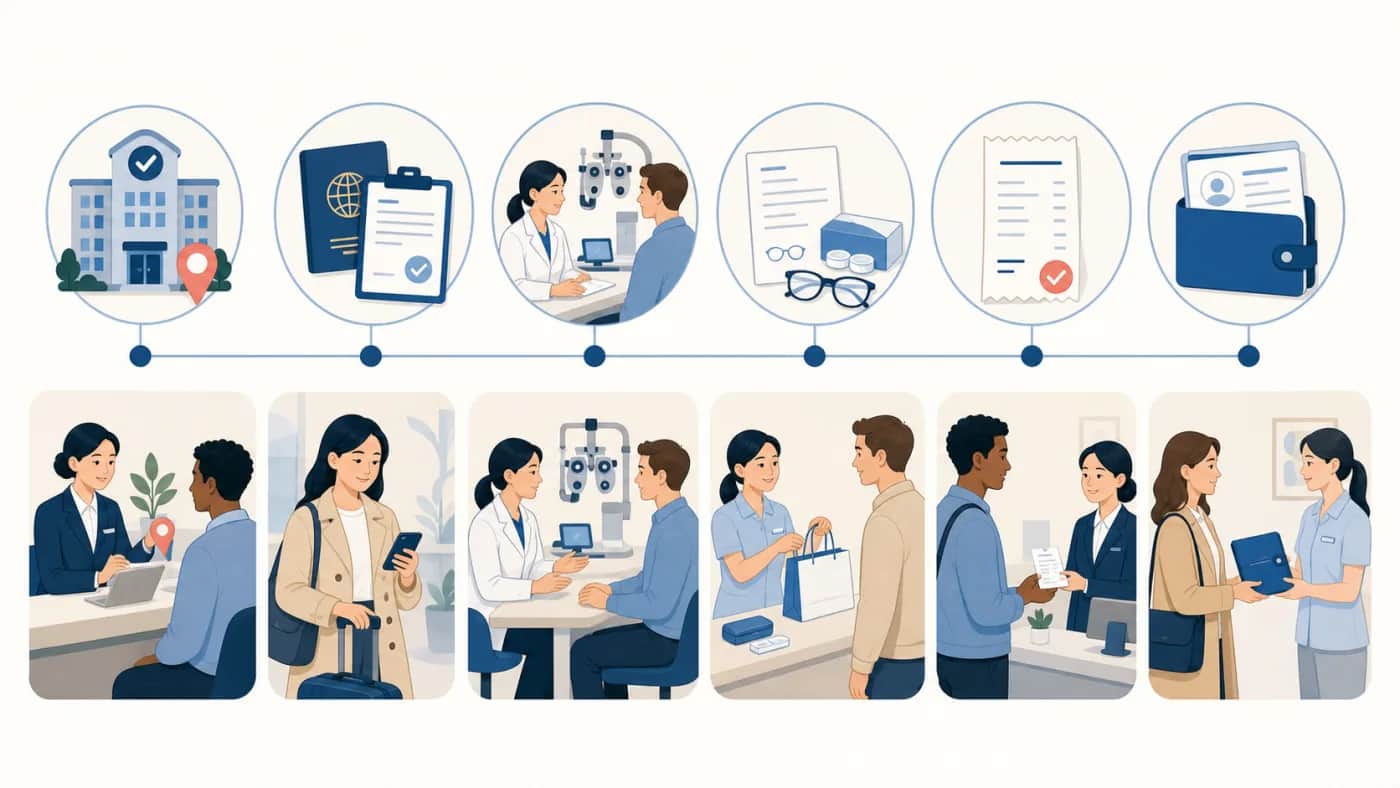
Moving within China can break an eye-care workflow even when the patient has complete records. Hospitals use separate registration systems, departments and image platforms; provider names and ophthalmology subdivisions differ; and insurance, appointment and payment rules can be local. National continuity policy supports referrals and information handoffs, but it does not create one nationwide ophthalmology record, guarantee acceptance by a new provider or require the new team to continue an old diagnosis, prescription, device or procedure plan. This guide covers the administrative transfer: identifying the receiving legal institution, requesting records, creating the new patient account, arranging language and payment and closing the old-provider loop. It does not interpret results, match a patient to a subspecialty, decide urgency, select treatment, advise on medicines or lenses or set a safe follow-up interval.
Use this as a practical starting point
Provider procedures can change, so confirm time-sensitive details with the hospital, insurer or service. A licensed professional must make clinical decisions for an individual patient.
At a glance
Key points
- Contact the receiving legal institution before moving and ask its staff to identify the correct ophthalmology booking route.
- A referral or prior plan supports a handoff but does not guarantee acceptance, an appointment, insurance settlement or continuation of the same treatment.
- Request a dated provider-issued summary, reports, available image data and relevant records before losing access to the old patient account.
- Preserve old and new passport, patient-number and insurance identifiers so records are not split across profiles.
- Only the receiving qualified team can interpret prior records, decide what it can use and issue any new prescription, procedure or follow-up plan.
- Recheck local provider designation, preauthorization, direct billing and claim documents; earlier payment does not prove future coverage.
- Close the transfer with written confirmation of the new department, records received, next provider-controlled step and old-provider contact route.
Choose the receiving route through provider staff
Search for the Chinese legal name of a medical institution and verify its registration where appropriate, then use its official website, verified account or telephone channel to confirm the exact campus and ophthalmology department. Give staff the purpose stated in the prior provider's referral or summary and ask them to identify the registration route. Department labels, subspecialty names and campus services vary, so this website does not map symptoms, images or diagnoses to a clinic and does not rank providers.
Ask whether the institution accepts a foreign passport in its online system, requires in-person account creation, reviews records before booking or needs a new first appointment. Record the accepted identity document, patient-number process, appointment channel, cancellation rule, language-support route and address. A matching medical-institution query confirms administrative identity only; it does not confirm that the exact team, equipment, language, service or appointment is currently available.
- Chinese legal institution name
- Exact campus and provider-confirmed department
- Foreign-identity registration route
- Appointment and cancellation channel
- Language-support arrangement
- Record-submission route
Ask the receiving institution to choose its booking route. Do not use an online guide to self-select an ophthalmic subspecialty.
Build the transfer pack before leaving the old city
Ask the old provider which office holds outpatient notes, reports, image data, prescriptions, procedure records, consent records, itemized charges and discharge or follow-up material where those items exist. Request only the records relevant to the handoff and create a dated index. Ask for the available original image format or secure viewer instructions separately from the report. Preserve Chinese originals and keep translations separate.
Request a concise provider-issued summary when available, including the provider-recorded history, completed work, unresolved provider-defined tasks and the old department's contact route. Do not rewrite it as a self-diagnosis or add a recommendation. Ask the receiving institution what file formats and translation it accepts before sending anything. National continuity policy supports information handoffs, but the receiving team decides whether it can use each item and whether its own process requires further review.
- Provider-issued summary or referral, if available
- Relevant notes and formal reports
- Available original image data and viewer instructions
- Prescription or device documentation actually issued
- Procedure, consent or discharge records where applicable
- Old provider's department and records contacts
Protect identity continuity across both systems
Compare the name, identity number, date of birth and patient number on the transfer pack with the document that will be used at the new institution. If a passport was renewed or transliteration changed, carry evidence connecting the old and new identity and tell both records offices before registration. Do not create multiple new profiles simply because an app cannot retrieve the old one; ask the institution whether it has a foreign-identity or account-merge route.
A parent, guardian, spouse, employer, school, insurer or interpreter may need separate authority documents to receive or transmit records. Ask each institution what it requires and share only the minimum set through its approved channel. Current electronic-record policy emphasizes secure and traceable access; it does not create automatic cross-city sharing or grant an organization blanket access. Save proof of release, upload and receipt.
A passport change can look like a new patient to an automated system. Resolve the identity link before relying on portal access or insurance matching.
Let the receiving team rebuild the clinical plan
At the new appointment, provide the indexed pack and ask staff to confirm which records were attached. The receiving clinician decides how to interpret prior findings, whether a report or image is sufficient, which provider-led examination is appropriate and what new plan, if any, to issue. This guide does not advise whether to continue, stop or change an eye medicine, contact lens, spectacle prescription, device, procedure plan or follow-up schedule. Do not extend an old instruction or use another patient's plan while waiting for the new provider.
If the old provider proposed surgery or another procedure, treat that proposal as background rather than an instruction binding the new team. Ask the receiving institution whether it requires a fresh evaluation, consent process, estimate, admission workflow or insurer authorization. If a product, device or unfinished course is involved, supply the exact provider-issued documentation available; only qualified providers can decide compatibility, continuation or replacement.
Continuity means an accountable handoff, not automatic continuation of every prior prescription, device or procedure plan.
Rebuild payment and insurance administration locally
Ask the new provider for its current registration, examination, record-copy and other relevant charges and request a written estimate for any provider-proposed next stage. Prices are implemented locally, and a national ophthalmic price-item guide is not a nationwide tariff. Confirm which entity collects payment and issues the itemized statement and valid receipt. Do not infer the new total from an old bill or another campus.
For basic or commercial insurance, verify the new institution and campus, local designation, network status, referral or preauthorization rules, direct-billing capability and claim documents. A move can change the insured place, employer policy, account identity or settlement route. Obtain answers in writing where possible. This guide cannot promise coverage, reimbursement, a personal-account purchase or a refund after self-payment.
- Current provider-issued estimate
- New campus and legal billing entity
- Basic-insurance designation and local settlement route
- Commercial-insurance network or preauthorization
- Itemized statement and valid receipt
- Manual-claim documents if applicable
Close the handoff and preserve fallback contacts
Before considering the transfer complete, ask the new provider to confirm the registered identity, department, records received and next provider-controlled administrative step. Keep the appointment confirmation, upload receipt and new patient number with the old-provider index. If something is missing, ask the old record holder for the exact named item rather than sending an unsorted archive again.
Keep the old provider's records office and clinical-department contact until the receiving team has completed its review. If acceptance is declined or a record cannot be opened, ask the new institution what format or referral information it needs and return to the old provider's formal process. A referral does not compel acceptance, and a complaint does not decide the clinical plan. Use complaint channels only for a documented administrative problem such as unexplained non-response, identity mismatch, failed record handling or an unresolved fee process.
Do not close the old portal or discard original files until the receiving provider confirms that the usable handoff arrived.
Useful language
Navigation phrases
Show the Chinese characters when pronunciation is uncertain. Use the copy button to send one phrase through a trusted channel without retyping it.
Avoidable problems
Common mistakes
- Selecting a subspecialty from symptoms or an image without provider staff.
- Assuming a referral guarantees acceptance or a fast appointment.
- Leaving the old city with screenshots but no formal reports or image data.
- Opening a duplicate patient profile after a passport change without asking about record linkage.
- Sending complete records through an unverified account or intermediary.
- Expecting the new clinician to adopt the old interpretation or procedure plan.
- Changing a medicine, lens, device or follow-up interval based on this administrative guide.
- Assuming the old provider's price or insurance settlement applies in the new city.
- Deleting old access and contacts before the new team confirms receipt.
Common questions
Frequently asked questions
Will my old ophthalmology record appear automatically in the new city?
Do not assume so. Institutions can use separate registration, record and image systems. Ask the receiving provider what it can retrieve and which reports or data must be submitted through its formal route. Keep proof of transfer and ask staff to confirm attachment to the new record.
Does a referral guarantee that the new hospital will accept me?
No. A referral supports a handoff but does not guarantee acceptance, department placement, appointment timing, language service, insurance settlement or continuation of the same plan. Confirm each point directly with the exact receiving campus.
Can I keep using the old prescription or device plan after moving?
This guide cannot tell you to continue, stop or change a medicine, prescription, contact lens, spectacle plan or device. Provide the exact old records to the qualified receiving team and ask it to issue patient-specific instructions through its own process.
What if my passport changed during the move?
Carry the old and new documents or other evidence accepted by the institutions, and ask both providers how to connect the identities and patient numbers. Resolve this before creating duplicate profiles or relying on insurance matching.
Will the same insurance arrangement work at the new hospital?
Not necessarily. Recheck the exact provider and campus, insured place, network, designation, referral, preauthorization, direct-billing and claim-document rules. Obtain the insurer or agency response for the new episode; past settlement is not a guarantee.
Must the new eye doctor follow the old surgery proposal?
No. The prior proposal is part of the record, not an instruction binding the receiving team. The new qualified provider decides how to assess the patient, interpret the material and conduct any new consent, estimate, admission or treatment process.
Evidence
Sources consulted for this guide
National rules are separated from city and provider examples. Access dates show when a source was collected; source pages and procedures can change afterward.