
Dental & oral care
Dental implants and crowns in China: costs and records
Compare a provider's written implant or crown quote, preserve product and treatment records, and prepare a safe handoff without choosing care online.
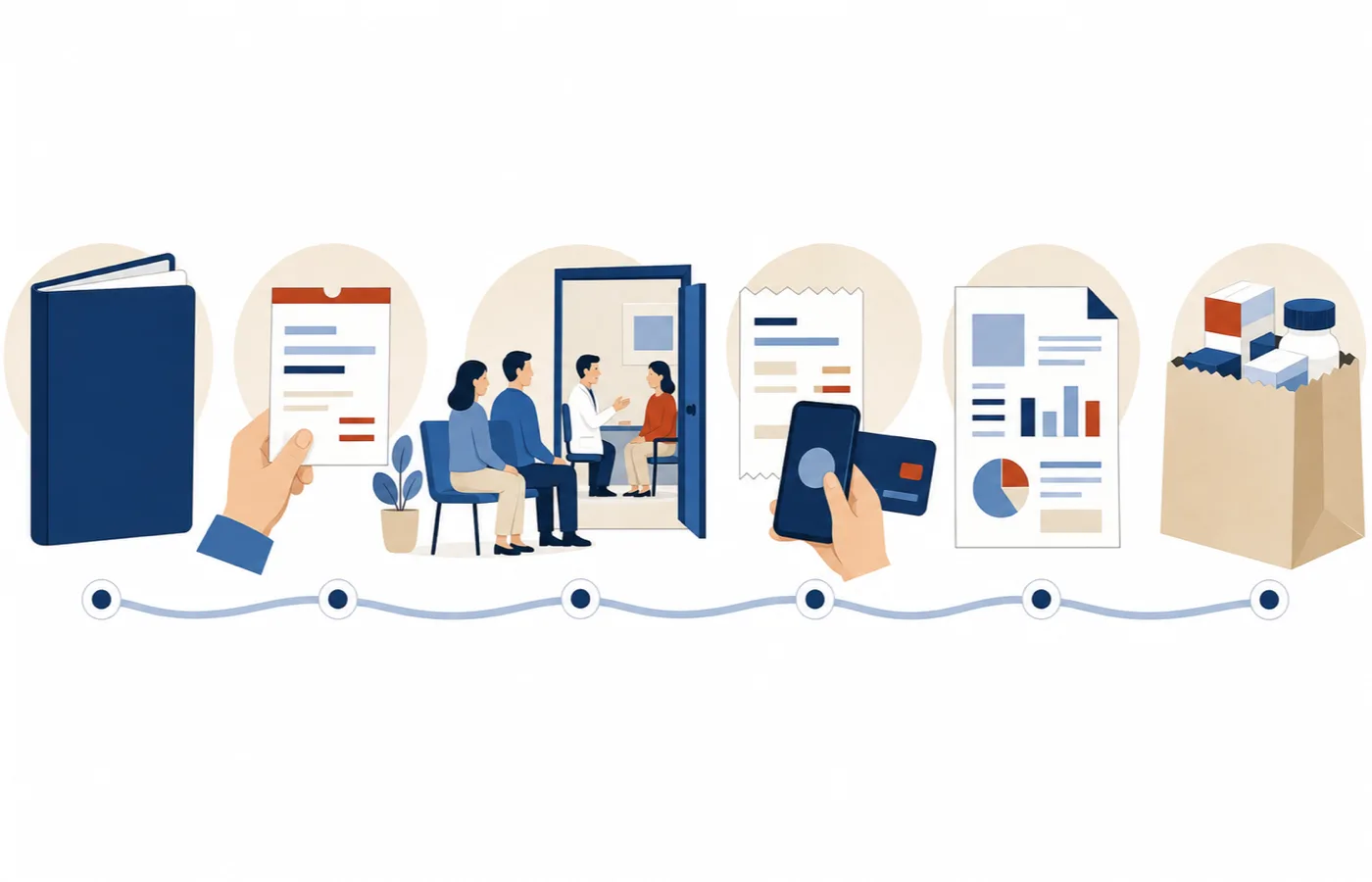
An implant or crown quote in China is useful only when it identifies the legal provider, the treatment stage, the services and products included, the exclusions, the payment terms and the records available for later care. National healthcare-security documents organize oral and implant price items, while provinces and local pooling areas implement prices. They do not create one nationwide patient total or make a clinical recommendation. This guide explains how to read and preserve a provider-issued quote and record set. It does not decide whether an implant, crown or any other treatment is indicated; compare brands or materials; choose a product, technique or clinician; estimate success; or tell a patient when to proceed. Those decisions require an individualized assessment and explanation from a qualified dental team.
Use this as a practical starting point
Provider procedures can change, so confirm time-sensitive details with the hospital, insurer or service. A licensed professional must make clinical decisions for an individual patient.
At a glance
Key points
- There is no single national patient price for an implant or crown; obtain the current written quote from the exact legal provider and campus.
- Separate the provider's clinical services, implant system, crown or other individualized product, additional services, follow-up and possible later charges.
- A national price-item catalogue standardizes project structure for local implementation; it is not a national retail tariff, insurance decision or complete treatment package.
- Ask who must approve a change in plan, product, clinician, stage or price and how the provider will document renewed explanation and consent.
- Preserve the Chinese originals of the plan, consent records, procedure record, available product information, images, itemized charges, receipts and follow-up instructions.
- A receiving dentist decides whether records, images, components or an unfinished plan can be used; this website cannot certify compatibility or continuity.
Identify the provider, stage and document owner
Start with the Chinese legal name of the institution that will examine the patient, issue the medical record, collect payment and take responsibility for follow-up. A consumer-facing brand, dental clinic operator, hospital partner, laboratory or product supplier may have a different name. Ask which licensed medical institution appears on the appointment, consent form, itemized statement and official receipt. If care is divided across campuses or entities, record which one owns each stage and which office handles later record requests. This prevents a payment made to one entity from being mistaken for a clinical record held by another.
Ask the provider to date and label the proposed stage. A first consultation, diagnostic work, preparatory treatment, implant-related procedure, temporary stage, crown-related stage and follow-up may be quoted separately or combined under locally implemented price items. These labels describe the provider's administrative structure; they do not prove that every stage is required. The treating dental team must explain what it proposes and why. Before paying, write down the exact campus, department, responsible clinician or team, planned sequence, expected decision points and the channel for changing or cancelling an appointment.
- Chinese legal name and licensed address
- Exact campus, department and appointment
- Entity issuing the treatment record and consent form
- Entity collecting each payment and issuing the receipt
- Named stage and date of the written proposal
- Record, follow-up and complaint contact channels
A brand name or package label is not enough. Match the clinical record, payment document and legal provider before comparing quotes.
Read the quote by component, not by headline total
National healthcare-security guidance separates broad implant-cost components such as medical services, an implant system and a crown, and the wider oral-service catalogue organizes professional outputs into locally implemented price projects. Ask the provider to show which lines in its quote fall into each group and which services are outside the quoted total. Depending on the provider's actual plan, exclusions may include separate consultations, imaging, laboratory work, preparatory care, anesthesia-related services, medicines, additional materials, temporary work, record copies or later follow-up. This is a quotation checklist, not a statement that any excluded item is clinically necessary.
Do not convert historic national governance figures, another city's benchmark, a procurement result, an online advertisement or another patient's bill into a promised total. Provinces and authorized local areas determine implementation, and public and private providers may use different lawful price structures. Compare two quotes only after the providers identify the same proposed stage and define what each line produces. Ask whether tax or receipt treatment, deposits, staged payments, unused amounts and additional visits are addressed. If a quote uses a package name, request the provider's written component list rather than assuming the package includes the complete course.
- Professional or facility services included
- Implant-system charge if one is proposed
- Crown or other individualized product charge if proposed
- Services, products and follow-up expressly excluded
- Deposit, staged-payment and cancellation terms
- Events that may change the quote and who approves them
The national catalogues organize price items for local use. They do not set one nationwide total or show that a quoted service is appropriate for a particular patient.
Keep product discussion inside informed consent
Ask the treating professional to explain the provider's finding, proposed plan, reasonable alternatives, material or device choices relevant to that plan, important risks, expected stages and follow-up responsibilities in a language the patient understands. The patient can ask how a proposed option changes the quote and what documentation the provider will create. A receptionist, sales page, package comparison or this guide cannot replace that explanation. Do not ask an interpreter to make the decision, and do not sign a blank or incompletely explained consent form.
If the provider later proposes a different product category, material, clinician, procedure, schedule or charge, ask for an updated clinical explanation and written estimate before agreeing, except where qualified professionals determine that an emergency requires a different lawful process. Preserve the version number or date of every plan and consent document so the accepted proposal can be distinguished from an earlier draft. This guide intentionally does not compare implant or crown brands, materials, countries of origin, techniques, expected lifetime or suitability. A qualified dental team must make and document patient-specific recommendations.
Price transparency supports a decision; it does not make the decision. Product and treatment selection remain clinical matters.
Build a traceable treatment and product record
Before each stage, ask what formal record will be created and which office releases it. Depending on what actually occurs, the provider may hold a consultation note, provider-recorded diagnosis, treatment plan, consent record, procedure record, prescription, imaging report and image data, laboratory result, follow-up note, itemized statement and receipt. Request named records rather than asking vaguely for 'everything.' National medical-record rules support formal copying through the institution's process, but they do not mean that every possible item exists or is available immediately in every format.
For an implanted or customized product, ask the provider what patient-facing identification or traceability information it supplies and where the corresponding information appears in the medical record, itemized charge list or other provider-issued documentation. Record the product description exactly as issued; do not infer equivalence from an English translation or online catalogue. Preserve the original Chinese document, payment proof and any packaging or card the provider formally gives the patient. If information is missing or inconsistent, request written clarification from the provider rather than reconstructing a brand, batch, material or specification from memory.
- Dated plan and consent documents
- Procedure and follow-up records actually created
- Reports plus original image data or access instructions
- Provider-issued product or material identification, if supplied
- Itemized charges, valid receipt and payment proof
- Named department and route for later record copies
Prepare insurance and cross-provider handoff separately
Dental coverage, network status, preauthorization, direct billing and reimbursement are policy-specific. Send the insurer the exact legal provider, proposed stage, dated estimate and product or service description it requests. Ask whether separate limits, exclusions, waiting periods, deductibles, co-payments or preauthorization rules apply and which records must accompany a claim. A provider logo, card terminal, earlier reimbursement or participation in a price-governance initiative does not prove coverage. Keep the insurer's written response with the provider's quote and do not treat an estimate as a guarantee of payment.
If another dentist in China or abroad may continue care, ask that receiving professional what documents and image formats it needs before the final visit. The receiving team decides whether it can use the prior records, continue an unfinished stage, service a product or accept a proposed plan; national referral policy does not guarantee acceptance or technical compatibility. Ask the originating provider for a concise treatment summary, formal record copies, images, product information it can lawfully supply, itemized charges and the named follow-up contact. Keep originals with translations and use a secure transfer channel.
A complete handoff reduces ambiguity, but only the receiving dental team can decide what it can safely accept or continue.
Useful language
Navigation phrases
Show the Chinese characters when pronunciation is uncertain. Use the copy button to send one phrase through a trusted channel without retyping it.
Avoidable problems
Common mistakes
- Publishing or relying on a historic governance figure as a fixed nationwide implant price.
- Comparing two headline totals without matching the same clinical stage and included components.
- Treating a procurement price, advertisement or package price as the complete patient bill.
- Choosing a brand, crown material, technique or treatment from an online comparison instead of a qualified assessment.
- Paying a brand or intermediary without identifying the licensed entity that owns the clinical record.
- Assuming an insurer logo or earlier claim proves coverage for the new plan.
- Accepting a changed product, clinician, plan or price without an updated explanation and written record.
- Leaving with only screenshots, chat messages or an English summary and no Chinese originals.
- Assuming another dentist must accept an unfinished plan, component, image format or product.
Common questions
Frequently asked questions
Is there one official national price for a dental implant or crown?
No. National healthcare-security documents organize price projects and describe broad cost components, while provinces and authorized local areas implement prices. The patient total also depends on the exact provider-issued plan and what is included or excluded. Obtain a dated written quote from the legal provider and do not present an old governance figure, procurement result or another patient's bill as a universal current price.
Can I compare two implant quotes by their total alone?
Not reliably. Ask each provider to identify the same proposed stage and separate professional services, the implant system if proposed, the crown or other individualized product, additional services, follow-up and exclusions. A lower total may describe a different output or omit later stages. The treating teams must explain the clinical plans; this site cannot decide whether the plans are equivalent or appropriate.
Which implant brand or crown material should I choose?
This guide cannot recommend or compare a brand, material, country of origin, design, technique or expected lifetime. Ask the qualified treating professional to explain the options relevant to the patient's assessment, alternatives, important risks, follow-up requirements, documentation and price effects. Use an interpreter if the explanation is not clear enough for informed consent.
What product records should I request?
Ask the provider what patient-facing identification or traceability information it supplies for the product actually used and where that information appears in the procedure record, itemized statement or other provider-issued document. Also request the treatment, imaging and follow-up records that were created. Do not infer a model, material, batch or compatibility from memory, packaging found online or an unofficial translation.
Will another dentist continue the same implant or crown work?
Only the receiving dentist can decide after reviewing the patient, records, images and available product information. A referral or complete record pack improves the handoff but does not guarantee acceptance, technical compatibility, warranty handling or continuation of an unfinished plan. Ask the receiving provider for its required documents before the originating provider's final visit.
Does a national price catalogue mean insurance must pay?
No. A price-item catalogue and an insurance benefit decision answer different questions. Ask the insurer about the exact legal provider, service, product category, benefit limit, exclusion, waiting period, deductible, co-payment, preauthorization and claim documents. Obtain the answer in writing for the planned stage.
Evidence
Sources consulted for this guide
National rules are separated from city and provider examples. Access dates show when a source was collected; source pages and procedures can change afterward.