
Women’s health & gynecology care
Gynecology exams, tests, pathology and records in China
Track orders, reports, images, pathology and consent records without interpreting results, then build a verified file for follow-up or transfer.
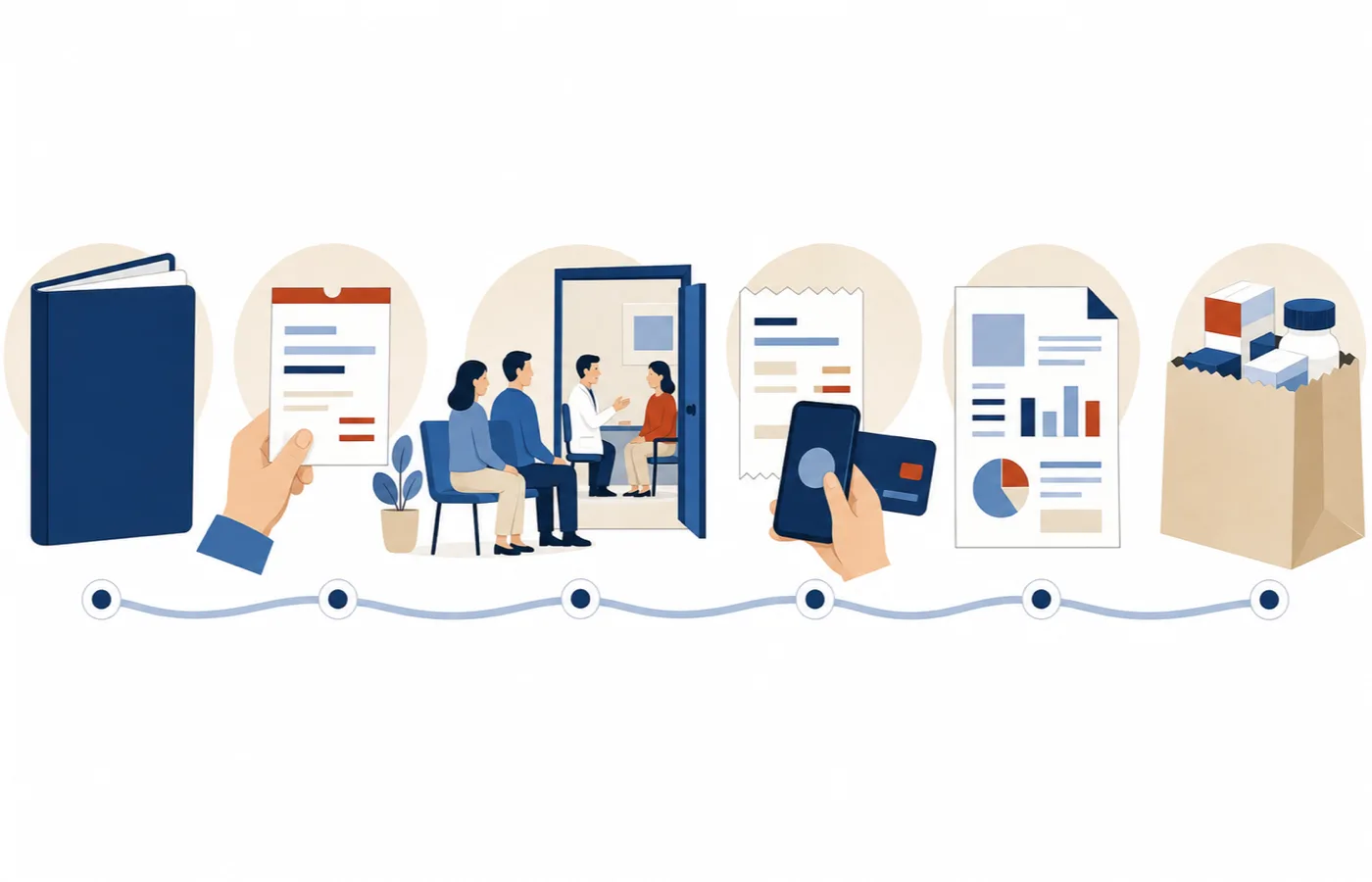
A gynecology visit can generate several administrative objects: an order, appointment, consent record, sample or imaging event, report, image-access method, pathology document, outpatient note, procedure record and bill. They may appear at different times and in different hospital systems. This guide helps foreign patients identify what the institution created, request verified copies and transfer them without changing their meaning. It does not recommend an examination, screening method or procedure, advise preparation, interpret a laboratory, imaging, cytology or pathology result, diagnose a condition, determine urgency, or tell a patient what treatment or medicine should follow.
Use this as a practical starting point
Provider procedures can change, so confirm time-sensitive details with the hospital, insurer or service. A licensed professional must make clinical decisions for an individual patient.
At a glance
Key points
- Treat an order, completed service, report, image, pathology document, medical note and charge as separate records.
- Ask which legal institution and campus owns each record when services are performed across several departments or providers.
- Confirm identity and consent before the service without using a form or booking label to infer clinical necessity.
- Record the provider’s expected report channel and responsible follow-up department rather than interpreting a portal status yourself.
- Use the institution’s formal medical-record request route with the required identity and authority evidence.
- Keep original provider text, dates, units, images and verification marks unchanged; label translations and patient summaries separately.
- A missing portal item may require a report enquiry, medical-record request, billing check or correction route, which are not interchangeable.
- Keep result discussion with the responsible clinician and keep complaints or record corrections from delaying the separate follow-up route.
Build a record map before drawing conclusions
Write down the institution, campus, department, appointment, order or application number, date and the exact provider label for each service. An examination order is not the same as completion; a completion status is not the same as a released report; a report is not the same as source images or a pathology document; and a payment entry is not a medical result. Mapping these objects prevents a foreign-language portal or incomplete screenshot from being treated as a clinical conclusion.
Ask the responsible department what documents it normally creates and which office releases them. A laboratory, imaging department, pathology department, outpatient clinic and medical-record office may each hold different parts of the trail. This guide cannot determine whether a service should have been ordered or what its result means. Any clinical explanation, urgency decision or next-care instruction must come from the qualified responsible team.
- Order or application record
- Appointment and completion confirmation
- Report and image-access method
- Pathology or procedure document
- Clinical note, charge and receipt
Record status is administrative evidence; it is never a substitute for the responsible clinician’s interpretation.
Confirm the institution, identity and consent trail
Verify the Chinese legal medical institution and exact campus, especially when a clinic sends a patient to another building, laboratory or pathology provider. Ask whether the outside service is part of the same institution or a separate legal provider and which entity will issue the report, bill and record. The official institution query supports an identity check but does not establish quality, clinical necessity, availability or whether the record will automatically return to the referring team.
Before a special examination or treatment, ask the medical institution for an understandable explanation and its consent process. For reproductive surgery, special examinations or special treatment, the women’s-rights law requires the woman’s own consent and respect for her wishes when they differ from relatives or connected people. This guide cannot classify an individual service under those legal terms or decide an emergency, capacity or representation question.
- Institution owning the order
- Institution performing the service
- Entity issuing the report and charge
- Patient identity matched across systems
- Consent record held by the responsible institution
Track release, access and responsible follow-up
At the time of service, ask when and where the provider expects a report to appear, whether images or pathology materials have a separate access route, whether a paper copy or verification mark is available and which department is responsible for follow-up. Record the official contact and reference number. Do not assume that a “completed,” “pending,” “abnormal” or other translated portal label supplies a clinical interpretation or tells the patient what to do.
If a report is released after the visit, ask whether the responsible clinician will review it automatically or whether the patient must book a follow-up. A customer-service desk can explain access but should not be relied on to interpret content. Preserve the provider-issued document and any provider-issued instruction. This site does not advise whether the timing is safe or whether a result requires urgent action; contact the responsible medical service or public emergency assistance when the patient believes that is necessary.
- Expected release channel and date
- Image or pathology access route
- Verification mark or original format
- Responsible clinician or department
- Follow-up booking responsibility
Request verified medical-record copies
National medical-record management rules support requests by eligible patients and qualifying agents for specified outpatient and inpatient materials, subject to identity and authority evidence, institutional verification and permitted copying charges. Ask for the exact named items rather than a vague request for “everything”: outpatient notes, reports, medical images, consent records, procedure records, discharge material or other documents the institution confirms it created. Keep the request date, accepted item list and collection reference.
The rules do not guarantee immediate release, every internal working document, raw device data, a universal portal or a particular electronic format. A companion, payer, employer, school, interpreter or overseas provider does not automatically have authority to collect the file. If an agent will act, ask the institution what authorization and identity evidence it requires and limit the authority to the defined task.
- Specific requested document names
- Patient identity evidence
- Agent authority evidence when applicable
- Institutional verification or seal
- Collection, copying and delivery record
Translate and transfer without altering meaning
Create a document index showing the original Chinese title, English working title, institution, campus, date, patient name and page or file count. Keep the original report, images or access instructions intact and attach a translation as a separate document. Do not replace units, dates, specimen labels, anatomical terms, signatures or provider conclusions with a patient-created version, and do not present a translated excerpt as the complete record.
Use the receiving institution’s approved upload, record-transfer or hand-carry route and confirm that the intended department can open the file format. Electronic-record rules emphasize authorized, minimum-necessary and traceable handling, but they do not guarantee interoperability between hospitals or countries. Ask whether the receiving provider needs verification, a particular translation standard, image media or a new local record; do not infer acceptance from a successful email upload.
- Original document preserved
- Separate clearly labelled translation
- Document index and page count
- Verified receiving channel
- Acceptance confirmation and next owner
Resolve missing, mismatched or disputed records
When an expected item is missing, first identify whether the issue concerns scheduling, completion, report release, image access, medical-record copying, identity matching or payment. Contact the office responsible for that object and preserve screenshots, order numbers, receipts and responses. A duplicate passport spelling or different campus can create a record-matching problem; ask the institution to reconcile identities through its formal process rather than editing a document yourself.
For a factual correction or addendum request, preserve the original and ask the institution which medical-record route applies. For a non-emergency complaint about access, privacy, staff identity, charges or handoff, use its published complaint office. A complaint does not interpret the result, establish professional fault or decide treatment. Keep the responsible clinician follow-up, record request, billing enquiry and complaint moving separately so one administrative dispute does not silently stop care continuity.
Fix the correct layer—appointment, report, record, identity, bill or complaint—without rewriting the medical content.
Useful language
Navigation phrases
Show the Chinese characters when pronunciation is uncertain. Use the copy button to send one phrase through a trusted channel without retyping it.
Avoidable problems
Common mistakes
- Treating an order or payment line as proof that a service was completed.
- Treating a portal status or translated label as a clinical interpretation.
- Assuming the referring clinic owns a report issued by another legal provider.
- Using several passport-name spellings and then overlooking the identity mismatch.
- Requesting “all records” without naming the reports, images or consent documents needed.
- Assuming a companion or interpreter can collect records without authorization.
- Replacing the original report with an edited translation.
- Sending a complete sensitive file through an unverified personal channel.
- Assuming one hospital can automatically open another provider’s images or portal link.
- Waiting for a complaint outcome before arranging responsible result follow-up.
Common questions
Frequently asked questions
Is an online report the complete medical record?
Not necessarily. A portal may show one report while outpatient notes, consent records, images, pathology documents or procedure records follow different release routes. Ask the institution which materials it created and how verified copies can be requested.
Can this guide explain a gynecology or pathology result?
No. It only maps records and access. Laboratory, imaging, cytology, pathology and other results require explanation by the qualified responsible clinical team. The site does not diagnose, assess urgency or recommend what should follow.
Can my interpreter collect the report?
Only if the institution’s process permits it and the required identity and authority evidence is supplied. Interpreter status alone does not grant access. Ask for a limited task-specific authorization route.
What if the report uses a different spelling of my name?
Contact the issuing institution’s identity or medical-record office and preserve both registrations, the passport and the affected records. Use its formal correction or reconciliation process rather than editing the provider-issued document.
Should I translate the report before sending it abroad?
Ask the receiving provider what language, verification and format it accepts. Keep the original unchanged and attach any translation separately with a document index. Successful delivery does not by itself prove the receiving provider accepted the file.
What if a report or image is missing?
Identify whether the gap concerns completion, release, image access, medical-record copying, identity matching or payment, then contact the responsible office. Preserve references and keep clinical follow-up separate from any complaint.
Evidence
Sources consulted for this guide
National rules are separated from city and provider examples. Access dates show when a source was collected; source pages and procedures can change afterward.